Satellite FLEX launches to study plant response to climate change from space
Published on 15/09/2026 - 10:03 GMT+2 The Vega-C rocket has placed the FLEX and Sentinel-3C satellites in orbit from French Guiana, making it possible to study the state of...
Published on 15/09/2026 - 10:03 GMT+2
The Vega-C rocket has placed the FLEX and Sentinel-3C satellites in orbit from French Guiana, making it possible to study the state of vegetation and gather new data on the oceans, land, ice and the atmosphere
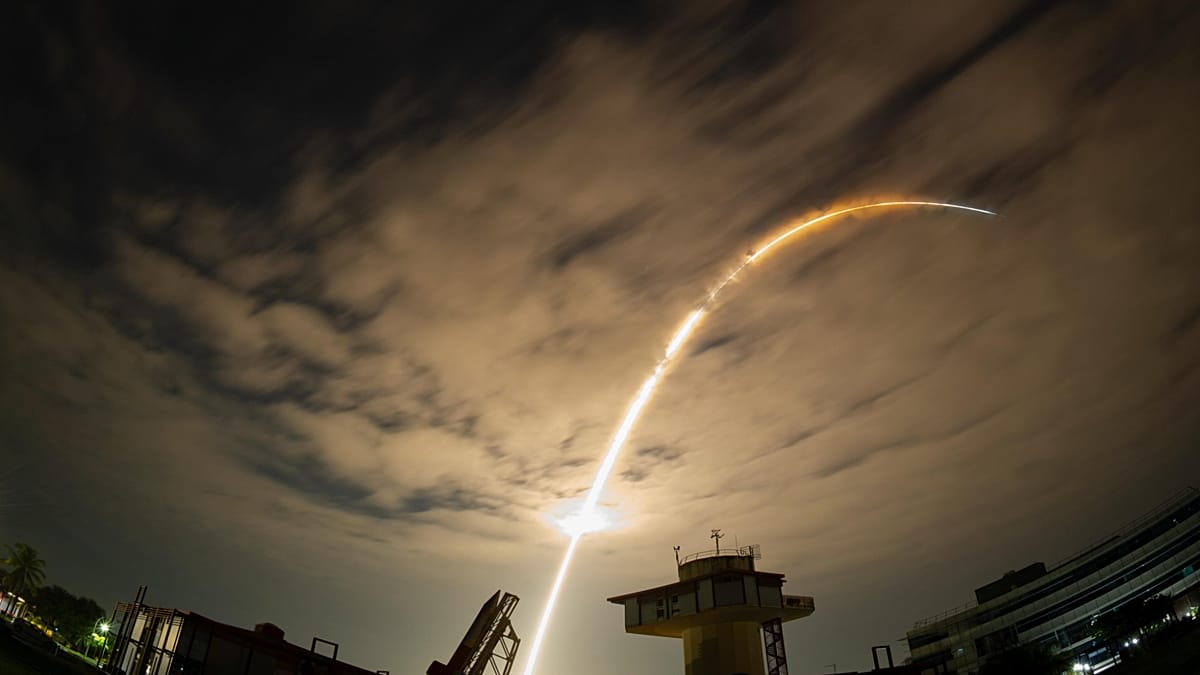
Europe now has two new satellites to observe Earth from space. The Vega-C rocket lifted off from the European spaceport in Kourou, in French Guiana, at 22:21 on Monday carrying the FLEX and Sentinel-3C satellites.
The mission, known as VV30, will expand the information available on the state of the planet and the effects of climate change.
FLEX's main objective is to better understand how plants function and how they respond to situations such as extreme heat or a lack of water.
The satellite is equipped with an instrument capable of detecting a faint light emitted by plants when they carry out photosynthesis. This signal cannot be seen with the naked eye, but it contains information about the condition of vegetation and makes it possible to detect when plants are suffering because of environmental conditions.
FLEX will be able to produce maps of vegetation activity with a resolution of around 300 metres by 300 metres. The mission is designed to operate for at least three and a half years.
The mission also has significant Spanish involvement. Scientist José Moreno, a professor at the University of Valencia and principal investigator of FLEX, is leading the mission's scientific team. Spain's own Ministry of Science has underlined the country's role in this European Space Agency project.
Travelling alongside FLEX is Sentinel-3C, the third satellite in the Sentinel-3 mission of the European Copernicus programme. Its role will be to monitor continuously the oceans, the Earth's surface, ice and the atmosphere. Its data are used, among other things, to improve weather forecasts and study how the climate and the environment are evolving.
Sentinel-3C will join a mission that already includes the Sentinel-3A and Sentinel-3B satellites. The new spacecraft will replace Sentinel-3A, which has been in operation since 2016.
Although FLEX and Sentinel-3C travelled into space together, they will not initially remain in the same orbit. In this way, data from both projects can be combined to gain a better understanding of how vegetation responds to environmental conditions.