Southern energy corridors set to dominate supplies to Europe, global leaders say
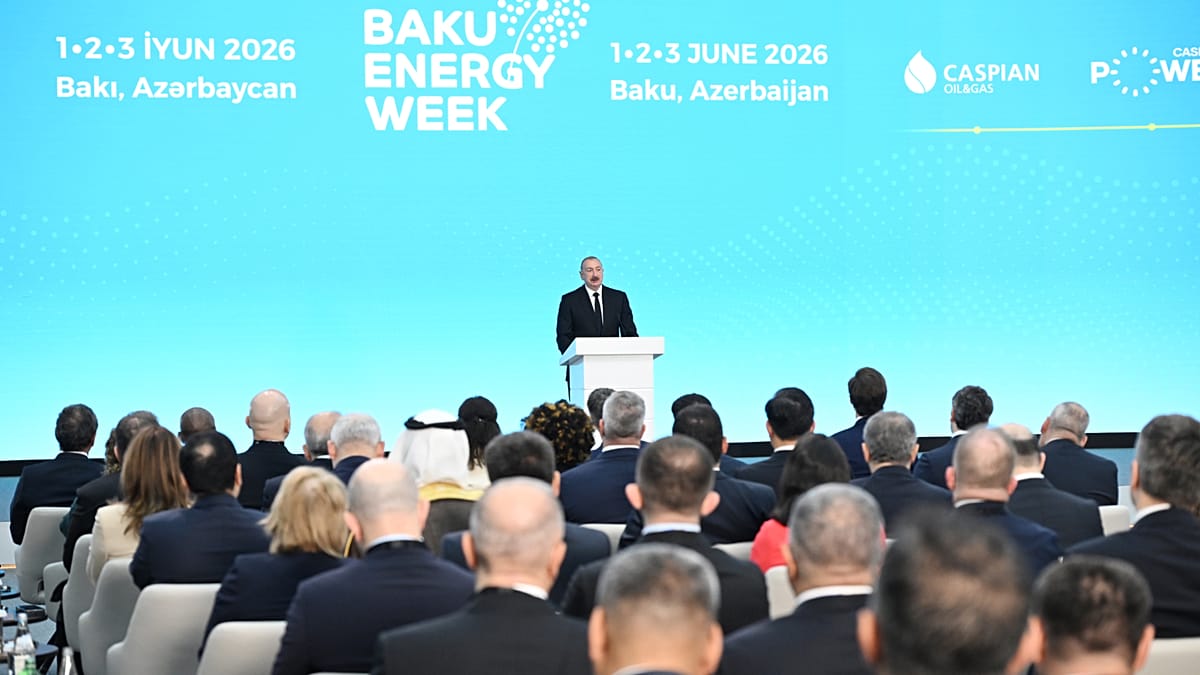
Opening Baku Energy Week 2026, Azerbaijan’s President Ilham Aliyev said the “world cannot live without fossil fuels,” while also insisting that countries “should be judged on how they invest in renewables.”...
Opening Baku Energy Week 2026, Azerbaijan’s President Ilham Aliyev said the “world cannot live without fossil fuels,” while also insisting that countries “should be judged on how they invest in renewables.”
Speaking about Azerbaijan’s role in global energy markets, Aliyev said it was “difficult to imagine what the European market would look like without the South Caucasus,” underscoring the growing geopolitical importance of the Caspian region as Europe continues efforts to diversify energy supplies.
Azerbaijan's president stressed that while fossil fuels remain essential for economic stability and energy security, investment in renewable energy and cleaner technologies must accelerate in parallel.
What dominated discussions
Artificial intelligence, gas geopolitics and emissions reduction dominated the opening day of Baku Energy Week 2026 on Monday, as government officials, global energy executives and technology companies gathered across two major venues in Azerbaijan’s capital.
Discussions reflected how rapidly the oil and gas sector is evolving amid shifting global economic and political realities. From AI-powered drilling systems and methane-reduction technologies to geopolitical discussions around gas exports and infrastructure investment, the event highlighted an industry under pressure to modernise while maintaining reliable supply.
Methane reduction emerged as another dominant theme throughout the exhibition.
Energy service companies and technology providers presented advanced drilling systems, autonomous offshore platforms, predictive maintenance software, and real-time digital monitoring tools designed to improve production efficiency, lower operational costs and reduce risks.
Industry representatives described AI as becoming increasingly central to upstream oil and gas operations, particularly as producers seek to maximise output from mature fields while facing pressure from investors to improve environmental performance and financial efficiency.
Several presentations focused on how machine learning and predictive analytics are now being used to optimise drilling operations, reduce equipment downtime and improve exploration accuracy.
Digitalisation was repeatedly framed not simply as a technological trend, but as a growing commercial necessity for producers facing rising operational costs and increasingly competitive global markets.
Companies showcased emissions-monitoring systems, leak-detection technologies and carbon-management solutions aimed at reducing methane emissions without disrupting hydrocarbon production.
The discussions reflected growing international pressure on oil and gas producers to reduce methane leakage, which is increasingly viewed as one of the fastest and most commercially viable ways to lower greenhouse gas emissions across the energy sector.
Executives attending the exhibition argued that emissions-reduction technologies are increasingly viewed not only as climate-related investments but also as tools that improve operational efficiency and profitability by reducing product losses and energy waste.
Energy-tech intersection
Another recurring theme was the growing overlap between traditional hydrocarbon production and the global technology sector.
Participants highlighted the growing importance of partnerships among oil producers, software companies, and engineering firms as digital infrastructure becomes more integrated into exploration and production activities.
Moldova’s Energy Minister Dorin Junghietu said countries are increasingly trying to balance “three main objectives": energy security, affordability and a "sustainable and just” green transition.
Speaking on the sidelines of the forum, Junghietu described Moldova’s experience of reducing dependence on a single supplier and strengthening interconnectivity across the region.
“We can tell a big story about interconnectivity, about removing the old dependencies, and about building a sustainable energy ecosystem,” he said, adding that Moldova has already installed more than one gigawatt of renewable capacity as part of its long-term energy security strategy.
Junghietu also stressed that despite the accelerating transition towards cleaner energy systems, natural gas remains strategically important.
“Gas will be there to provide the flexible generation,” he said. “Azerbaijan was and will still be one of the key suppliers of gas to Europe.”
He added that Moldova had benefited from Azerbaijani gas supplies during the regional energy crisis triggered by Russia’s war in Ukraine, describing Azerbaijan as a “trustable partner” for countries seeking reliable long-term energy supply.
'Sustainable and reliable' partnerships
Throughout the exhibition, Azerbaijan was repeatedly presented as an emerging regional hub where traditional energy production is increasingly intersecting with digital innovation, automation and sustainability strategies.
The strategic role of Azerbaijan and the wider Caspian region featured prominently throughout the forum, particularly as European countries continue efforts to diversify supply routes and strengthen long-term energy security partnerships.
Officials, executives and analysts examined how geopolitical tensions, supply disruptions and Europe’s diversification strategy are continuing to reshape global gas markets.
Discussions also focused on infrastructure development, pipeline connectivity and future export capacity, with regional cooperation emerging as one of the strongest geopolitical themes of the day.
Bulgaria’s Deputy Energy Minister Kiril Temelkov described Azerbaijan as a “sustainable and reliable partner,” particularly regarding long-term gas supply cooperation.
“More than 30% of the consumption in Bulgaria is supplied by Azerbaijani gas,” Temelkov said, highlighting the strategic importance of the Southern Gas Corridor and regional interconnectors linking Southeastern Europe.
Temelkov said Baku Energy Week has evolved far beyond its original oil and gas focus and is increasingly becoming “a real event for innovations in the energy sector,” particularly in areas such as renewables, grid modernisation and energy efficiency.
He also highlighted the growing strategic importance of electricity interconnectivity projects linking Europe with the South Caucasus and Central Asia.
“We are talking about the corridor for green energy to supply, on the same way, green energy from Azerbaijan through Bulgaria to the whole Southeastern Europe,” he said.
The Bulgarian official pointed to battery storage, nuclear expansion and renewable grid infrastructure as key pillars of Bulgaria’s energy transition strategy, arguing that “the only way to achieve the results of the policy of the European Union is to be very active and very well interconnected.”
Long-term energy challenges
Meanwhile, at the forum hosted at the Baku Convention Centre, discussions focused more heavily on geopolitical risks, gas diplomacy and long-term energy investment.
AI again featured prominently during forum sessions, particularly in conversations surrounding exploration and field development.
Energy companies described growing use of AI-powered seismic imaging, predictive modelling and advanced data analysis technologies to improve exploration success rates and reduce operational uncertainty.
Executives argued that digital technologies are becoming increasingly important in helping producers reduce exploration risks, shorten project timelines and improve commercial competitiveness in both frontier and mature energy markets.
The issue of investment competitiveness also dominated several sessions, with speakers discussing how energy producers are competing for international capital at a time of economic uncertainty, geopolitical instability and accelerating global energy transition policies.
Participants highlighted how upstream investment remains essential for maintaining future supply security, even as governments and investors place greater emphasis on lower-carbon energy systems.
Several discussions also addressed the growing challenge facing energy companies as they attempt to balance continued hydrocarbon production with pressure to lower emissions and accelerate sustainability commitments.
Kyrgyzstan’s Energy Minister Taalaibek Ibraev told Euronews that the forum had become an important international platform for energy diplomacy and regional cooperation.
“The platform is very useful,” Ibraev said. “At this time, I think that it will be very useful to exchange experience.”
He highlighted the increasingly close cooperation between Azerbaijan and Kyrgyzstan in areas including electricity supply, renewable energy and petroleum products, saying both countries are actively strengthening ties in the energy sector.
Ibraev also outlined Kyrgyzstan’s large-scale renewable ambitions, particularly in hydropower and solar generation.
“Our country is rich in water resources,” he said, adding that Kyrgyzstan is currently developing multiple hydroelectric projects while also rapidly expanding solar energy infrastructure.
According to Ibraev, Kyrgyzstan plans to connect nearly 1.9 gigawatts of solar capacity to its network in phases, while broader renewable energy agreements already cover around six gigawatts of future projects.
“The Kyrgyz Republic in Central Asia generates 90% green energy today,” he said, adding that the country’s long-term objective is to eliminate “dirty electricity” and significantly reduce emissions.
Across both venues, the opening day demonstrated how the global energy industry is increasingly converging around a model that combines traditional oil and gas production with digitalisation, automation and emissions management technologies.
Baku Energy Week continues throughout the week with further discussions expected on LNG infrastructure, renewable energy integration, regional transit corridors, offshore development and the expanding role of artificial intelligence across the global energy sector.