Zhu Rongji obituary
Zhu Rongji, who has died aged 97, was the fifth premier of the People’s Republic of China and one of its most effective administrators and economic reformers following its foundation in 1949.In 1991, Zhu was...
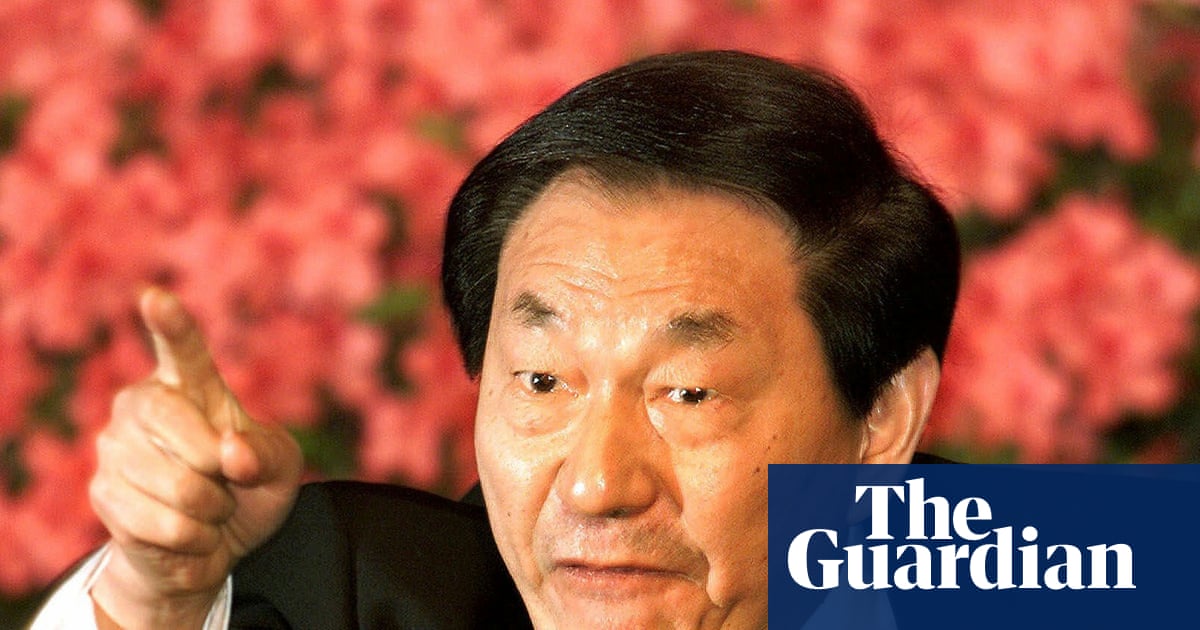
Zhu Rongji, who has died aged 97, was the fifth premier of the People’s Republic of China and one of its most effective administrators and economic reformers following its foundation in 1949.
In 1991, Zhu was summoned to Beijing, in the footsteps of the then president and party secretary Jiang Zemin, and in the aftermath of the 1989 uprisings in Beijing and the collapse of the Soviet Union.
As vice premier in the state council, and governor of the People’s Bank of China (1993-95), Zhu was put in charge of China’s economy at a time of immense turbulence, with many fearing that the country would once more turn inward as it had under Mao Zedong.
Zhu implemented contentious and tough reforms to straighten out the highly inefficient state-owned sector, and to modernise China’s infrastructure. By the end of the decade, Zhu could rightly declare that the country had become “the factory of the world”, a status that in many ways it maintains.
A straight-talking and forceful figure, he was famously harsh on corruption, once sacking a governor of Heilongjiang province on the spot for failing to meet growth targets. This laid the foundation for his popularity within China generally, and the high regard with which he was held abroad. He seemed to come close to the ideal image of a Chinese leader possessed of moral dignity.
Alone among high-level politicians of his period, he attempted to reach out to the population at large, and speak to them as an equal. Nor was he willing to stand on ceremony. As he stated in 1998: “I have prepared 100 coffins here – 99 for corrupt officials and one for myself,” according to the party newspaper People’s Daily. This gained him the nickname of “the Boss”.
His most significant achievement as premier was to secure China’s entry to the World Trade Organization (WTO). What had begun in 1986 as negotiations over entry into the General Agreement on Tariffs and Taxes (Gatt), had spanned out over a decade, involving an epic series of agreements with both the EU, the US and dozens of other countries.
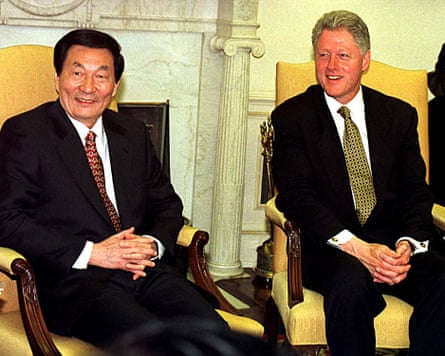
In 1999, the deal with the US, which was the most contentious and important, was almost completed. Zhu was on a visit to Washington, expecting to sign this off, but it was pulled by President Bill Clinton at the time because of domestic problems following the Monica Lewinsky scandal.
Aiming some of his famous sharpness and temper at the Americans, Zhu reportedly told his officials that he was in awe of Washington’s incompetence and lack of foresight.
The final deal was signed in 2001. It can be seen as a watershed moment in China’s attempts to modernise, and to internationalise its economy, with strong growth and a doubling of the Chinese economy over the next five years. Zhu retired after one term in power, in 2003, and was replaced by his protege, Wen Jiabao.
For all the successes of his time in power, these did not come as easy gifts. In the 1990s, the state sector, which comprised most of the key enterprises, was riddled with debt, inefficiency and poor management. To address this, the whole social welfare and public sector framework had to be changed. Up to 60 million workers were laid off, some of them never employed again. Unrest was a striking feature of this period, with one commentator calling it a period of “ferment”.
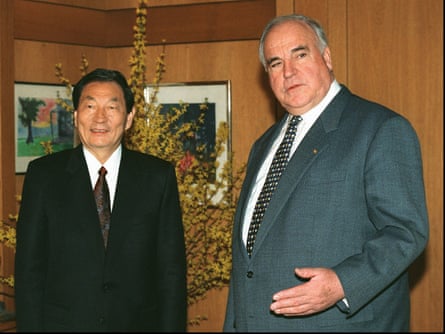
Even WTO entry offered no panacea, with the agricultural and manufacturing sector going through painful adjustments. Zhu was an obstinate and hard-eyed man: he had to be, to deal with the issues he faced.
Much of this toughness came from his early years. Born in Changsha, the capital of the central Hunan province – Mao’s home province, too – Zu was orphaned when young and brought up by two of his father’s brothers. He enjoyed a typically technocratic education, joined the Communist party in 1949, and graduated in electrical engineering from the elite Qinghua University in Beijing in 1951.
His career through the 50s and into the 70s was rocky. He worked largely in the state development and planning commission (in charge of national implementation of the various five year plans), as an engineer, dealing with the typical duties of resource allocation in a command economy.
But his criticism of what he saw as the inefficiency of Maoist policies during the infamous Hundred Flowers campaign of 1956-57, where intellectuals and officials were invited to offer their opinions on the party, led to his being branded a “rightist” and sent to the countryside to be a teacher.
His rehabilitation back into the central government in 1962 was short lived. Once branded with the stigma of being politically unreliable in Maoist China, suspects were never fully rehabilitated.
In 1969, in the depths of the Cultural Revolution, which Mao started to wage war against what he called “bureaucratism and capitalist tendencies” in the CCP, Zhu was once more sent to one of what were euphemistically called “7 May schools” named after the central decree that had set thousands of them up across the country. In effect, they were mini-concentration camps.
There he languished until 1975, when he was sent to Beijing for a third time to work at the Chinese Academy of Social Sciences, as an economist. A spell from 1979 to 1982 in the state economic commission, at the start of what has come to be known as the reform and opening up period, led to him being appointed as a vice minister. This marked his full transition from engineering to economics. It was as an economist that he was to have the greatest impact on China in the years ahead.
Zhu’s first step towards national and international prominence came in 1987, when he replaced Jiang Zemin as mayor of Shanghai.
Shanghai was then at the dawn of its extraordinary growth, starting to build a foundation as the commercial centre of China, a position it had ironically enjoyed before the revolution, in the 20s and 30s. He was instrumental in making the city one of the special economic zones, in 1990, joining places such as Shenzhen, adjoining Hong Kong, and Xiamen, on the coast facing Taiwan.
He also steered the city successfully through the trauma following the 4 June massacres in Tiananmen Square, Beijing, in 1989. Shanghai was largely to avoid the turbulence and recriminations that this event led to elsewhere.
Zhu was frequently called the “Gorbachev of China”, though it was an epithet he disliked. Despite his suffering in the past, he remained resolutely committed to the Communist party and its continuation in power, and his economic reforms were targeted at ensuring that this happened.
He did not propose, or support, political reforms, and regarded Mikhail Gorbachev with something approaching contempt, for the way in which his policies had effectively led to the fall of the Soviet Communist party, and the break up of the USSR.
Zhu’s fundamental objective, which he achieved, was to ensure that the PRC remained stable, and that it continued to deliver economic growth. He spent his retirement largely uninvolved in politics, appearing only from time to time at high-level party congresses, the last of which was in 2017. The last image of him appeared while he was in hospital in 2020.
There is no record of what he made of the leadership of Xi Jinping, or of whether he shared the view that, after Mao and Deng Xiaoping, he was the person who had contributed most to China’s current economic success.
He is survived by his wife, Lao An, a retired business executive, and a son and a daughter.