Heatwave and jellyfish: a fifth of French nuclear capacity offline
By Serge Duchêne with AFP Published on 12/08/2026 - 16:09 GMT+2•Updated ...
By Serge Duchêne with AFP
Published on 12/08/2026 - 16:09 GMT+2•Updated 16:12
France on Wednesday recorded a shortfall of more than 20% in its nuclear electricity generation capacity, a new record for outages due to "environmental constraints" or "external environment-related causes": drought, extreme heat and a jellyfish invasion.
Nuclear power accounts for around 70% of electricity production in France. This year, output has been disrupted by multiple heatwaves and periods of drought.
According to AFP calculations based on data published by energy group EDF since 2015, 20.4% of generation capacity was unavailable.
Between 9:45 and 10:00, EDF's nuclear fleet hit a new peak of unavailability for reasons described as "environmental constraints" or "external environmental causes", both in terms of the number of reactors shut down or running at reduced power and the amount of generation capacity lost.
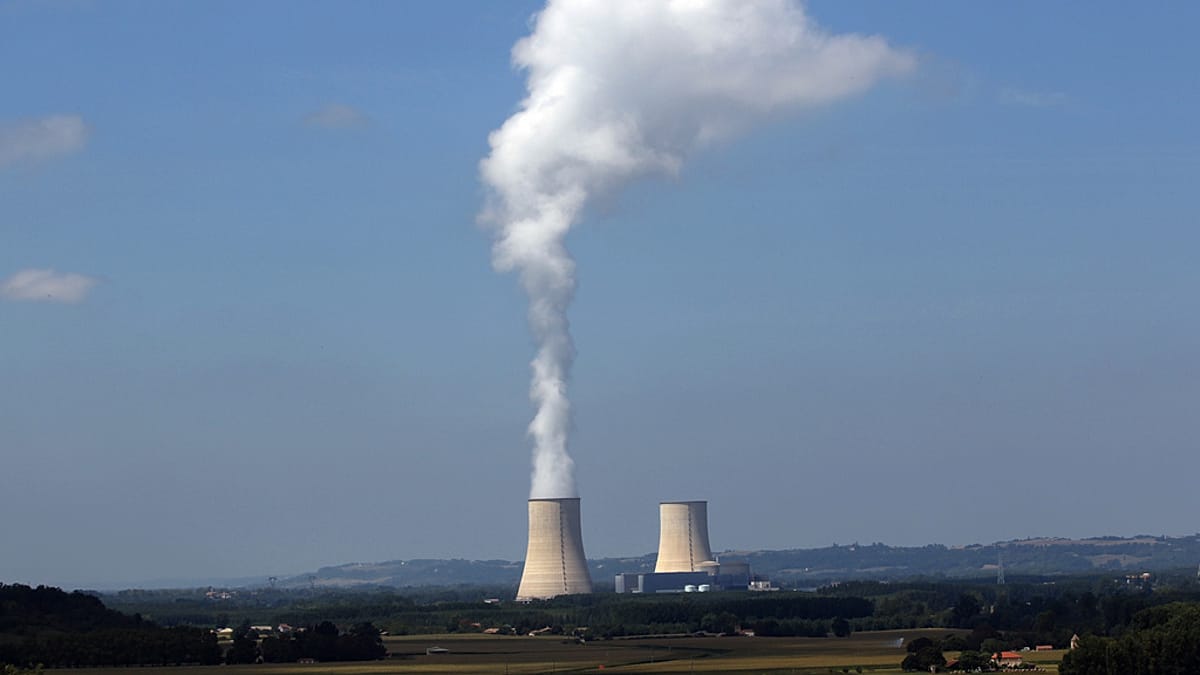
In all, 13 of the 57 reactors in France's nuclear fleet were affected. Eight were completely shut down (Bugey 3, Cattenom 1, Chooz 1 and 2, Golfech 2, Gravelines 2, 3 and 4) and five were operating below capacity (Saint-Alban 2, Tricastin 1 and 4, Gravelines 1 and 6).
Eight reactors were completely offline, while five were running at reduced power.
A large share of the lost nuclear capacity was due to full or partial shutdowns of five of the six reactors at the Gravelines plant, the largest in western Europe, after a swarm of jellyfish clogged the pumps used to cool the installations.
"Several tonnes of jellyfish" surged into the seawater pumping stations, eventually blocking the filter drums, an EDF spokeswoman explained.
Units 1 and 6 have since returned to full power at around 10 a.m. on Wednesday, while reactor 5 is in a scheduled shutdown for maintenance. Gravelines 2, which is currently offline, is due to be reconnected to the grid on Wednesday at 11 p.m.
Gravelines, which draws water from the North Sea to cool its installations, had already faced the same problem exactly a year earlier.
Experts say overfishing, plastic pollution and warming waters linked to climate change have created ideal conditions for jellyfish to proliferate and reproduce.
Apart from the Gravelines plant, the largest in western Europe, shutdowns or cuts in output affecting other reactors are linked to extreme heat and drought, which deprive the plants of the water they need for cooling.
During droughts or heatwaves, lower river flow and higher water temperatures can force EDF to cut, or even halt, production in order to protect the environment and biodiversity. The operator is then unable to discharge chemical or radioactive effluents or further warm rivers with its cooling water, which is returned to the river at a higher temperature.
"But there is enough leeway that this does not pose any supply problems in the short term," says Nicolas Goldberg, an energy expert at consultancy Colombus Consulting quoted by CNews. In this month of August, when electricity demand is lower, France was still on Tuesday a major exporter of electricity, after posting a record net export balance of 51 TWh in the first half of the year.
However, over the longer term, "particularly if the lifespan of reactors is extended to 70 or 80 years, adapting them to climate change will amount to a real stress test over the next 20 to 30 years, in a warmer climate," the expert warns.