Revealed: how Europe’s most powerful farming lobby killed EU’s pesticide law

Newly revealed documents from inside the most powerful farming lobby in Europe reveal how it delayed, gutted and overturned some of the most sweeping farming reforms in EU history, including a plan to cut...
Newly revealed documents from inside the most powerful farming lobby in Europe reveal how it delayed, gutted and overturned some of the most sweeping farming reforms in EU history, including a plan to cut pesticide use in half.
Copa Cogeca describes itself as the voice of 22 million farmers across the continent, and enjoys unrivalled access to EU lawmakers. It has even been described as a “partner in policymaking”.
So when the EU launched plans for radical farming reforms in 2020 in response to concerns about climate breakdown and the nature crisis, Copa Cogeca swung into action and in February 2021 set out its lobbying strategy. Dozens of documents recording internal Copa Cogeca meetings, obtained by Grilled and the Guardian, give a rare glimpse into the inner workings of the lobbying giant.
Controversial animal products – such as foie gras and fur – would be defended, Copa Cogeca’s then secretary general, Pekka Pesonen, told members, “in the same way as tobacco”.
A key EU target was cutting pesticide use by half to protect biodiversity. Copa Cogeca’s response, the documents show, was to combine delay tactics with an intensified lobbying drive.
“The European parliament elections are in 2024,” the note from September 2022 reads. “Perhaps it is worth delaying until then. We must force the [European] Commission to abandon its objectives.”
That same meeting, the lobby group decided to demand a new impact assessment for the policy, which the commission undertook at the end of year, slowing the policymaking process by six months. The following spring, it rejected a European parliament report on the policy as “offensive” and its members presented privately commissioned research highlighting the economic impacts to EU ambassadors at a Copa Cogeca event. Member states, its minutes record, “showed understanding”.
The documents also capture the organisation’s lobbying to protect the use of bee-harming pesticides and glyphosate, which the World Health Organization’s cancer body has classified as probably carcinogenic. “Pressurise permanent representations to support” glyphosate’s licence renewal,” the secretariat told members. “Copa Cogeca will send a letter to permanent representations.”
Thomas Waitz, a Green MEP from Austria who sits on the agriculture committee, said: “Copa Cogeca focused on sabotaging, delaying and ultimately killing the Sustainable Use of Pesticides regulation. They are acting in the interest of large agrichemical multinationals and against the wellbeing of small and medium farmers.”

The pesticide regulation was withdrawn in February 2024, just months before the elections Copa Cogeca had been deliberately stalling for.
The EU is now debating a proposal that would remove the periodic safety reassessments required for pesticides already on the market.
Cutting red-meat consumption was also a prime focus. Every year, the EU spends hundreds of millions of euros promoting agricultural products, including “Become a Beefatarian”, a 2020 advertising campaign that led to outcry among campaigners. When the commission proposed restricting that money from red and processed meat as part of its cancer plan, Copa Cogeca viewed it as an existential threat.
“We are not talking here only about promotion policy,” officials said at a meeting in January 2022. “If meat is treated in this way there, it will spread to other policies as well.”
Copa Cogeca coordinated three named commissioners to challenge the new guidance, brought in the wine and alcohol lobbies as allies, and told its members to pressure their national governments to remove the restrictions. The next year the measures were weakened. The year after, the health criteria was quietly dropped. Copa Cogeca’s verdict: “Lobbying has borne fruit.”
Copa Cogeca acted fast to have rules on factory farms weakened before the public had seen them. An internal memo from 2022 states that letters to senior commissioners resulted in the threshold for what counts as an industrial farm – based on the number of animals kept – being raised by 50% before the proposal was released. Analysis found that the change cost the public €1.8bn (£1.5bn) a year in lost health benefits.
This was just the start of a years-long operation. Lawmakers were taken on organised farm visits in Belgium. Media campaigns were launched. Letters went to EU ambassadors before critical European Council votes. On the day of the final parliamentary vote, tractors and invited MEPs gathered outside the European parliament in Strasbourg as “a large screen showing the IED [Industrial Emissions Directive] vote” streamed live.
The final law was far weaker still, significantly raising the thresholds for poultry and pig farms and excluding cattle entirely. Only about 1% of Europe’s cattle farms would have been covered by the original proposal. Marco Contiero, agriculture policy director at Greenpeace EU, said Copa Cogeca had “chosen to shield a small group of highly industrialised operators responsible for a disproportionate share of pollution” rather than defend the majority of Europe’s farmers.
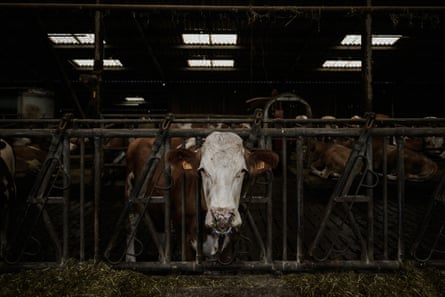
On animal welfare, Copa Cogeca’s private admissions and its public positions tell different stories. At an internal meeting in 2021, an official stated the industry could ditch caged farming immediately if financially supported. But Copa Cogeca’s lobbying position demanded a transition period of up to 15 years. The European Commission is expected to announce plans to phase out cages for laying hens by the end of 2026, years after its original commitment.
On wolves, Copa Cogeca spent years trying to strip the animal’s protected status from EU nature law, a goal its own officials privately described as “probably naive” since the directive had remained untouched for 30 years. Yet, in September 2024, the presidium declared: “A major lobbying victory. The fight is over.” The Habitats Directive was amended in June 2025. Copa Cogeca’s documents show the organisation immediately began drawing up a list of other animals and birds it wanted targeted next.
Despite multiple requests for comment, Copa Cogeca preferred not to respond.
A spokesperson for the European Commission said its decisions were taken “on Europe’s terms, under Europe’s rules, and in the European interest”.
“Big Agri’s interest is not in simplifying the Green Deal,” Delara Burkhardt, a German MEP on the environment committee, said. “It wants to dismantle it.”
You can read a longer report on this investigation at Grilled