Monday briefing: Thousands of sex offenders could be offered libido-suppressing drugs – will they work?
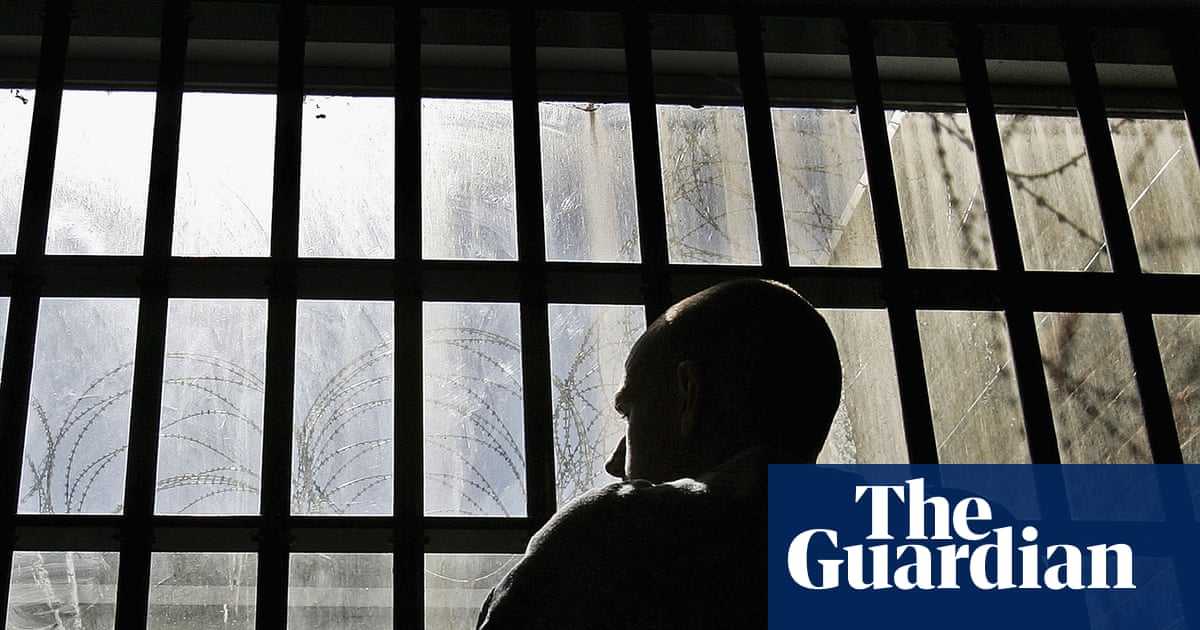
In today’s newsletter: The government wants to expand the use of medication among sex offenders – but the plan raises difficult questions about consent, rehabilitation and life after prison
Good morning. I know sex offender treatment might not sound like an obvious August topic, but trust me, this is worth your attention. It’s a contradiction we seem unable to resolve: as a society, we abhor the crimes these offenders commit against mainly women and children, but put little thought into their management beyond (mostly temporarily) locking them away.
This may be about to change. Over the weekend, our home affairs editor, Rajeev Syal, revealed that thousands of male prisoners in England and Wales could soon be offered sex drive-suppressing drugs in a radical scheme aiming to reduce reoffending – and ease the prison overcrowding crisis.
But what are the practical and ethical considerations at play in medicating this growing sector of the prison population? I spoke to Rajeev to find out. But first, a roundup of this weekend’s other biggest stories.
Weekend roundup
-
UK | Cleveland police have published photographs of PC Matthew Blades and PC Tom Clough who died when a car travelling the wrong way on the A66 crashed head-on into their police vehicle.
-
US-Canada trade | Donald Trump has lashed out at Canada after trade talks collapsed, with the US imposing 50% tariffs on $20bn (£15bn) of Canadian goods and Mark Carney vowing to retaliate “dollar for dollar”.
-
Russia | A 32-year-old Russian woman has been accused of assassinating a Russian naval commander with a bomb in occupied Crimea, allegedly on behalf of Ukrainian intelligence.
-
Labour | Andy Burnham is facing pressure from Labour groups to recognise Israel’s actions in Gaza as genocide and impose a full arms embargo, setting up a potential showdown at next month’s party conference.
-
Ukraine | Britain will boost Ukraine’s capacity to make its own long-range missiles, Andy Burnham will announce today, as he travels to Kyiv for the country’s independence day on his first foreign visit as prime minister.
In depth: ‘There are people who are obsessed with sex, but don’t want to be’

The number of sex offenders in prison in England and Wales has risen sharply in recent years to 15,000. This growth is driven by mounting prosecutions for historic crimes and a huge increase in online offending, with more than 850 men arrested on suspicion of online child sexual abuse every month.
The ongoing row over early release has exposed how prisons are struggling to maintain even basic levels of safety and human dignity, never mind having the capacity to work on rehabilitation. Once inside prison, these offenders – in particular those who target children – live with the constant threat of violence, and get minimal support with their offending behaviour. Sex-offender treatment programmes – which offered group-based psychological therapy – were quietly abandoned in the late 2010s amid controversy about whether they increased reoffending risks.
Sex offenders already have comparatively low reoffending rates compared with other groups – 11.7% for those released in early 2023, compared with 21.7% for other violent offences, or 19.6% for robbery. Now, Rajeev tells me, the main thrust of government plans to reduce this further is the use of sex drive-suppressing medication. This autumn, an initial pilot will be scaled up to include 20 prisons, and officials could be ready to launch the drugs in prisons and probation services across England and Wales by the end of 2028 if early results prove favourable.
Government sources have told the Guardian that ministers are keen to expand the voluntary use of sex drive-suppressing drugs as they reach desperately for solutions to the prison overcrowding crisis.
After an outcry from victims that proved an early test for his leadership, Andy Burnham announced earlier this month that prisoners convicted of rape, grooming and serious child sexual offences would be excluded from the early release scheme due to begin in October, but other sex offenders serving sentences of less than four years will still be eligible.
*****
How does it work in practice?
Prisoners on the trial are typically offered a combination of pills: a selective serotonin reuptake inhibitor (SSRI), such as sertraline, which limits invasive sexual thoughts, and anti-androgens, which reduce the production of testosterone and limit libido. One in four sex offenders – equating to 3,750 current prisoners – would be considered for the treatment.
“It’s meant to target sex offenders who experience intrusive, persistent and intense sexual thoughts, as well as persistent arousal and unhealthy sexual urges and sexual behaviours,” Rajeev says. “There are people who are obsessed with sex, but don’t want to be.”
These offenders differ significantly from others who seek power or sadistic enjoyment through abuse and don’t recognise the impact of their offending.
Prof Belinda Winder (pictured, below) is a leading forensic psychologist who has evaluated the use of these drugs. She insists that the scheme does not amount to “chemical castration” – a phrase that’s also inaccurate because, bluntly, it requires the continued ingestion of medication, not surgical intervention. The proposal for “mandatory chemical castration” made by then justice secretary Shabana Mahmood last year has since “hit the rocks”, says Rajeev.
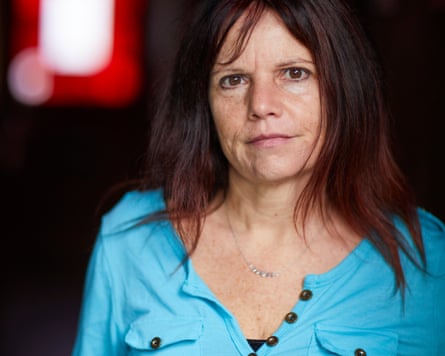
“There is wide agreement that this scheme has to be voluntary,” he says, “working with people who really want to stop their offending, with their knowledge and consent.”
****
What are the considerations?
Medicating offenders raises complex questions. Concerns have surfaced about the limited data available on the long-term effects of these medications. For example, we know that testosterone suppression can cause osteoporosis and cardiovascular disease. Serious side effects could also affect how likely offenders are to continue with their medication once they leave prison, Rajeev says. Their use could even result in legal action being taken against the government, particularly if an individual claims they felt pressured into the scheme.
Assessing who is suitable for medication takes lengthy observation and analysis. Intensive oversight would also be necessary once a prisoner was released from custody, to ensure they continued to take their medication.
“That’s one big problem with seeing this as a way of bringing down prison overcrowding,” says Rajeev. “How do you monitor it outside, given how over-stretched the probation service already is?”
And then there are the ethical considerations that arise, even when medicating an offender with their explicit consent. In other jurisdictions, including Australia and the US, modern mandatory schemes have been subject to fierce debate about whether they are, in principle, inhumane, a populist exploitation of public disgust for sex offenders, or a brave and creative approach to rehabilitation.
While those running the pilot emphasise its voluntary nature, critics are already warning that this could become blurred if an offender’s willingness to take medication is considered when making parole decisions, or if it’s used as a criterion for eligibility in future early release programmes.
****
What else is available when sex offenders leave prison?
For some prisoners treated by Prof Winder, this medication has been transformative. One man who experienced problematic sexual arousal – intense sexual urges throughout the day – described finally being able to follow the plot of a film without being plagued by compulsive thoughts. “Without the drugs, these images were going around his head all the time,” said Winder. “He did not want them any more.”
The fact that the government is prepared to focus on such a radical solution – which it accepts is not appropriate for the majority of sex offenders – underlines how very little support is available for this group. And if you don’t like the idea of giving sex offenders support, then consider it victim protection: a means of breaking the isolation and shame that often leads people to reoffend.
There are alternatives. Over the years, I’ve reported on a handful of programmes that work with sex offenders once they leave prison, and interviewed men whose thinking has been substantially changed not by medication but by human intervention.
The best known of these is the Circles programme, which provides a local network of volunteers to support and hold accountable their “core member”, a child sexual offender who wants to reintegrate into the community. Although evaluations consistently show its significant impact on reoffending, when I interviewed its founder, Rev Harry Nigh, a couple of years ago, he spoke of being worried that a rightward shift in politics was making it tougher for decision-makers to justify funding these interventions.
In this context, dare I say that any effort to look beyond an offender’s past and consider their future is brave.
And there’s a definite upside for our new PM in making the scheme work, Rajeev reminds me. “If the government can ensure that a quarter of the sex offender population will take a pill and not feel compelled to commit another crime, relieving some of the huge pressure on the criminal justice system, it’s a huge win.”
after newsletter promotion
The week to come
-
Wednesday | Ofgem will announce its quarterly energy price cap affecting bills for the last quarter of 2026.
-
Thursday | Quarterly immigration and Neet statistics will be released, two policy areas Andy Burnham is keen to focus on.
-
Thursday | The 17-year-old who pleaded guilty to arson over the attack at Kenton United synagogue in April is due to be sentenced.
What else we’ve been enjoying

-
I’ll never tire of watching, reading and listening to Miriam Margolyes (pictured), and her essay on how to save the nation doesn’t disappoint. (She only mentions sex once.) Michael
-
Author Meg Mason’s thoughtful meditation on the intense parasocial bonds between readers and writers has had me re-evaluating my close friendships with John Steinbeck, Liane Moriarty and Katherine Rundell. Libby
-
I found Hannah Richell’s thoughtful reflection on grief, after her husband died in a surfing accident ten years ago, particularly moving. Michael
Sport

Fifa | The Uefa president, Aleksander Ceferin, has described Gianni Infantino’s doomed attempt to sell stakes in the World Cup as “even worse than the Super League plan” and warned his embattled Fifa counterpart that he will face an opponent if he runs for re-election next March.
Formula One | Britain’s Lewis Hamilton said talks were needed at Ferrari as to why they delayed bringing teammate Charles Leclerc into the pits at the Dutch Grand Prix.
Cricket | Brydon Carse has become the latest England cricketer involved in a late-night incident after footage emerged of the fast bowler in police handcuffs outside a bar in Derby.
The front pages
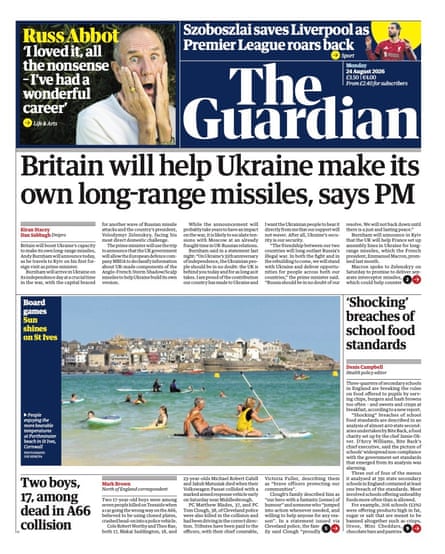
“Britain will help Ukraine make its own long-range missiles, says PM”, is the Guardian’s front page today, while the Times says “Burnham to gift Ukraine blueprints for missiles”. The i Paper has “Burnham open to cutting uni fees for EU students as bargaining chip for better Brexit deal”, and the Express writes “‘Let’s talk about assisted dying Mr Burnham … while I still can’”.
The FT leads on “Warsh seeks to calm investor jitters as signs of economic strain increase”, and the Telegraph splashes “Graduates face worst job market on record”. The Mail says “Children are ‘not safe’ on the internet”, and Metro has “‘Joyride’ five & cops killed in 4am crash”.
The Mirror, reporting on football fan behaviour, writes “The Prem suspects” while the Sun, on the royals, has “We’re all grin it together”.
Today in Focus

The connectionists
Guardian journalist Michael Safi looks into the world of artificial intelligence, exploring the dangers and promises it holds for society.
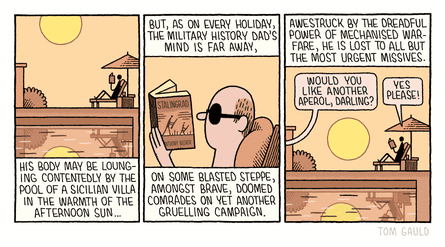
Cartoon of the day | Tom Gauld
The Upside
A bit of good news to remind you that the world’s not all bad

Seventeen medieval manuscript fragments discovered in Guernsey are shedding new light on the island’s previously unknown literary life, reports Dalya Alberge. Dating from the 12th to 15th centuries, the texts range from the Bible and Ovid to a rare French play, revealing surprisingly broad reading tastes. The fragments survived after being recycled as bindings for administrative records – and researchers believe many more may still be hiding in the island’s archives.
Sign up here for a weekly roundup of The Upside, sent to you every Sunday
Bored at work?
And finally, the Guardian’s puzzles are here to keep you entertained throughout the day. Until tomorrow.