Mobilisation fears grip Russians as Kremlin's forced recruitment spikes
Russian security forces are detaining civilians off the streets and pressuring them to sign military contracts, as reports emerge that the Kremlin is preparing for a new wave of mobilisation for its ongoing...
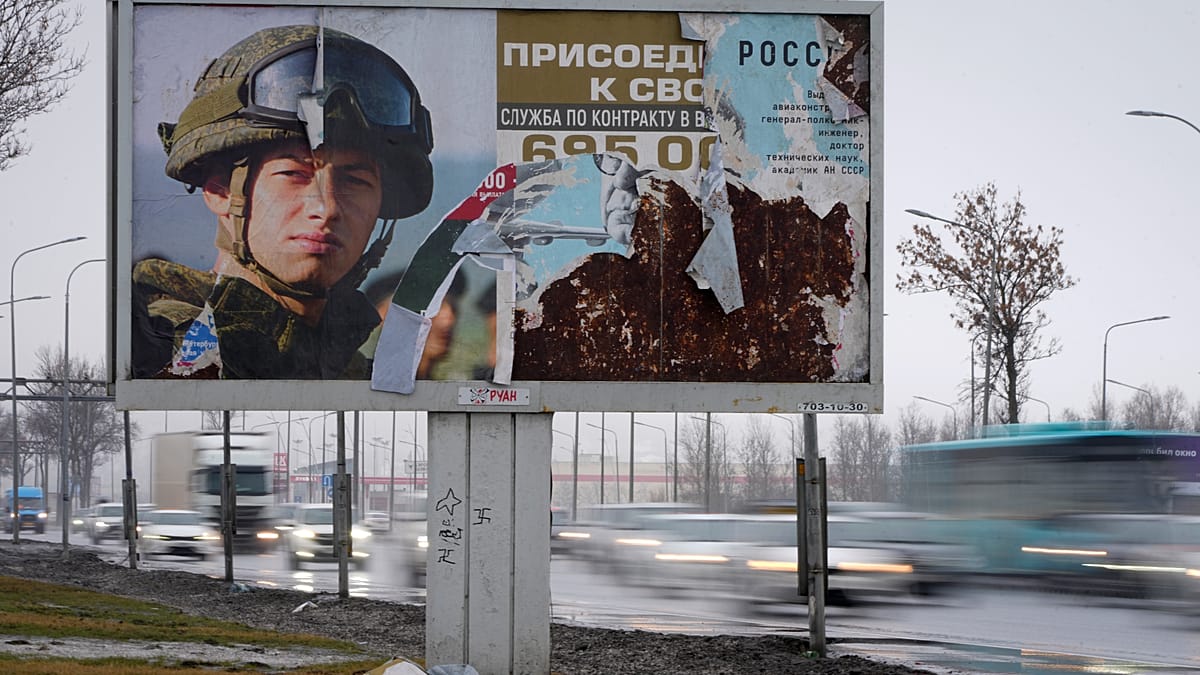
Russian security forces are detaining civilians off the streets and pressuring them to sign military contracts, as reports emerge that the Kremlin is preparing for a new wave of mobilisation for its ongoing all-out war in Ukraine.
In mid-August, the Russian human rights project Idite lesom received 14 appeals from people who said security forces had detained them and forced or pressured them into signing military contracts, either at police stations or directly at military enlistment offices.
The project, which helps Russians avoid taking part in the war, said the peak began on 10 August. "There were only isolated round-ups in July, now we are at a peak," Ivan Chuvilyaev, a representative of the project, told Euronews.
Reported cases span from Novorossiysk to Birobidzhan. Men have been detained on the street under the pretext of document checks or for drinking in public, at their workplaces, and on their way home.
Cases in the Penza region have been recorded since mid-June. In the same period, Idite lesom — whose name is a deliberate play on a Russian expression meaning "get lost" —reported seven cases of conscript soldiers being forced or pressured to sign contracts with the Russian Defence Ministry.
Prison authorities are also being used as a recruitment channel. Chuvilyaev said representatives of Russia's Federal Penitentiary Service are searching for potential contract soldiers in remand centres and colonies.
Separately, civilian recruiters are targeting people in financial difficulty — such as debtors and the unemployed — through job advertisements, agencies and personal contacts.
"If someone has money problems, the recruiters will find them," he said. "People realise what they have got into only when they are already at the front."
Since the start of Russia's full-scale invasion of Ukraine in early 2022, more than 80,000 people have sought advice from the project, according to Idite lesom.
Mobilisation after the elections?
Ukrainian officials, including President Volodymyr Zelenskyy, have repeatedly said Russian authorities are preparing a new wave of mobilisation after the State Duma elections in September.
Sources in Western intelligence told the Wall Street Journal that mobilisation-preparedness drills — covering accommodation, food supply and arming of residents — were conducted in the Kaliningrad region last month.
Russian state media reported separate exercises in the same region in July, describing them as focused on repelling drone attacks.
Representatives of NGOs helping Russians leave the country have also reported a sharp increase in inquiries since mid-July.
"It is reminiscent of the situation in 2022, early 2023," a coordinator of the German human rights initiative inTransit, who asked not to be named, told Euronews.
"The threat of mobilisation keeps cropping up like a refrain in a large number of requests. People are afraid that they will not be able to leave later if they do not do it now," the inTransit coordinator said.
"They also fear that they may be forced to sign a contract, even if they resist, or the signature may be forged on their behalf."
The coordinator said people under investigation — including on politically motivated charges — who have not yet been placed in remand centres are also reporting pressure from prison service representatives or investigators to sign contracts and go to war, even those under travel bans or house arrest.
Now, an increasing number of Russians with no history of work in jobs that are targeted by the Kremlin, such as journalism, human rights work or anti-war activism, are considering leaving the country, the coordinator said.
Requests to leave for Georgia and Armenia — countries Russians can enter without visas — and subsequent legalisation in the EU on standard grounds have risen sharply.
The Unified Register of Military Records, launched in May 2025, has made leaving harder. Once a summons is received and a person is entered into the system, departure becomes significantly more complicated.
"There is a high likelihood that their departure will also be restricted from Belarus," the inTransit coordinator said.
"Now people understand that, in the event of a new mobilisation wave, they may simply be left with no way to leave and will find themselves locked in."
Moscow bleeding troops
Russian army losses since the start of the full-scale invasion in February 2022 have amounted to approximately 1.4 million troops, according to both Ukraine's General Staff and the US-based Centre for Strategic and International Studies (CSIS). CSIS further estimates that up to 450,000 have been killed.
Experts at the think tank assess that in 2026, Russia has been losing more than 30,000 personnel per month — roughly 3,000 more than the approximately 27,000 new contract soldiers it is recruiting each month.
The average life expectancy of a newly recruited Russian soldier on the front line in Ukraine is 20 to 30 minutes, CIA director John Ratcliffe said on 15 July at a defence forum in Pennsylvania.
The Kremlin generally does not fully disclose its losses.
Russian officials have denied any plans for mobilisation. "We do not need mass mobilisation at the moment; it is neither planned nor expected," Russia's permanent representative to the UN Vasily Nebenzya said on Friday. He added, "As far as I know."
Kremlin spokesman Dmitry Peskov on Tuesday described reports about mobilisation preparations as attempts to "stir up the situation ideologically" inside Russia.
Russia announced "partial" mobilisation on 21 September 2022. No official decree ending it has ever been issued.