

No heating or AC needed in France's first housing building of its kind
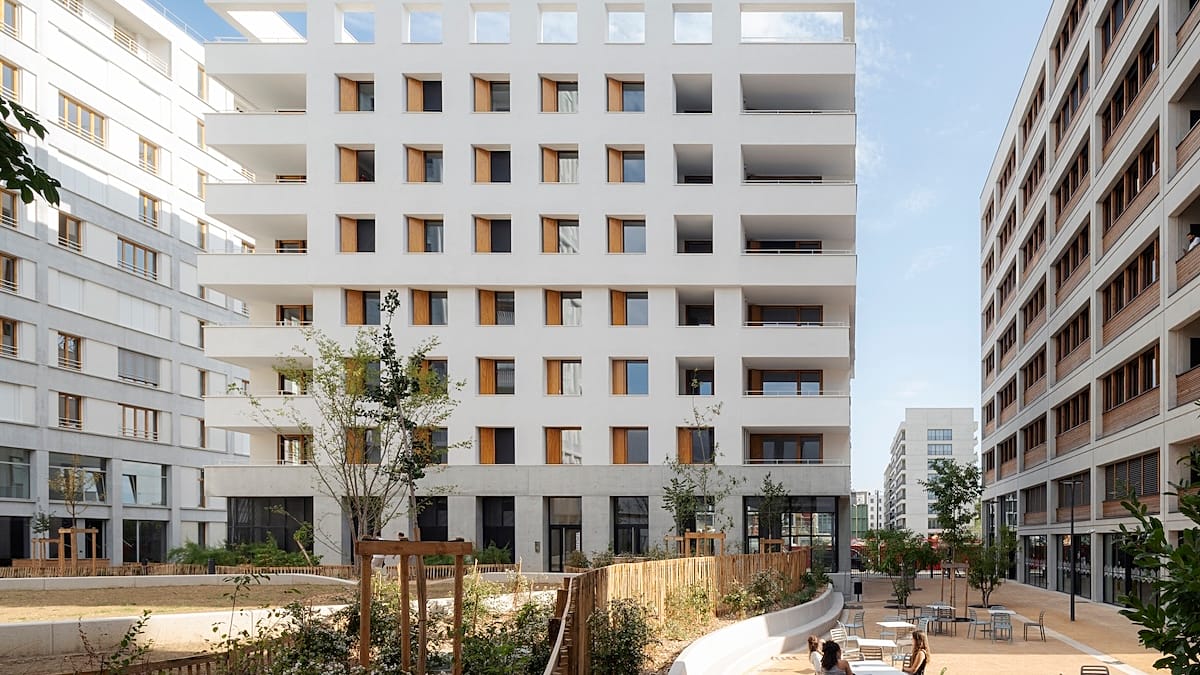
French real estate company Nexity presented the first apartment building of its kind on Tuesday, which is designed to maintain an interior temperature between 20 °C and 26 °C without heating or air conditioning.
Almost brutalist in style, this new white and cubic building is the first of its kind in France. Its cutting-edge design allows it to regulate its interior temperature without using heaters or air conditioning.
In Lyon, French real estate company Nexity and Austrian architectural firm Baumschlager Eberle presented on Tuesday their new seven-story-high project of 23 housing units in the ever-transforming Confluence neighbourhood.
No need for air conditioning in the summer or heating in the winter; that's the realtor's promise. The building is designed to maintain an interior temperature of 20 to 22°C in the winter and 26 to 28°C during heatwaves.
An Austrian concept
Seeking a response to the energy and climate crisis, Austrian architect Dietmar Eberle designed a building capable of letting sunlight in to retain the heat, called "22-26" in reference to the interior temperature it should maintain.
This cutting-edge technology that has yet to prove its effectiveness, is based on the building material's inertia.
"These play a major role and have been selected for a common characteristic: their ability to store and release energy," Anne Speicher, director of the Baumschlager Eberle agency, told online French media Vert.
"An insulating envelope, constructed from Monomur bricks (a hollow-core terracotta structure), concrete and a lime render, helps to retain heat or coolness inside homes," reports the French media.
The heat is "retained" by the walls and floors that are twice as thick as France's average, 61 centimetres compared to around 30 in average.
Two layers of hollow bricks interspersed with glass wool insulation give the building a quite massive appearance while also protecting it from direct sunlight thanks to large recesses.
The concept also relies on innovative construction planning and on an automatic slat system controlled by multiple sensors.
Wooden slats installed in each housing unit automatically open and close to air out the apartment regarding its "temperature, humidity, air quality and weather," explains Nexity in a press release.
"Residents can also monitor them themselves. Auxiliary heaters, which are required by regulation, only turn on during extreme weather events or following a prolonged period when the property has been unoccupied."
Residents act as heaters
The greatly insulated apartments retain the heat produced by the residents' bodies, "we are the heaters of the home — us and what we do," Cédric Hatat, Programme Manager at Nexity Auvergne Bourgogne told French broadcaster BFM Business.
The heat produced by cooking, showering or electric appliances will also be trapped in the apartments, reducing energy bills by 80%, according to Nexity's CEO Véronique Bédague. This would save every resident €380 a year for a three-room apartment.
Each apartment is still equipped with heaters and a double-flow mechanical ventilation system, as required by French law. The realtor claims this has raised the construction cost by 15% to connect the building to the city's heating system.
This technology is also supposed to cut energy consumption associated with thermal comfort by 73%, reducing carbon emissions by 65% over 50 years.
High construction cost
The Austrian agency has already built two of these "22-26" type buildings in Switzerland and Germany, but it's the first one in France.
Its reproducibility is uncertain because of high construction costs, "this project cannot be replicated on a large scale," elected ecologist metropolitan councillor at the Métropole de Lyon, Renaud Payre, told Vert.
"The cost of materials, the highly sophisticated home automation system on which it is based… The 22-26 is quite simply too complex to establish itself as a standard model for construction."
"It is designed to serve as a showcase for sustainable housing and to encourage the development of local supply chains," Payre told Vert.
The ecologist councillor claims that housing renovation remains the best way to improve apartments' energy consumption.
"Of course, you can pick up a few techniques or ideas here and there, but as things stand, you cannot turn a draughty building into an energy-efficient one using state-of-the-art, very expensive home automation systems," Payre told Vert.
Other cities have been won over by the concept; the building's realtor, Nexity, plans to complete the construction of a similar 22-26 project in La Garenne-Colombes, near Paris, in 2028. This other test project building that will host 80 housing units is set to gauge the effectiveness of this concept.