What it takes to build the world’s longest railway tunnel – and restore nature once it’s done
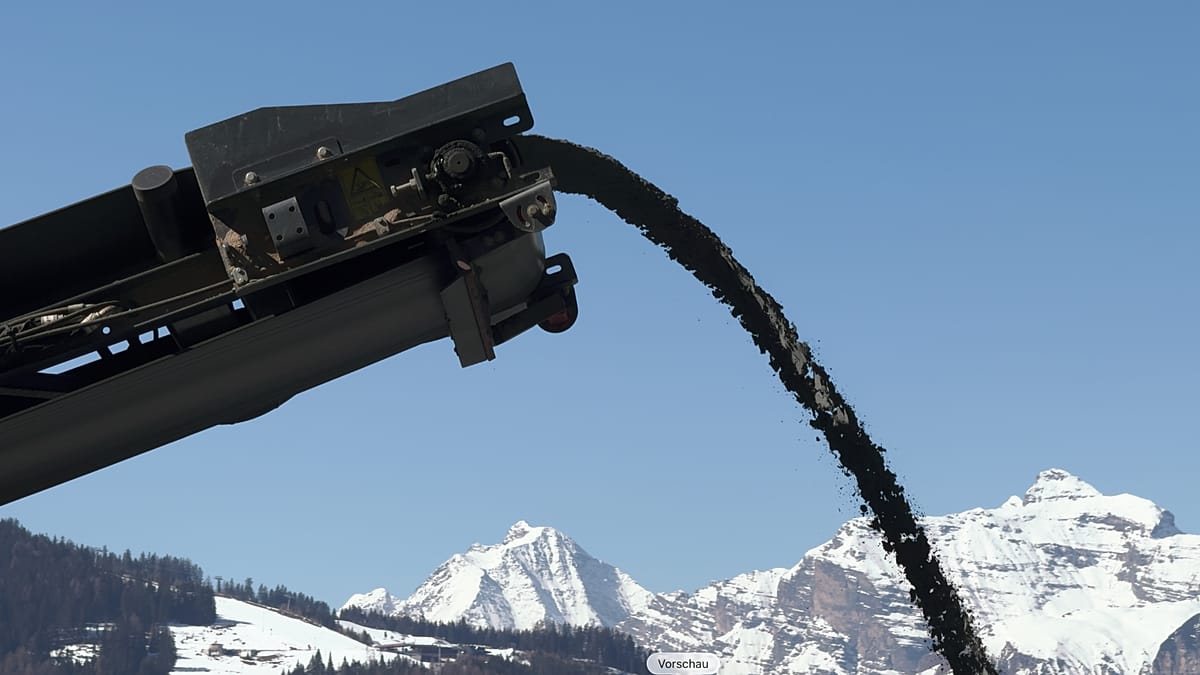
The multi-billion-euro Brenner Base Tunnel project is one of Europe’s biggest construction sites. Deep down, in the heart of a Tyrolean mountain valley, gigantic tunnel-boring machines are gnawing their way...
The multi-billion-euro Brenner Base Tunnel project is one of Europe’s biggest construction sites.
Deep down, in the heart of a Tyrolean mountain valley, gigantic tunnel-boring machines are gnawing their way through the Austrian Alps.
This is where the longest railway tunnel in the world is being built – and all that blasted rock has to go somewhere.
Engineers, geologists and landscape planners wrestled with this environmental quandary when designing the “new” Padaster Valley.
Work began around 10 years ago. Today the valley is a stony wasteland. Yet in 10 years’ time a blossoming Alpine landscape is supposed to stretch out here once again.
It will look a little different to before: once a sharp V-shaped incision in cross-section with sleep slopes, the valley is now wide with a gentle U-shape.
But the company building the Brenner Base Tunnel promises to make it a model example of renaturation both in Europe and the whole world.
‘The effort is gigantic’: Europe’s largest excavation dump
To grasp the sheer mass of debris that has to be moved – and disposed of – here, it helps to picture the Great Pyramid of Giza: at almost 147 metres, it is the tallest pyramid in the world.
Now imagine three of them being run through a gigantic stone mill, and you will have roughly the pile of rock waste that workers on the Brenner construction site are tasked with disposing of in an environmentally friendly way.
Sebastian Reimann is a project manager and among other things responsible for construction section H53, the Pfons/Brenner tunnel segment.
“We have a huge construction site here with a landfill volume of 7.7 million cubic metres of excavated material,” he tells Euronews Earth. This is the largest excavation dump by volume in the European Union.
“There were a few months when four tunnel-boring machines were advancing underground at the same time,” recalls Reimann. “Every month more than 250,000 cubic metres of spoil were brought up from underground and placed here on the dump. The effort is gigantic, both logistically and in terms of manpower, but it is simply great fun to be involved.”
A 30-kilometre conveyor belt avoids heavy lorry traffic
But do local residents and the surrounding environment share this enthusiasm?
Tunnel-boring machines run without a break, chomping their way through the mountain massif 24 hours a day and grinding tonne after tonne of rock out of the Alps with the steel teeth of their gigantic cutterheads.
Millions of cubic metres of crushed rock must then be transported from the mountain’s core into the Padaster Valley.
Project manager Reimann smiles, then points with satisfaction to a thick giant tube gleaming in the sun, running along the length of the valley as far as the eye can see.
This is only the small end section of a gigantic conveyor-belt system – and vivid proof that a rubble dump like this can operate (almost) without heavy lorry traffic.
“Here in section H53 we installed this enormous conveyor belt system,” explains Reimann. Its length varies depending on progress underground: sometimes a few kilometres are added, sometimes it is shortened. “At its longest, the conveyor belt was 30 kilometres.”
The decision to opt for the conveyor-belt solution is one way the project is lowering its impact on local communities and the environment. The Padaster Valley may be uninhabited, but nearby lie Steinach am Brenner and other villages. For the people there, having 100 lorries loaded with rock debris thundering along the village road every day, for several years, would have been unacceptable.
So an additional access tunnel was driven, an exclusive direct connection between the landfill valley and the tunnel construction site deep inside the mountain.
The underground construction teams drive down a four-kilometre access ramp to the Brenner Base Tunnel’s vast underground site. Vertically, it drops several hundred metres. The rock chippings brought up from the depths, however, travel in the opposite direction: on conveyor belts reaching far into the mountain they move uphill, into the Padaster Valley.
A mountain stream temporarily diverted
Until a few years ago, the Padasterbach river flowed through this idyllic, remote side valley of the Wipp Valley. Now, it’s nowhere to be seen.
“At the moment it is still a grey stony desert,” Reimann’s colleague Andreas Ambrosi concedes. But he is quick to reassure us: the Padasterbach has not disappeared, it has only been diverted – and that is just for a limited period.
A specially built 1,500-metre diversion tunnel provides the Padasterbach with a temporary riverbed. This diversion was a legally required condition; without it, the mega landfill would never have been approved at this location. And the diversion is only temporary.
“That’s where the new riverbed is already being built,” says Reimann, pointing down at the giant, 1,400-metre-long landfill.
In sweeping curves, the structure winds its way through the landfill floor, which for now is still stone-grey.
The valley floor has been raised by almost 80 metres
Once breakthrough inside the mountain has been achieved, the tunnel-boring machines will come to a halt, the conveyor belts will be dismantled, and a thick layer of soil will be spread across the “new” valley floor. Trees and shrubs will then be planted on top.
The Padasterbach will be allowed to return to its newly created bed. A mix of mountain forest, pastures and ecological compensation areas is planned. Work on renaturation is due to begin as early as next year.
“So we have not only dug a huge tunnel, we have also created a new valley,” says Ambrosi. “We have raised the old valley by 70 to almost 80 metres,” Reimann adds. The present valley floor is therefore much higher than before. “But it remains a valley,” says Reimann, “it will just be a different kind of valley.”
Saving a blooming orchid meadow
But can everything really be restored here in these sensitive Alpine habitats just as it was before?
Tyrolean politicians have insisted on stringent environmental standards for the project, not only in the Padaster Valley but also on other sections of the cross-border railway tunnel project between Austria and Italy, northern and southern Europe.
There was a very extensive and lengthy environmental impact assessment; for projects of this scale in the European Union that has now become standard. In total, around 350 nature protection conditions have to be complied with.
Some measures were implemented before and during construction. Before anything could start, a detailed survey of soils and vegetation, watercourses and forest, wildlife, flora and fauna had to be carried out.
Geologists mapped every square metre of the valley floor. Biologists and zoologists combed the narrow basin, identified species and counted animals and plants.
It turned out that the nutrient-poor rough grassland in this Alpine valley was home to a 250-square-metre orchid meadow. As one of the first protective measures, this valuable micro-habitat was successfully “relocated” even before construction began. The rare orchids were transplanted and now bloom on a compensation area of the same size.
Moving protected brown long-eared bats
And then there were concerns about the brown long-eared bat (Plecotus auritus). From the vesper bat family (Vespertilionidae), it is one of Tyrol’s 24 bat species. In the Alpine region some of these species are considered particularly worthy of protection.
In the Padaster Valley, bat researchers spotted seven species in total, including the brown long-eared bat. The Austrian Red List classifies the brown long-eared bat as “not threatened”, but it is protected under the Bern Convention on the Conservation of European Wildlife and the European Union’s Habitats Directive (92/43/EEC). This translates to an obligation to maintain a “favourable conservation status”.
After the wide-ranging bat survey, numerous nesting boxes were installed in the surrounding area – far enough away from the landfill site, yet close enough for the brown long-eared bats to find and accept the offer of a move.
For these nocturnal insect hunters with their ultrasonic equipment that was no problem: if social cohesion and a favourable climate remain intact, experts consider bats to be adaptable when it comes to changing roosts.
The future vision for Padaster Valley
Riverbed management, orchid rescue, bat relocation, reforestation and renaturation: a great deal has been done and is still being done in the Padaster Valley to soften the impact of this massive construction project on natural cycles and ecological balance.
The Padaster Valley lies between 1,100 and 1,500 metres above sea level and stretches far up into Tyrol’s mountain world. There are many hiking trails in the area.
Once construction work is finished and the valley has been renatured, tourism is expected to revive.
For now, patience and time are needed for the grey-black scar of rubble to heal over again, with the active help of foresters, landscape planners, engineers, hydrologists, geologists, landscape architects – and nature itself.
Ambrosi has an idea for the day the valley is finally restored: to walk the hiking trail together, track down this exact spot, and sit down for a relaxed picnic. Reimann likes the plan. “Of course, let’s do it,” he says, laughter lines crinkling around his eyes. “In 10 years’ time this will be a rustic biotope. No one will believe there was once a huge construction site here.”
Just one part of a bigger picture
The Padaster Valley is only one of many renaturation and compensation measures linked to Europe’s biggest construction site, the Brenner Base Tunnel.
Altogether, 21.5 million cubic metres of excavated material will be heaped up in Italy and Austria – the equivalent of eight Cheops pyramids. Part of it will be reused for concrete production; the rest will be spread across the Padaster Valley, Ahrental, Ampass, Genauen and Hinterrigger landfills. Every single area will be recultivated or renatured.
The Tantegert forest and bog complex has been revitalised as one of 200 ecological compensation measures. In Austria alone, 140 hectares of compensation areas are planned. In addition, fish ladders are being built (for example on the Gschnitzbach), weirs are being removed (on the River Sill in Innsbruck), floodplains created and geological nature trails plus footpaths and hiking trails laid out. Near Franzensfeste, 50,000 plants have been set on former construction sites.
But it is still too early to draw up a balance sheet. Some of the recultivation and renaturation measures can already be chalked up as a success. But on other sections, such as the Padaster Valley, the work of repairing nature is only just beginning.
One thing is clear: close cooperation between supervisory authorities such as the Tyrol region, independent experts and the Brenner Base Tunnel construction company has ensured that nature conservation in the Alps is taken seriously.