She shoots, she scores: Spain's pioneering women's footballers get big screen treatment
Long before Spain lifted the Women's World Cup, or stadiums began to fill up to watch women playing football**,** there was already a Spanish women's team playing international matches without the support of...
Long before Spain lifted the Women's World Cup, or stadiums began to fill up to watch women playing football**,** there was already a Spanish women's team playing international matches without the support of the federation.
In the early 1970s, a group of footballers travelled around the country promoting a sport that was still viewed with suspicion under the Franco dictatorship. That team went on to face Portugal and Italy and had a captain who would become one of the greatest legends of Spanish women's football: Concepción Sánchez Freire, better known as Conchi Amancio.
Regarded as the first Spanish female professional footballer, Conchi spent a 25-year career in Italy and England and scored more than 500 goals**.** Yet, more than half a century after her first successes, she remains largely unknown to much of the public.
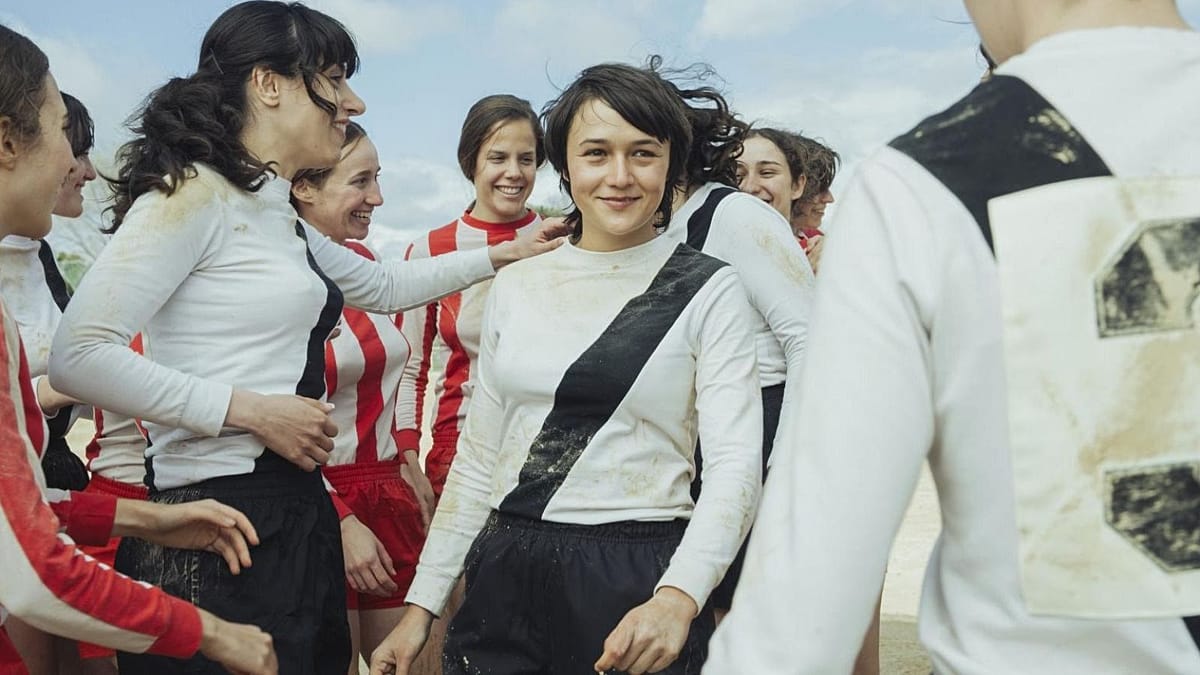
Her story and those of other pioneers of Spanish women's football are the inspiration behind 'Pioneers. They Just Wanted to Play' (source in Spanish), the new film by Marta Díaz de Lope Díaz, which hits cinemas on 12 June. For the director, the lack of awareness that still surrounds these players was precisely one of the reasons for bringing their story to the big screen. "I found it incredible that I myself didn't know about this story," she tells Euronews. "I've loved football since I was a child, I like telling stories about women and I thought it was a fascinating story."
Spain's "clandestine" national team
Spain's women's national team played its first international fixtures in 1971, but did so without recognition from the federation. Those matches were not recognised by UEFA or FIFA either. The team was driven by Rafael Muga, regarded as one of the main promoters of women's football in Spain at a time when women still faced huge obstacles to playing the game.
Conchi was the first captain of that pioneering team, which went on to face Portugal and Italy when Spanish women's football was only just taking its first steps. "They've already been playing for six or seven years and for us it's only two years since we started playing," a young Conchi said at the time in archive footage recovered by RTVE. (source in Spanish)
The former player herself would recall a period defined by constant travel and efforts to promote women's football across Spain: "We played a lot of matches; we almost played more games than training sessions, because we were travelling around Spain promoting women's football."
Those players became known as the "clandestine national team", a term that has endured for decades to describe a side playing international fixtures without official recognition. However, Díaz de Lope Díaz explains that some of the pioneers themselves qualify that definition. "They said they weren't hiding, that there was a crowd and people came to watch them," the director notes. "But it's also understandable, because they had no official support."
The lack of institutional backing was evident even in symbolic details. As the filmmaker explains, the players were not allowed to use official crests or national anthems in their matches. "Not even the referee, for instance, was allowed to wear official kit," she says. For the director, these are details that illustrate "the federation's determination to keep them on the sidelines".
The day the legend was born
The team's story began to be written on 8 December 1970, at the old Boetticher ground in the Madrid district of Villaverde, in a match that drew thousands of spectators and is regarded as one of the first major women's football games held in Spain. According to testimonies gathered by RTVE broadcasts, between 7,000 and 8,000 people went to the stadium, drawn by the novelty of the event.
Conchi was just 13. That afternoon she scored all five of her team's goals and instantly became the great sensation of Spanish women's football. Her dribbling and finishing earned her the nickname Conchi 'Amancio', in reference to Real Madrid legend Amancio Amaro.
The young Madrilenian's talent did not take long to cross borders. As a teenager she signed for Gamma 3 Padua and became one of the first Spanish women footballers to build a professional career abroad. The move was so striking for the time that it featured on television news, which reported that her contract was worth close to 100,000 pesetas.
Conchi went from working as a trainee hairdresser in Madrid to becoming one of the standout figures in Italian women's football. Over her career she won several leagues and cups, played for some of Italy's leading clubs and also spent part of her career in England. In total she spent 25 years in the professional game before retiring in Bristol.
An "unpaid debt" honoured half a century later
Official recognition took decades to arrive. In 2019, the Royal Spanish Football Federation brought together (source in Spanish) at its Las Rozas Football City headquarters the members of that first national team that began playing matches in 1971, among them their captain, Conchi Sánchez Freire.
The federation described the event as a tribute to the women who "changed history" and acknowledged that it still had an "unpaid debt" to those pioneers. During the gathering, the RFEF stressed that those players had been a "driving force behind fundamental transformations" and had helped turn women's football into a sport followed and recognised by more and more people.
Decades on from those early matches, and years after receiving that official recognition, the story of these players is still finding new ways to reach the public. Director Marta Díaz de Lope Díaz explains that, as the research for the project progressed, she discovered a narrative that went far beyond sport.
"The film is about football, but in reality it talks about much more", the filmmaker tells Euronews. "We used football precisely as a pretext to talk about almost the entire journey women have had to make in the fight for their rights."
For Díaz de Lope Díaz, it was essential to place the story in the context of Francoist Spain in which these players grew up. "These women were doing something that today seems as harmless as playing football, but it provoked a lot of hostility and ruffled a lot of feathers," she says. The director recalls that the regime promoted a very specific model of woman through the Women's Section and that the footballers faced both institutional obstacles and entrenched social prejudices.
Díaz de Lope Díaz believes the trajectory of women's football also helps to explain the transformation Spain has undergone in recent decades. "The talent was there," she argues. "The problem was that there was no structure, there was no project and the spotlight wasn't on them." Today, she notes, new generations have role models such as Alexia Putellas or Ona Batlle, something unimaginable for those first players.
The director describes the film more as a "social feat" than a sports story. Through a group of young footballers, the film portrays the role of women in that Spain and the constraints they faced in different areas of everyday life. "We paint a picture of the role of women at the time and of the freedoms they have gradually won, not only in sport," she explains.
For Díaz de Lope Díaz, the story of those pioneers helps us understand both the long road travelled by women's football and the changes Spanish society has undergone in recent decades. "It was a way of highlighting what they did, of paying tribute to them and also of telling audiences a bit about where we come from," the director concludes.