Macron to host King Abdullah II and Lebanon's Aoun to discuss support for Lebanese Armed Forces
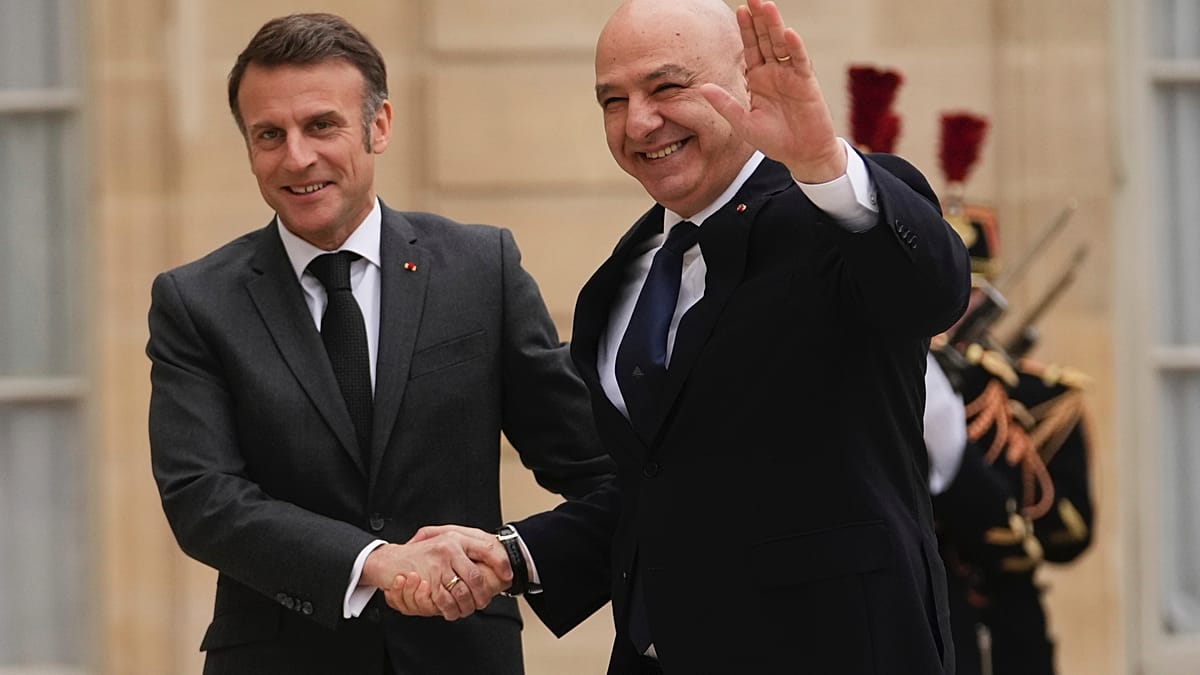
French President Emmanuel Macron is set to host Jordan’s King Abdullah II and Lebanese President Joseph Aoun in Paris on Thursday, ahead of an international summit, aimed at mobilising support for the...
French President Emmanuel Macron is set to host Jordan’s King Abdullah II and Lebanese President Joseph Aoun in Paris on Thursday, ahead of an international summit, aimed at mobilising support for the Lebanese Armed Forces (LAF).
According to an Elysée source, the talks — which are part of the Aqaba Process launched by Jordan in 2015 — will bring together senior officials and military experts from France, Britain, Jordan, Lebanon and the US to discuss plans for deploying the LAF, as well as wider efforts to stabilise the region.
At present, Lebanon is seeking international support for its armed forces and working to avoid a security vacuum in the south, following the UN Security Council's decision to end the mandate of the United Nations Interim Force in Lebanon (UNIFIL’s) on 31 December 2026, followed by a year-long drawdown and withdrawal — a move supported by the United States. At present, it has around 7,500 peacekeepers from nearly 50 countries.
Thursday’s meeting will focus on “direct operational matters” as France and its partners seek to assess how to assist the Lebanese Army with financial aid, equipment, intelligence and, if needed, operational guidance, according to an Elysée source.
UNIFIL was established in 1978 to oversee the withdrawal of Israeli troops from southern Lebanon and assist the government in restoring its control of the area. At the time, Israel's three-month long occupation was sparked by the March 1978 "Coastal Road Massacre" — a deadly hijacking carried out by militants from the Palestinian Fatah group, which killed more than 30 Israelis.
In 2006, following the war between Israel and Hezbollah, UNIFIL's mandate was expanded to help prevent Hezbollah and other armed groups from maintaining a military presence in southern Lebanon.
European efforts to establish a post-UNIFIL
In June, France and Italy announced they would lead efforts to establish a post-UNIFIL international coalition in support of Lebanon during the autumn of 2026, at a Franco-Italian summit.
Meanwhile, EU Foreign Policy Chief Kaja Kallas said on 1 September that more than 10 EU member states were willing to provide personnel and resources for a new civilian and military mission to support Lebanese forces, stressing that the EU was not seeking to “replace” UNIFIL, but instead to invest in “Lebanon's capacity to provide security for itself."
Ahead of his France trip, Lebanese President Joseph Aoun told Agence France-Presse (AFP), Aoun stressed the importance of a new force for Lebanon — whether it be European or not.
“Whatever the nature of this force, that poses no problem for me: European, non-European, American, another United Nations force, Asian, or even a mix of European, Arab and Asian forces,” he stated, adding that “the best and most optimal option remains extending UNIFIL's mandate”.
Aoun said that any new force in southern Lebanon, part of which is occupied by Israel, would be “temporary until the (Lebanese) army can deploy”.
Although he stressed that the goal was to strike a security agreement with Israel “primarily to end the state of hostility and the deployment of the army on the border”, he cautioned “we cannot jump directly to a peace agreement”.
The ongoing conflict
Lebanon was drawn into the wider regional Middle Eastern conflict after Hezbollah, the Iran-backed Shiite militia, launched rockets at Israel in early March in retaliation for US-Israeli strikes on Iran — prompting an Israeli military response across the country.
More than six months after the conflict erupted, and despite a ceasefire agreed in June, Israeli airstrikes, military operations and demolitions have continued in southern Lebanon, leaving villages abandoned and residents displaced.
Meanwhile, Hezbollah has continued to attack communities in the north of Israel, causing civilian and military casualties, as well as leading to the displacement of residents from communities along the Lebanese border.
Multiple rounds of US-mediated talks between Israel and Lebanon have yet to resolve the conflict. Hezbollah has rejected calls for its disarmament, while Israel has linked its full withdrawal from southern Lebanon to the group’s disarmament and the removal of its military infrastructure.
Meanwhile, hardline right-wing politicians, such as Israel's Finance Minister Bezalel Smotrich, have called for Israel to annex southern Lebanon up to the Litani River. Israel and Lebanon have experienced repeated periods of armed conflict and renewed hostilities since the 1948 Arab-Israeli War.
Speaking to AFP ahead of his Paris trip, Aoun said that Lebanon remained determined to disarm Hezbollah, describing the issue as “neither negotiable nor open to discussion."
Despite this, Lebanon’s armed forces have struggled to enforce the government’s decision to establish a state monopoly on weapons, amid Hezbollah’s refusal to disarm.
Hezbollah has long maintained a substantial arsenal, which it has used to fight repeated wars with Israel, while also playing a major role in Lebanese politics. It operates both as an armed group and as a political party, with members in parliament and ministers serving in the government cabinet.
France's role in the process
Karim Émile Bitar, associate research fellow at the Institute for International and Strategic Affairs (IRIS) said that in his view, Hezbollah's disarmament campaign was an "impossible" task.
“The army is a cross-community institution in Lebanon and it faces an impossible mission. It is being asked to disarm, within a few weeks, a militia that has been more powerful than the state for decades. This army lacks everything, from logistical resources and financial means. Politically, it is also not easy to confront Hezbollah, which continues to enjoy significant support from the Lebanese Shia community", he told Euronews.
Bitar said Thursday's meeting serves as an example of France’s longstanding role in Lebanese affairs (from 1920 to 1943, Lebanon was governed under a French mandate).
"Today, France views itself and has often been viewed, as the guarantor of unity, of sovereignty, of territorial integrity for Lebanon. These three things are now threatened: territorial integrity is absent as Israel occupies 6% of Lebanon's territory, sovereignty is because Hezbollah is refusing to hand over its military arsenal to the army and unity is being challenged in light of rising extremism, polarisation and fragmentation", Bitar told Euronews.
The US and Israel's decision to exclude France from ceasefire negotiations between Israel and Lebanon earlier this year left Beirut in a difficult situation, stressed Bitar.
"For Lebanon, this posed a problem because the United States is not perceived as an 'honest broker.' The Lebanese would have liked countries such as France, Italy and Saudi Arabia to have been involved in these negotiations, so that they would not have found themselves confronted with Israeli intransigence, supported by the United States", he said.