Wednesday briefing: Can the UK adapt in time to a new normal of extreme heat?

In today’s newsletter: As heatwaves intensify, Britain must confront the limits of a society built for cooler weather, forcing policymakers, communities and households to rethink how we live, work and stay cool
The UK swelters once again. On Tuesday, temperatures surged to 35C, condemning millions of people to another sticky night in homes ill-prepared for such warm conditions.
The heat is record-breaking: we are still in spring, yet temperatures are close to extremes we once never expected even in high summer. Yorkshire experienced its first ever “tropical night” in spring on Monday, when the evening temperature failed to fall below 20C. Health alerts remain in effect across large parts of the country due to the increased likelihood of deaths, particularly among vulnerable and elderly people. Yet, experts warn, this may just be the road to a new normal.
For today’s First Edition, I have spoken with the Guardian’s environment editor, Damian Carrington, about how the country can adapt to heatwaves and improve resilience to extreme heat. But first, the headlines.
Five big stories
-
UK politics | Tony Blair has accused Keir Starmer, Andy Burnham and Wes Streeting of putting Labour’s future at risk by abandoning the centre ground, warning that the party’s “almost infinite capacity for self-delusion” means it is likely to lose the next election.
-
UK news | One out of every five people arrested after their participation in the 2024 summer riots has since been reported to the police for domestic abuse, the Guardian can disclose.
-
Middle East | The continuing US-Israel war on Iran has compounded other global disasters to drive record numbers of people into hunger at a time when funding to combat famine has fallen dramatically, the head of the UN World Food Programme has said.
-
UK news | The court of appeal will review the non-custodial sentences given to three teenage boys for the rape of two girls, Keir Starmer has announced.
-
US politics | Alabama cannot use a new Republican-friendly map in this year’s midterm elections because it intentionally discriminates against Black voters, a panel of three federal judges have ruled.
In depth: ‘It shows how quickly climate change is impacting us’
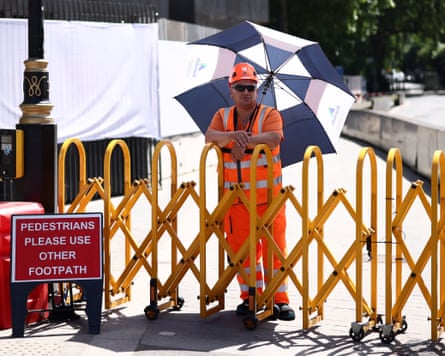
Climate scientists often warn British audiences that they have already lived through the coolest years of their lives. It is a sobering thought: a nation of grandchildren that will probably not recognise the seasons of their elders’ youth. The UK’s mild, predictable weather patterns are fading in a rapidly warming world, replaced instead by extremes. Winter is increasingly wet, dominated by deluges that flood and waterlog the country. Summer is punctuated by heatwaves and drought which turn the lush, verdant landscape brown.
This week’s heatwave is another reminder of what could await us in the coming decades. Late May, which typically sees average temperatures in the mid-to-high teens, has been historic: records have been shattered across England day and night. National infrastructure creaked in the scorching conditions, with offices, hospitals and homes overheating, train journeys cancelled, and some hospitals reporting a rise in admissions.
Damian says the current extreme weather is an example of the speed at which rising temperatures are affecting the UK. “Carbon emissions produced by fossil fuel burning are trapping heat in the atmosphere and warming the planet. We’ve known that for a long time and this is what happens. It is nearly 15 degrees hotter than normal right now, which is really crazy,” he says. “We usually break temperature records by a tenth of a degree. But this one was broken by two [degrees]. To me, it shows how quickly climate change is impacting us.”
The consequence of decades of emissions
The current heatwave is not being driven by natural climate phenomena like El Niño, which will probably start to affect UK weather patterns in the autumn. While there are warnings of a so-called “Super El Niño” developing in the Pacific, which would probably cause extreme heat and weather around the world, this has not yet happened. Instead, the warm temperatures in the UK are the consequence of decades of greenhouse gas emissions, and will become increasingly common in future years.
To adapt in the short term, Damian says that British society needs to reexamine its “mad dogs and Englishmen” approach to hot weather, and consider adopting customs that people use in warmer countries. Many British people do not recognise the danger that high temperatures can bring – especially for the most vulnerable.
“In the UK, we typically have a very mild climate. It’s not renowned for its hot summers. It’s grey and rainy in people’s imaginations. So, when we get heat, people tend to rush out and go to the beach, go out for a drink. In places that are used to this kind of heat, people do not usually do that. They stay inside in the hottest parts of the day, they sit under trees and parasols,” he says. “We [reporters] are not killjoys. But I remember seeing a poll last year which said that about a third of people still do not think the heat we get is dangerous. People can get severely ill, so there’s definitely a cultural change that needs to happen.”
Bad news for south facing homes, schools and prisons
But short-term, sensible changes are not going to be enough to prepare the UK for a hotter world. Last week, a major report by the Climate Change Committee (CCC), which advises the government on rising temperatures, warned that Britain is built for a climate that no longer exists, calling for radical changes.
UK homes will need air conditioning to survive the predicted temperature rises, which will probably surpass current conditions by several degrees. Heatwaves are expected to surpass 40C in all parts of the country by the middle of the century, with hot weather lasting longer, causing the vast majority of homes to overheat without intervention.
“The heat that we are experiencing will get worse in the future. Measures like lining streets with trees are fantastic and can help, but unfortunately this is not going to be enough, particularly in homes in the south of England. We are going to need active cooling from air conditioning,” says Damian.
“The CCC were particularly worried about schools, care homes, hospitals and prisons where people may not be able to go outside but might be vulnerable to high levels of heat. We have reported on people who live in south-facing flats which are unbearably hot in the summer. They have no way of dealing with the heat because they are facing into the sun.”
Better approaches to heat inequality
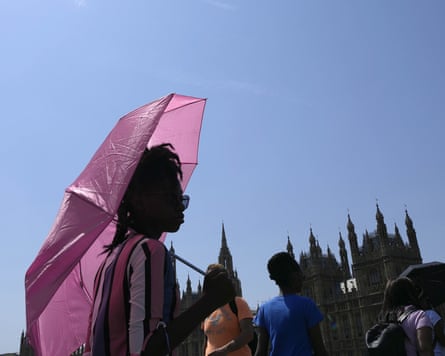
Adapting to rising temperatures is expensive – and the heat will probably most impact those who have the least resources to adapt. Ethnic minorities and people living in the most deprived areas of England have the highest risk of death due to extreme heat, with hundreds of excess deaths already recorded in heatwaves in the UK.
The UK is going to need to get serious about public health initiatives that allow everyone to cool down during heatwaves, says Damian, including public cold rooms and mist dispensers that spray passersby with cold water.
“Rolling out things like air conditioning across the country is expensive, so people on lower incomes may need help with that. Experts say you could think about cooling one room rather than the whole house. But there are bigger things that the government could do. For example, just like warm hubs were provided for people in the last energy crisis for people who were finding it too expensive to heat their homes, we could do the same thing with cooling,” he says.
Now really is the time to act, says Damian. More heatwaves with hotter temperatures are expected in coming decades – and a failure to do enough could be deadly.
“It is perfectly natural to enjoy warm, sunny weather, particularly when you’ve come through a rain-soaked dark winter like we have in the UK. But we are entering a new world. It’s a new level of heat that we’ve not really seen before. It can be very dangerous,” he says.
What else we’ve been reading

-
The phrase AI-generated time-travel vloggers filled me with horror, but in this piece by Priya Bharadia there is at least one historian trying to convince me my reaction is wrong and it is a good engaging thing. Martin
-
Lucy Knight has written a very entertaining piece about former partners squabbling over furniture after a breakup. Patrick
-
Paul Hanford visits a former power station in Berlin for a 30-hour art and music event which includes 500 beds, with attenders uniquely encouraged to “sleep, rest, eat, listen, watch” during proceedings. Martin
-
Do not miss the latest film in the Guardian’s Against the Tide series about a 19-year-old’s search for work in Grimsby. Patrick
-
The FA is hoping that switching young kids to playing 3x3 football, with no referee and no goalkeepers, will help develop key skills at a crucial development age. Martin
Sport

Tennis | French teenager Moïse Kouamé became the youngest man to win in Paris since 1991 while Daniil Medvedev lost in five sets and injured Cameron Norrie pulled out of his match.
Football | Oliver Glasner has urged Crystal Palace to win the Conference League final so they can take up the Europa League place denied them this season after they fell foul of Uefa’s multi-club ownership rules.
Cycling | Jonas Vingegaard underlined his dominance on uphill finishes at the Giro d’Italia, launching a solo attack on the climb to Carì to claim victory on stage 16.
The front pages
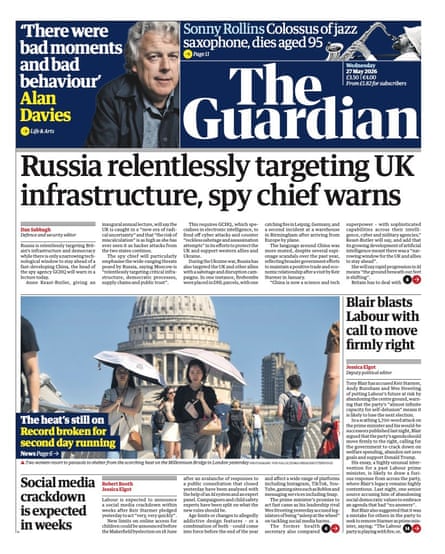
The Guardian’s splash today is “Russia relentlessly targeting UK infrastructure, spy chief warns”.
The Telegraph leads on “Blair: Starmer has no plan for Britain”, the Daily Mail’s take is “Now Blair savages Labour’s lurch to the left” and the Times says “Lurch to left puts Britain at risk, Blair tells Labour”. On the same topic the i Paper says “‘Britain at risk of becoming irrelevant’ – Blair turns on Labour rivals”.
Elsewhere, the FT says “BP unseats Manifold as chair after ‘serious concerns’ over his conduct”. The Express writes “Step up Keir to stop kids dying” and the Mirror leads on a case review of teenage rapists with the headline “The right decision”. Lastly, the Sun on calls to limit some water usage amid the heatwave says “Paddling fools!”
Today in Focus

Can dating reality shows ever be safe?
A BBC Panorama investigation recently reported that two women alleged they were raped by their on-screen “husbands” during the filming of Married at First Sight UK. A third woman, who agreed to be identified, Shona Manderson, accused her on-screen husband of subjecting her to a non-consensual sex act. All the men deny the allegations. Guardian investigations correspondent, Sirin Kale, talks about the “pressures and expectations” of the show.
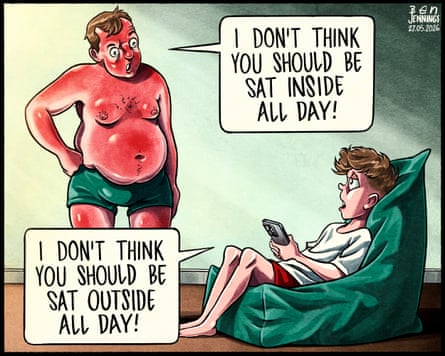
Cartoon of the day | Ben Jennings
The Upside
A bit of good news to remind you that the world’s not all bad
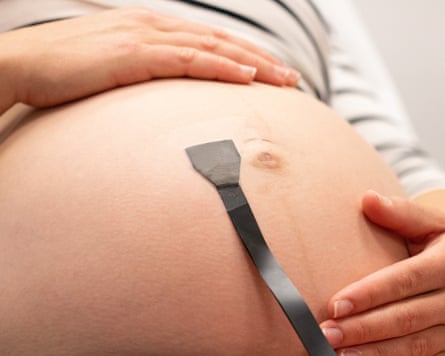
Scientists have created a wearable ultrasound patch, the “UPatch,” to monitor babies in the womb continuously. Prof Sheng Xu noted that current hospital devices only capture “a snapshot of what’s going on.” Although it is at present a proof-of-concept device, this new technology tracks fetal blood flow in real-time, even during movement. In one trial, it successfully identified severe growth restriction, “leading to caesarean delivery to prevent stillbirth.” Dr Antoniya Georgieva, a senior author of the study, believes the potential is “huge,” opening doors to understanding “what makes some babies survive and others not.”
Sign up here for a weekly roundup of The Upside, sent to you every Sunday
Bored at work?
And finally, the Guardian’s puzzles are here to keep you entertained throughout the day. Until tomorrow.