
Tens of thousands rally in Georgia to demand return to EU path
The demonstration marks two years since the Georgian government suspended EU accession efforts, triggering a wave of anti-government protests that have been met with an increasingly severe crackdown.
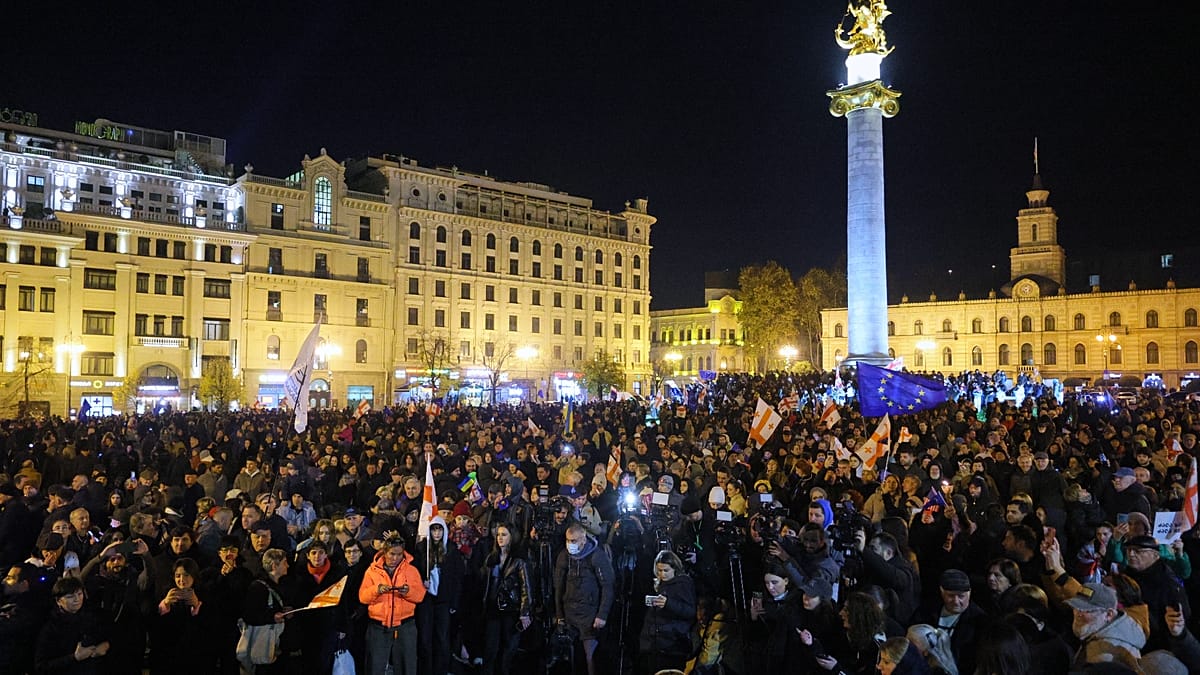
Tens of thousands of opposition supporters rallied in the Georgian capital Tbilisi on Saturday, marking the second anniversary of mass protests sparked by the government’s decision to suspend efforts to join the European Union.
Waving EU and Georgian flags, demonstrators filled the capital’s main square following a call to mobilise by pro-European activists and five opposition parties facing a government attempt to outlaw them.
The Black Sea nation has been gripped by political turmoil since disputed parliamentary elections in October 2024, in which the ruling Georgian Dream party tightened its grip on power.
Prime Minister Irakli Kobakhidze’s announcement a month later that his government would suspend EU accession efforts until at least 2028 triggered nationwide demonstrations that were met with a violent police crackdown.
Despite mass arrests, heavy fines and increasingly restrictive legislation, protesters have continued to take to the streets of Tbilisi daily, demanding fresh elections and the release of jailed demonstrators.
“We need to show that we won't bow to pressure and that we'll keep fighting for Georgia's European future for as long as it takes,” Natela Mujiri, a 48-year-old musician attending Saturday’s rally, told AFP.
Another demonstrator, 19-year-old student Giorgi Sartania, accused the government of isolating Georgia internationally.
“It's leading Georgia towards disaster. It has to go,” he told AFP.
Georgian government insists it remains committed to EU membership
Ahead of Saturday’s demonstration, organisers accused Georgian Dream of betraying the country’s European and Euro-Atlantic aspirations, which are enshrined in its constitution.
Kobakhidze insisted on Friday that his government remained committed to EU membership and was “ready to begin accession talks today”.
“Everything will be done to ensure that Georgia becomes a full-fledged member of the European Union,” he said in televised remarks.
“We hope that by then the EU will also change its approach and return to its traditional values.”
Georgian Dream has repeatedly accused Brussels of promoting liberal policies that it says undermine traditional family values, particularly through its support for LGBTQ+ rights.
Critics accuse the party, which has been in power since 2012, of steering the traditionally pro-Western country closer to Russia and eroding its democratic institutions.
The government, however, insists that its policies are designed to protect Georgia’s sovereignty against alleged foreign interference and attempts by the opposition to destabilise the country.
It insists it still wishes to continue its EU accession process, but with its own conditions.
Speaking at the Euronews Enlargement Summit on 3 November, Kobakhidze ruled out repealing controversial laws on foreign influence and NGO registration, arguing that Brussels’ demands amounted to interference in Georgia’s domestic affairs.
He also criticised the European Commission for what he described as double standards and political pressure, calling for greater respect for Georgia’s sovereignty and traditional values.
Georgia an EU candidate ‘only on paper’
Georgia was granted EU candidate status in December 2023, but its accession process effectively came to a halt the following year amid mounting concerns in Brussels over democratic backsliding.
In October, EU Enlargement Commissioner Marta Kos described Georgia as “a candidate country only on paper”, expressing regret that the country had fallen behind Moldova and Ukraine in its progress towards EU membership despite strong public support for European integration.
Brussels reiterated its concerns this month, describing Georgia as a candidate country “in name only” and pointing to the continuing deterioration of democratic standards.
EU membership remains enshrined in Georgia’s constitution and is supported by around 80% of the population, according to opinion polls.
Mounting pressure on opposition and civil society
Amnesty International said ahead of Saturday’s rally that thousands of protesters had faced arbitrary detention and fines over the past two years, with hundreds reporting torture or other ill-treatment.
More than 150 people have been imprisoned following what the rights organisation described as unfair and politically motivated trials.
Marking the second anniversary of the protests on 27 November, Amnesty International's Denis Krivosheev said: “What began as a crackdown on street protests has become a daily assault on fundamental rights and freedoms.”
Several prominent opposition leaders have been jailed, while the authorities have introduced sweeping legislation restricting the activities of independent media and civil society organisations.
Seven imprisoned protesters were pardoned earlier this week. Kobakhidze has said the authorities are prepared to release those who “show remorse and acknowledge their crimes”.
Last month, Georgia’s Constitutional Court began hearing a case brought by Georgian Dream seeking to ban five major opposition parties, which the ruling party accuses of attempting to undermine the constitutional order.
The court has until June 2027 to issue its ruling.
The European Parliament has condemned the proposed ban, warning that it would further distance Georgia from the EU.