Masters of Uzbekistan: how traditional crafts are passed on to new generations
Traditional workshops in Uzbekistan are teaching younger generations the skills behind woodcarving, embroidery and ceramics, while adapting their work to contemporary tastes and new opportunities.
A workshop can be a classroom, a workplace and a family archive. In Uzbekistan, traditional crafts are often learned through close work with experienced masters, with techniques passed from parents and grandparents to younger generations.
The process can take years. Apprentices begin with basic tasks and gradually learn how to handle materials, tools, patterns and techniques. For some families, the craft itself has continued through several generations. For others, workshops have become places where people can learn a profession and earn a living.
A fifth-generation woodcarver in Fergana
In Furqat district of the Fergana region, woodcarver Muhammadali Yunusov is continuing a family tradition that he says goes back five generations.
He began working independently at the age of 15 and later studied at vocational schools while developing his skills. Today, his sons work in the same field, making them the sixth generation of craftsmen in the family, while his grandchildren are also learning the trade.
Yunusov says his workshop has trained more than 2,000 apprentices. Many have worked with him on decorative woodcarving projects and the construction of traditional ayvons, open-air verandas with carved wooden elements.
For Yunusov, becoming a master begins with patience and determination. Some small areas of a carving can take an entire day to complete. Larger pieces may require weeks of work because the patterns are carved by hand using fine chisels known as ‘naqshqalam’.
The timber itself also requires preparation. Walnut, elm, mulberry and plane-tree wood can be soaked in water for six months or longer before being dried and processed. The wood is then cut into boards, dried again and shaped according to the final object, whether it is a gate, column, door or traditional wooden platform.
The workshop currently works with almost 100 apprentices.
Yunusov says the designs include geometric and Islamic patterns, with different forms carrying different meanings. He works in what he describes as the Fergana style, one of five major regional traditions of Uzbek craftsmanship, alongside Tashkent, Samarkand, Bukhara and Khorezm styles.
For him, the most valuable works are those designed to last for generations.
He is particularly interested in architectural elements such as ayvons and gates, which can remain part of a building for decades or centuries. In this way, the work of a master and his apprentices can become part of the physical history of a place.
Technology has also entered the workshop. Yunusov says artificial intelligence has helped him find references to designs and techniques that had become less familiar over time, providing new sources of inspiration.
A workshop creating jobs for women
In another Fergana workshop, traditional crafts are also being used as a source of employment.
Sadokat Mirzayeva runs a handicraft centre and educational institution where women and girls can learn different crafts while receiving support to find work.
The centre has trained more than 500 women and girls over six years. More than 100 now work with the enterprise, either from home or as permanent employees.
The artisans produce more than 100 types of products, including traditional dolls, folk toys, bags, headwear, chapan robes and other clothing. The products are supplied to tourist centres, regional markets and duty-free shops at Tashkent International Airport, and are exported to countries in Central Asia.
For Mirzayeva, preserving traditional craft is closely connected with creating opportunities for women to develop practical skills and earn an income.
The products are made using natural materials such as silk and cotton. Traditional embroidery, clothing and patterns remain central to the designs, while individual orders allow customers to request new products or adaptations.
The showroom brings these different forms of craft together, giving visitors an opportunity to see the work and the materials in one place.
Seven generations of ceramics in Tashkent
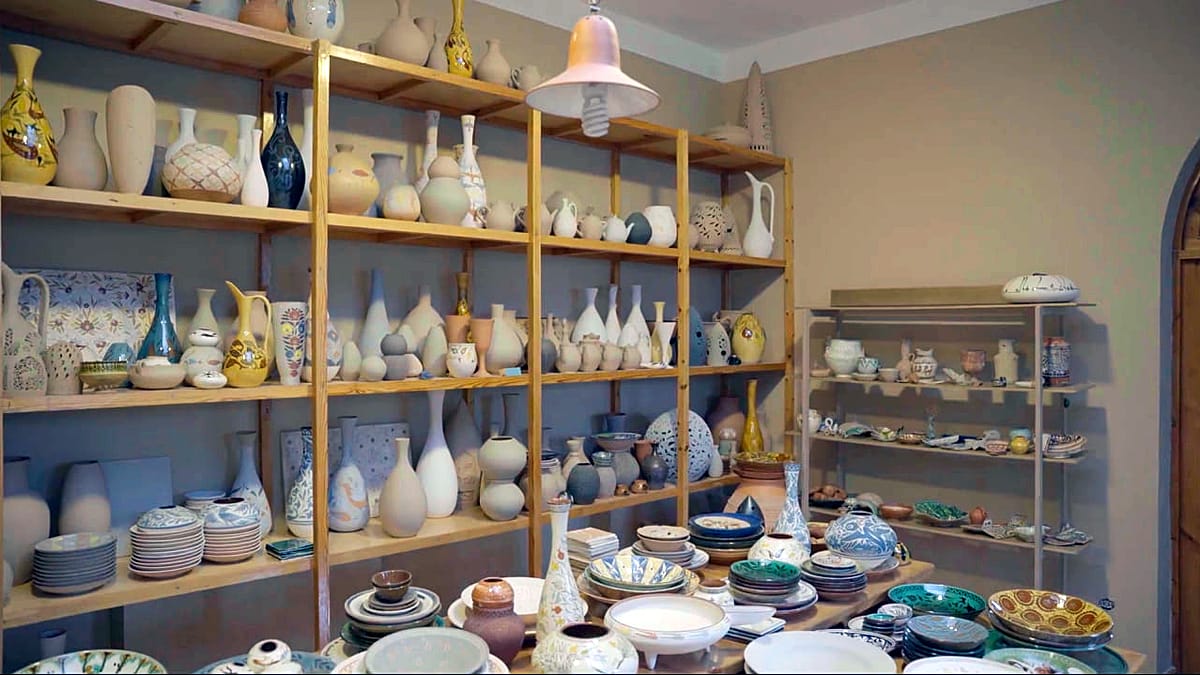
The final stop is Tashkent, where the Rakhimov family has worked with ceramics for seven generations.
For ceramist Shokhrukh Rakhimov, inheriting that knowledge comes with a responsibility. Each new generation first has to learn what came before and then develop its own ideas.
The family has its own visual identity, including a green-and-black colour combination associated with Tashkent ceramics. At the same time, Rakhimov says younger craftsmen need to experiment with new shapes and approaches.
He describes working with clay as a process of collaboration. Rather than completely controlling the material, the craftsman responds to how the clay behaves and gradually guides it towards the desired shape.
The family's ceramics also carry influences from different cultures and periods. Colours, ornaments and symbols can have particular meanings, with flowers, birds and fish appearing in designs associated with ideas such as paradise, freedom, happiness and life.
International exhibitions and biennials have given the workshop opportunities to work with artists from other countries and experiment with contemporary approaches while retaining traditional techniques.
But learning the craft remains a long process. Rakhimov says young apprentices may spend years learning how to maintain the studio and work with the tools before progressing to preparing clay, glazes and colours and eventually making their own pieces.
For him, patience is one of the essential qualities needed to continue the family tradition.
Learning the craft
The three workshops differ in their materials and techniques, but their approaches to teaching have something in common.
Yunusov says his father first taught him how to think, stay focused and approach a piece of work with determination. His apprentice, Samandar Tokhirov, joined the workshop at 14 and says his interest in woodcarving grew after he began learning from the master.
For Tokhirov, the next step is to work on larger and more complex pieces and introduce Uzbek traditions to a wider audience.
In the workshops of Fergana and Tashkent, traditional craftsmanship is therefore part of both family life and professional training. The techniques may be old, but the people learning them today are working with new technologies, markets and ideas.
Three workshops, three different crafts and one common lesson: mastery takes time. These traditions continue when someone is willing to learn them, practise them and pass them on.