How the deadly Nepal and Tibet flash flood unfolded – a visual guide
The massive glacial collapse that caused catastrophic flash floods in the Himalayan border region of Nepal and Tibet has killed at least 165 people, though the number of dead is set to rise, with local...
The massive glacial collapse that caused catastrophic flash floods in the Himalayan border region of Nepal and Tibet has killed at least 165 people, though the number of dead is set to rise, with local officials saying more than 1,000 were missing.
Officials said 826 people were missing in Nepal, among them 579 tourists from two dozen countries, including India, the US, Australia, Britain and Canada. Chinese state media said 558 people were missing in Tibet’s Gyirong county. It was not immediately clear if the missing counts were separate or some people been counted twice.
At 8.37am on Wednesday, an enormous section of a glacier in the Himalayas sheared free and crashed on to the valley floor in Nepal’s Langtang national park, about 60km north of the capital Kathmandu, near the mountainous Nepal-Tibet border.
Such was the force of the event, it was initially reported as a magnitude 4.4 earthquake. The United States Geological Survey later determined the tremor was caused by glacial rock and ice collapsing, registering a magnitude of 5.2.
The collapse triggered a huge release of water, mud, rock and ice that thundered down valleys and swept down the Lhende Khola, Bhote Koshi and Trishuli rivers.
The high-speed flash floods careered towards northern Nepalese towns, including areas popular with mountaineering tourists and pilgrims.
Horrifying videos from the Gyirong border post, which connects Nepal and Tibet, showed people running for their lives as the wall of debris obliterated buildings and swept away lines of buses.
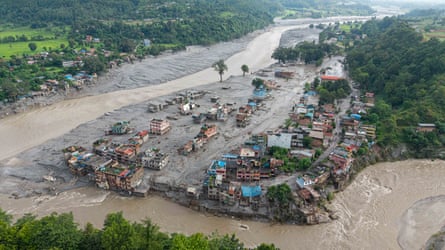
In Nepal, houses and roads were washed away in seconds.
“It was a huge gush of mud coming straight towards us. As it got closer, it kept rising higher and higher. When I saw it enter our home, I tried to grab my wife’s hand and take her to the terrace. But she was swept away by the mud,” said Keshav Prasad Baral, a 68-year-old survivor, who was being treated at a small hospital.
“Four or five hours later, a helicopter came to rescue me. My wife is still somewhere beneath the mud. She’s gone.” Another survivor described being saved by clinging to a mango tree as he watched the house where he had been working disappear.
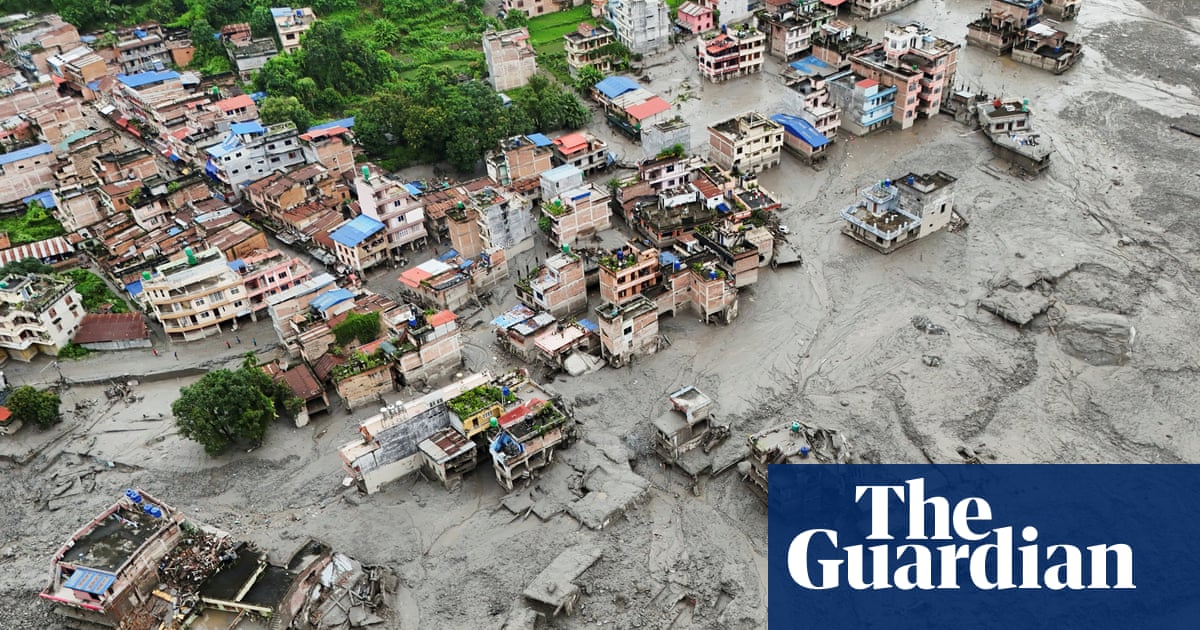
In a stark illustration of the deluge’s deadly power, a bridge crossing the Trishuli river was shown in a video being washed away in a tsunami-like flood. Multi-level homes were quickly submerged as the torrent gouged through the riverside town.
Bibek Kumal, a Nepali labourer, was working in Bidur when others sounded the alarm. “I started running. Then a wall of water came thundering down as if it was an earthquake,” Kumal said from his bed at Kathmandu’s National Trauma Centre.
The torrent swept him downstream amid mud and debris, but “luckily I was stuck up in a mango tree, he said. “Had there been no mango tree, I would have been washed away to death.”
At a location just north of Kumal’s lucky escape in Bidur, a video shows an immense flood swallowing a river valley as it surges towards Betrawati Bazaar, an important historical and pilgrimage town.
Mud and water moving at such high speeds forms a lethal combination “like liquid concrete,” said Hatim Sharif, a hydrologist at the University of Texas San Antonio, adding that it cannot be outrun.
Nepal’s tourism ministry said hundreds of people were believed to have been trekking in Rasuwa, one of the worst hit districts. Officials said 133 tourists from India and the Indian diaspora were missing, as they made their pilgrimage to Mount Kailash in Tibet, a sacred site for Hindus.
Rescue operations were difficult on Wednesday because of damage to infrastructure and higher than normal river levels. Helicopters could not land in Nepal’s affected areas of Syapru Besi and Timure in the Rasuwa region, which has a population of about 50,000.
Rescuers waded through mud and sludge, looking for survivors after flood waters buried the lower floors of multi-storey buildings.
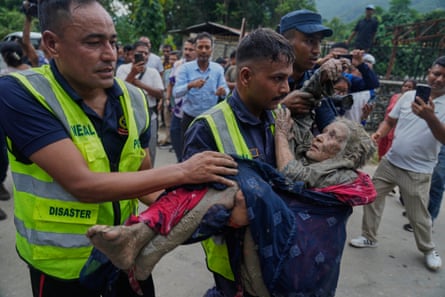
“There is devastation everywhere we look,” Tula Bahadur BK, a health worker in Rasuwa, told Reuters. “The settlements next to the river have been completely swept away. Five of my own relatives are missing.”
Dave Petley, an earth scientist with Nottingham Trent University, described the scale of the event as close to “apocalyptic”. The huge volume of water was possibly a combination of ice that converted to water as a result of the initial collapse and river water. But until the exact cause of the disaster could be confirmed by scientists, that was just speculation, he noted in the science outlet Eos.
The Himalayan mountain range spans several countries in South Asia and has many of the world’s highest peaks and remaining glaciers.
The steep slopes and the lush valleys below are especially vulnerable to flooding and landslides, and extreme weather events like intense monsoons and melting glaciers have become more common because of warming due to human-caused climate change.
Researchers in Kathmandu found earlier this year that glaciers across the Hindu Kush Himalaya region are melting faster, with ice loss rates doubling since 2000.
With Reuters and Associated Press