Fishing waste from as far away as US and Canada washes up on Portuguese beaches
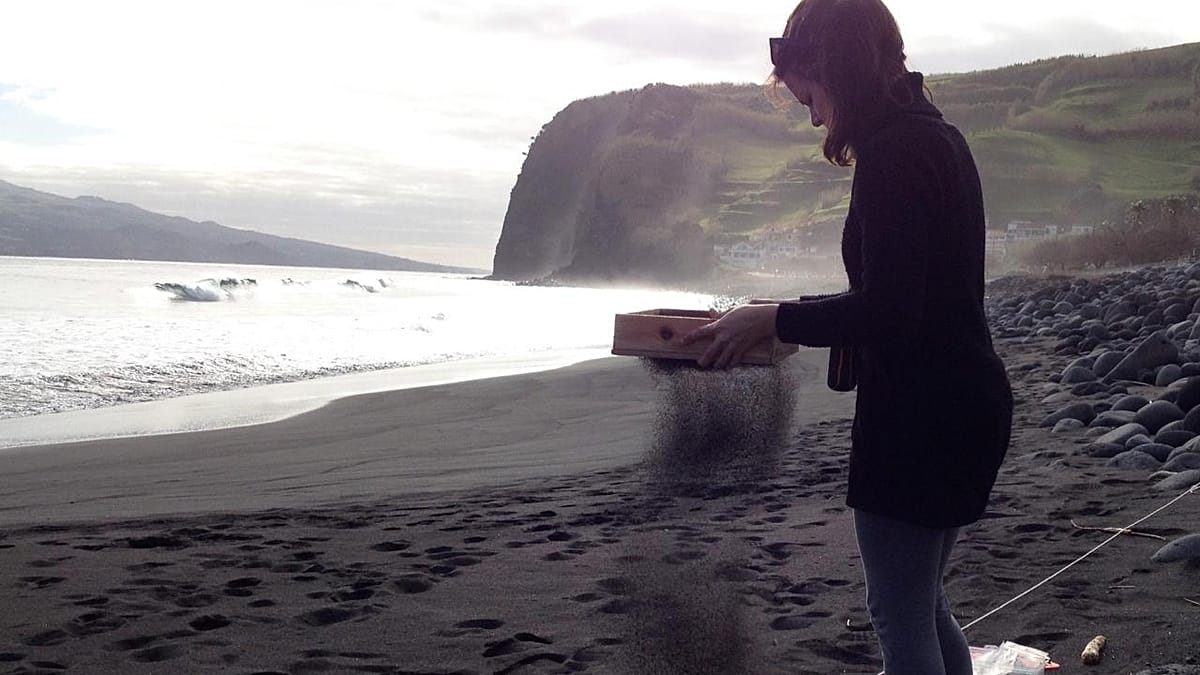
Since 2010, researchers at the University of the Azores have been monitoring waste brought in from the sea, until they began noticing the same objects appearing again and again. "We started to realise that...
Since 2010, researchers at the University of the Azores have been monitoring waste brought in from the sea, until they began noticing the same objects appearing again and again.
"We started to realise that these items, which at first we did not know where they came from, had certain numbers on them. And when we started to find quite a lot, we began trying to look up what they actually meant," explains Christopher Pham, researcher and head of the marine litter research group at the University of the Azores.
It turned out that the objects were coming from the lobster fishery, a sector with significant economic weight along the North American Atlantic coast. They also realised that the numbers printed on some of these plastics were mandatory tags that make it possible to identify their origin and date.
That is how a study involving scientists and volunteers began.
"We asked local people and colleagues that if they went to the beach and managed to find these items, they should bring them back," says Christopher Pham. "We had at least ten people who were very interested and kept sending us material every month."
Between 2017 and 2025, they found more than 1,500 items on the beaches of Faial and Pico.
These two islands are part of the Portuguese archipelago of the Azores, located in the middle of the Atlantic Ocean, about 1,600 km from mainland Europe.
Waste travels more than 3,000 km
These items are objects or fragments of objects that are placed in the sea to catch lobster, such as corners and clips from the pots (cage-like traps), funnels or tags.
The tags with legible inscriptions had their origin in the United States (63%) and Canada (37%). Within the United States, the tags referred mainly to the state of Maine (80%) and Massachusetts (11%). The tags from Canada refer to the province of Newfoundland and Labrador.
The study, published this summer, says it is an example 'of how an isolated oceanic archipelago is directly exposed to plastic waste from a coastal fishery that operates more than 3,000 km away'.
For waste to make the journey across the ocean from the North American coast to these Atlantic islands is not exactly a surprise to the researchers; it is more a confirmation. This movement of debris had already been suggested by models showing the behaviour of currents, winds and waves.
"We know there is that direct link and it was to be expected that we would receive particles from this part of the Atlantic, because the currents really circulate clockwise, from west to east," says Christopher Pham, explaining that this study validates those models.
And although this study is limited to the islands of Pico and Faial, this waste can travel much further, even all the way to mainland Europe.
"These lobster-fishing items are also quite frequent along the Portuguese coast and even in England and Ireland," adds the researcher.
More than 40 years in nature
The researchers were also able to determine the age of part of this waste because among it there are tags stamped with the year of registration.
Most of the tags are between 7 and 13 years old. The most recent dates from 2023 and the oldest from 1983, meaning it was put into the sea more than 40 years ago. This shows that these plastics can reach the Azores in just two years and then remain in the environment for many decades without breaking up.
"Most of the items entered the sea many years ago. That is also significant because it shows that plastic has enormous persistence in the environment", says Pham.
"It is very likely that, if we keep looking, we will find things that are perhaps even older. Because these tags are made from very high-quality plastic."
Access to this information was possible because this industry in North America requires this material to be tagged, even though the rules differ between the United States and Canada, for example in terms of the information provided and how long the tags remain valid.
More waste on Azores beaches
Lobster fishing is the most economically important fishing activity in the United States and Canada. In 2020, lobster exports from the two countries were worth around 1.74 billion euros.
Estimates suggest that every year three million pots (traps) are deployed off the coast of the United States and two million off Canada to catch these crustaceans.
But lobster fishing is not the only source of pollution on Azores beaches. There is other fishing-related waste on these beaches in the middle of the Atlantic, but it is less common and cannot be traced back to its source.
"We found trawl nets, but a trawl net can be used in Greenland or in Brazil. In those cases we no longer know where it comes from," explains Cristopher Pham.
"Sometimes we manage to find some pots that are typical of octopus fishing, but these traps are used from Spain all the way to Morocco; they are not as specific as in the case of lobster."
Other types of waste also wash up on these beaches, and they can come from anywhere.
"We almost never know the precise geographic location. Sometimes we have Chinese bottles, but we do not know if they come from China. They probably come from a Chinese ship that was offshore and threw the bottle into the sea," says Christopher.
Besides bottles, there are also cigarette butts, shoe soles and lighters. But the most common waste consists of small pieces of plastic, "a 2-centimetre white piece of plastic", fragments of an unrecognisable object.
"All these towns that are dumping huge amounts of plastic into streams," says Christopher Pham. "With sunlight and the action of the sea, it starts to fragment and then you get that soup of fragments that entered the sea many years ago but are no longer recognisable in their original form."
Tackling the problem at source
Only by knowing where these objects come from can we take measures at the source to solve the problem. That is why labelling fishing gear, as happens in the lobster industry, is so important.
The Food and Agriculture Organisation of the United Nations (FAO) has issued recommendations that gear used in fishing should be identifiable. The scientists at the University of the Azores stress how important it is to adopt this practice.
The team behind this study also has specific recommendations for the fishing industry in North America. These include better management of gear, incentives to hand in old material and the creation of collection points.
For these researchers, the next step is to carry out a more systematic analysis, in terms of the density and volume of waste from lobster fishing.
"To try to understand whether this is increasing or decreasing and what proportion it represents in the overall picture of plastic pollution – what contribution these items make," explains Christopher Pham.
But they believe the most important work has already been done: alerting the authorities in the United States and Canada, so that they act.
"It is important that you take action to reduce this flow of plastic into the sea, because people who have nothing to do with the pollution are becoming victims," Christopher Pham concludes.