The Rt Rev Lord Harries of Pentregarth obituary
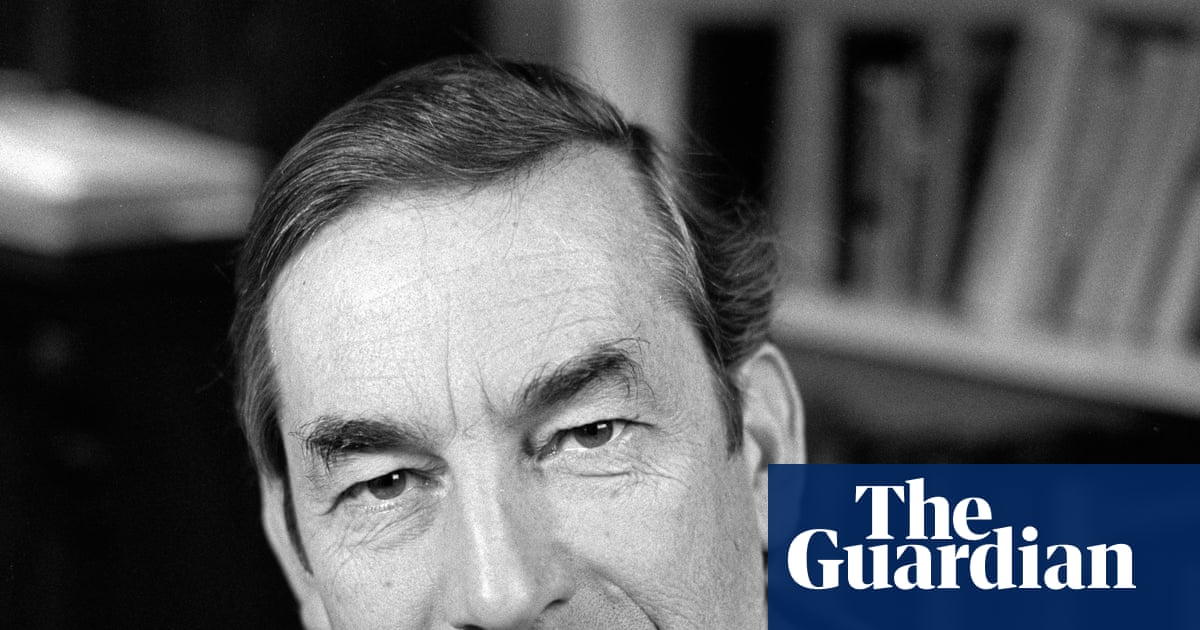
Richard Harries, Lord Harries of Pentregarth, who has died aged 89, was best known to millions of listeners to BBC Radio 4’s Today programme as one of the most esteemed contributors to its religious Thought...
Richard Harries, Lord Harries of Pentregarth, who has died aged 89, was best known to millions of listeners to BBC Radio 4’s Today programme as one of the most esteemed contributors to its religious Thought for the Day slot over 54 years. His brief three-minute talks to early-morning listeners – the last of them broadcast at the end of March, a few days before he fell ill on Easter Sunday – were invariably cogent, compulsive and challenging, gently spoken and often laced with literary allusions.
In that, he certainly reached a wider audience than even his many books of theology and culture, despite his career as a cleric, university dean and bishop of Oxford for 19 years – though he was admired within and beyond the Church of England for that too.
He was one of the most assured and thoughtful spokesmen for the liberal, progressive and sometimes embattled wing of the church in Britain. Rowan Williams, the former archbishop of Canterbury, once described him as “that rarity, a Christian public intellectual”. He was a lifelong reader of the Guardian, as it happens, as well as a regular contributor to it and other newspapers.
His causes, in favour of women’s ordination, opposition to homophobia in the church, for ethical investment, the promotion of interfaith relations, particularly with the Jewish community, and urgent exposition of just war theory, about which he had studied for a doctorate, were not knee-jerk or necessarily predictable, but deeply thought through – he was, for instance, in favour of Britain’s nuclear deterrent.
Perhaps that was unsurprising, because Harries’ original career had been in the army. He was the son of Brigadier William Harries and his wife, Greta (nee Bathurst-Brown), born in Eltham, south-east London, while his father was posted at Woolwich, and grew up peripatetically following his father’s career, including to the US during the second world war. He was sent to Wellington college, in Berkshire, traditionally a school for army officers’ sons, and then to Sandhurst military academy, after which he was commissioned in the Royal Corps of Signals.
The family was not particularly religious – Harries used to claim the only connection had been a relative who had run off with a clergyman – but his path to ordination was typically considered. It had been expected that he would study engineering at Cambridge, but his conversations with a fellow army recruit turned his mind towards religious belief. As he told the Times in 1989: “I used to go to church very occasionally, then suddenly I got the thought in my mind that if Christianity is true, it ought to be the centre of my life; if it is untrue, I ought to drop it altogether.
“I am naturally drawn to orthodoxy. I am not really interested in a particularly watered-down version of Christianity. That would strike me as rather bloodless. The only really interesting thing about religion is that it might be true … if it is not, it must be a sick phenomenon.” He believed there was a legitimate diversity of belief and described himself as “a liberal catholic, slightly on the conservative side”.
Accordingly, he wrote to Cambridge colleges asking to change course to theology, but only one, Selwyn, then offered him a place. On graduation he trained for ordination at Cuddesdon College, near Oxford, where Robert Runcie, the future archbishop of Canterbury, was principal. He served as curate at Hampstead parish church, in north London, becoming also chaplain at Westfield College (now part of Queen Mary University of London) and then lecturer at Wells Theological College in Somerset, and, after a merger, as warden of the new Salisbury and Wells Theological College. Back in London, from 1972 he was vicar for nine years of All Saints, Fulham, and from 1981 dean of King’s College London.
His appointment in 1987 to the Oxford diocese, undoubtedly encouraged by Runcie, was a popular one: already a broadcaster and author of books on prayer, Christianity and War in a Nuclear Age (1986), and articles on the ethics of conflict, he also had parochial and academic experience that made him a good fit for a large multicultural diocese with 500 clergy and three suffragan area bishoprics, a cathedral situated within one of the Oxford colleges, a car factory complex and a large rural hinterland. He proved to be not only an intellectual able to hold his own within the university, but also articulate, accessible and approachable – and a good manager and delegator.
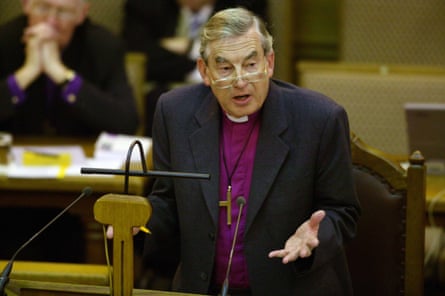
Although Harries occasionally courted controversy and lost – as when he and others took the church commissioners, responsible for administering the CofE’s finances, to the high court to get them to invest ethically, by disinvesting in apartheid South Africa, instead of maximising returns – he was also prepared to speak out when other bishops kept their heads down. His name was widely spoken of as a future archbishop, but it was never likely to happen while Margaret Thatcher was prime minister: she chose the evangelical George Carey when the time came instead.
Harries argued for the ordination of women and had little patience when evangelicals claimed that homosexuality was sinful, saying instead that being gay was as natural as having ginger hair.
That brought about the greatest controversy of his episcopacy, when he promoted the appointment of Jeffrey John, the gay albeit celibate dean of Southwark, to become suffragan bishop of Reading in 2003. Harries had proceeded carefully, winning the support of Rowan Williams, the newly appointed liberal archbishop of Canterbury, and taking soundings from the diocese about whether John, a noted theologian and preacher, would be acceptable because of his sexuality.
The announcement of the appointment (and its formal approval by Queen Elizabeth II) had unfortunate timing. Conservative evangelicals, with the support of some bishops, were looking for an issue over which to unite their flock and had lighted upon homosexuality, especially among the clergy, as a means to assert their authority within the church. It was a political decision even more than a theological one and John’s opponents called in support from conservative American Episcopalians and African archbishops, threatening worldwide schism in order to oppose the appointment to a minor bishopric in the south of England.
Williams backed down, John was forced to stand aside and Harries was left feeling, if not betrayed himself, certainly strongly disappointed. He said afterwards: “I believe Jeffrey John conformed to the church’s criteria. He is a very gifted person and certainly has the qualities to be a bishop.” John, whose tenure at Southwark had not been contentious, went on to be dean of St Alban’s without incurring further evangelical anathemas.
Harries retired as bishop in 2006 and, unusually, was immediately given a life peerage, choosing his title from the small Welsh village of Pentregarth, part of the seaside town of New Quay (Cei Newydd), Ceredigion, where his relatives had lived and the family holidayed. Although he spent little of his life there, Harries’s family background was Welsh and he supported the country’s rugby teams.
As a crossbencher in the Lords, he made frequent interventions on ethical issues. He opposed the Iraq war and served on church bodies including its board for social responsibility, the Council of Christian Action, and commissions and committees for reform on citizenship and civic engagement, on charities and interfaith relations. Articles and books continued to pour out, at least 35, including works on faith and art, literature and poetry and, in 2021, a memoir entitled The Shaping of a Soul.
Harries married Josephine Bottomley, a paediatrician, in 1963 and latterly cared for her for more than 10 years when she developed vascular dementia. She survives him, as do their two children, Mark and Clare, and four grandchildren, and his sister, Linda, and brother, Charles.