Von der Leyen warned about China. Europe didn't listen. Will it now?
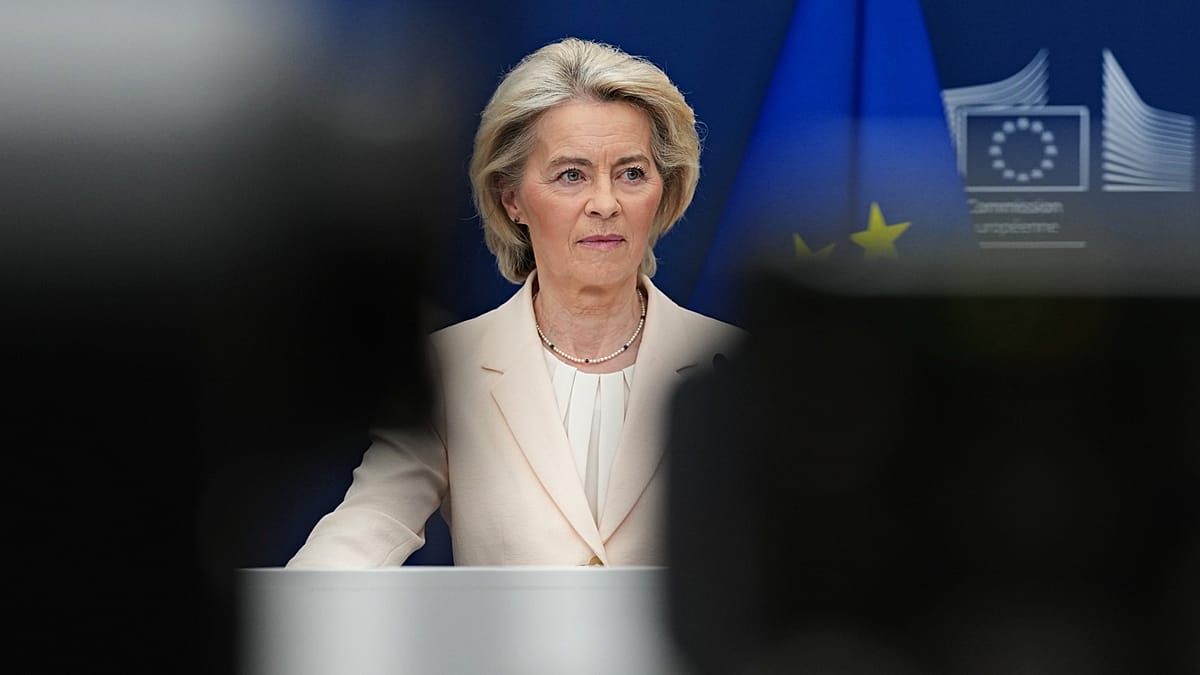
Three years ago, Ursula von der Leyen set an assertive tone in a landmark speech about EU-China relations. Today, she is on the verge of turning her words into action. But a formidable challenge remains in her way.
Out of all the speeches that Ursula von der Leyen has ever given, there is one that resonates to this day, perhaps louder than ever before.
More than three years ago, in March 2023, the president of the European Commission delivered a landmark, wide-ranging addressdissecting the state of EU-China relations, which she described as "the most intricate and important anywhere in the world".
Back then, it was rare for an EU leader to focus a public intervention exclusively on China, as Russia's war on Ukraine dominated the political agenda. In fact, von der Leyen devoted the first part of her address to castigating Chinese President Xi Jinping for his "no-limits friendship" with Russian President Vladimir Putin.
Her main grievances, though, lay on the economic front. Von der Leyen spoke at length about China's distorting subsidies, unfair competition, coercive practices, growing imbalances, forced technology transfers and monopoly of critical raw materials, all of which, she said, required a brand-new approach: de-risking.
These friction points are now at the centre of a fast-moving reckoning inside the Commission as the glut of low-cost imports from China strangles the European economy, destroys jobs and shuts down factories.
Fears of de-industrialisation, which are today widespread across Europe, were not explicitly featured in her speech, but the scope of the threat was made unequivocal.
"We can expect to see a clear path and push to make China less dependent on the world and the world more dependent on China," she said. "The imperative for security and control now trumps the logic of free markets and open trade."
The 36-minute-long speech was greeted by analysts and commentators, who praised it as a matter-of-fact, clear-eyed analysis, and excoriated by Chinese officials, who denounced it as misleading and incoherent.
But neither of them was von der Leyen's prime audience. Her words aimed at those who ultimately hold the cards: the member states.
"We need the collective will to respond together," she said.
Ironically, it was member states, caught up in their perennial disagreements over Beijing, that did the most to undercut her core messages.
Von der Leyen's plea to diversify trade was largely brushed off, worsening the lopsided trajectory that began during the COVID pandemic. 2025 marked the first time on record that every single member of the bloc posted a trade deficit with Beijing.
Governments never agreed on a common understanding of what de-risking meant in practice, with some shifting responsibility to private companies, which did not see the financial incentive of moving away from China and footing a higher bill.
Meanwhile, her call for a "bolder and faster" use of trade tools yielded mixed results.
On the one hand, the Commission succeeded in imposing extra tariffs on Chinese electric vehicles (EVs) after a contentious process that sharply split member states. Spain flipped from in favour to abstention after the prime minister visited Beijing. Von der Leyen's home country, Germany, moved aggressively to form a majority against.
The executive also unveiled initiatives to boost domestic production in certain sectors and exclude China's Huawei and ZTE from connectivity infrastructure.
On the other hand, the Commission failed to convince member states to grant it greater powers to control sensitive exports, which capitals jealously guard. Von der Leyen's economic security strategycame and went, and her eye-catching pitch for a new tool to screen outbound investment was abandoned amid political backlash.
The Anti-Coercion Instrument (ACI), partially designed with China in mind, has yet to be triggered despite von der Leyen herself openly accusing Beijing of blackmail.
"We've come late to the discussion," a diplomat admitted. "China has been thinking about economic security for 30 years. This is new for us."
The disunity trap
Admittedly, the big speech fell short of delivering. But the diagnosis has been retrospectively "vindicated", says Fabian Zuleeg, the chief executive of the European Policy Centre (EPC), who was in the front row when von der Leyen delivered the address.
"She recognised early that the relationship with China was no longer just about economic opportunity but also about vulnerabilities, dependencies and economic security risks," Zuleeg told Euronews.
"But being right in the analysis is not enough," he cautioned. "What Europe needs is strategic direction and consequential action. That is where progress has been more limited. The challenge has never been identifying the risks. It has been on agreeing what to do about them and being willing to bear the costs."
Some heeded the lessons, albeit with considerable delay. French President Emmanuel Macron and Belgian Prime Minister Bart De Wever are among those who have recently hardened their stance on China and urged stronger protective measures, echoing the assertive approach that von der Leyen introduced in her address.
The rhetorical shift has caught the Commission's attention.
EU officials hope the bloc's ballooning trade deficit will create an opening for a mightier and bolder strategy to contain China before the damage, already extensive and expensive, becomes irreversible. The executive is assessing the adequacy of existing trade weapons and the possibility of devising new ones.
"We want dialogue, but dialogue has to deliver. We like competition, but competition has to be fair. And we want access to the Chinese market that shows reciprocity," von der Leyen said this week. "It's a whole concept that we're working on."
Brussels, however, is well aware that the road ahead will be fraught with difficulties.
As the world's second-largest economy, Beijing holds enormous sway over EU countries, with billions in goods, services, investments and infrastructure projects at stake. Those that rely on exports see in the Chinese market a valuable alternative to the United States, where a 15% duty has made commerce considerably less attractive.
Germany and Spain are under particular scrutiny for their close business ties with China.
Berlin continues to send mixed signalsas it balances the interests of big and small companies, which feel exposure to China differently. Meanwhile, Madrid distanced itself from a draft document signed by France, Italy, the Netherlands and Lithuania calling on the Commission to "be more proactive" against China.
Von der Leyen and her team are also deeply wary of what she calls Beijing's "divide-and-conquer tactics", which have been credited with splitting member states to derail collective action. The messy vote on the EV tariffs is remembered as a case in point.
But if there is one thing that keeps governments awake at night and casts a shadow over von der Leyen's grand vision, it is the threat of painful reprisals. Beijing has pre-emptively warned it would "resolutely retaliate" if Brussels beefed up its response.
The EU is still reeling from the shock of last year's curbs on rare earth exports, when China proved to the world the power of its invaluable chokepoint. The way the country hit back at the US tariffs and held its ground until the White House gave in shows how far the Communist regime is willing to go when push comes to shove.
Privately, diplomats admit that the prospect of tit-for-tat is the root cause of the intractable divisions among the 27 leaders. Although they all agree with von der Leyen's grim diagnosis, they are still reluctant to apply the medicine she prescribed.
The fear of retaliation is such that leaders consistently avoid mentioning China by name in the joint conclusions of their regular summits. Instead, they tackle the topic as part of a wider point on geo-economics and competitiveness.
"Member states see the danger of moving individually against China and are happy to send the Commission to do the dirty work for them," a senior diplomat said, noting the alarming trade figures raise the odds, but not guarantee, of a new policy.
"It needs to be very carefully orchestrated."