Did Harold II take an arrow to the eye? We cannot be sure | Letters
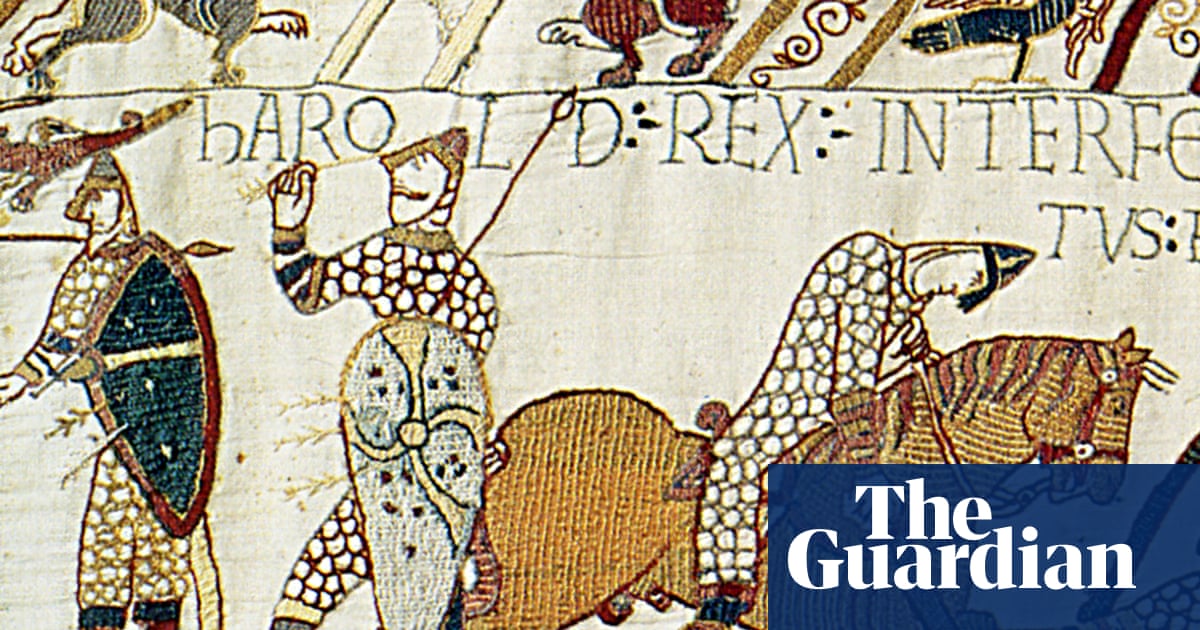
Your article on the loan of the Bayeux tapestry to the British Museum states with admirable caution that Harold II is “represented in his final scenes in the embroidery with an arrow in his eye” (‘Of course...
Your article on the loan of the Bayeux tapestry to the British Museum states with admirable caution that Harold II is “represented in his final scenes in the embroidery with an arrow in his eye” (‘Of course we will give it back’: Bayeux tapestry set for secret journey across Channel, 3 June). But was this always the case?
In 1816 the Society of Antiquaries sent their historical draughtsman Charles Stothard to draw the Bayeux tapestry. Where the threads had worn away, he put in the stitch holes. These plainly show the arrow in Harold’s helmet, not his eye.
A restoration in 1824 seems to have bent the arrow further towards Harold’s eye – because the story was so strongly established, even though the earliest accounts of the Battle of Hastings do not mention it.
In another part of the Bayeux tapestry, there is a figure in the lower margin who plainly does have an arrow in his eye. His mouth is open and his limbs are spread, as if he were screaming and flailing about. This is very different from Harold, who is calmly dealing with the arrow. The next image shows him being cut down by a Norman cavalryman – which would be easier had he been distracted by an arrow in his helmet.
Jane M Card
Harwell, Oxfordshire
Is the French minister of culture, Catherine Pégard, accurate in stating that the loan of the Bayeux tapestry would “allow the English people to contemplate on their own soil the act that was the birth of their nation”? If King Æthelstan could be contacted for comment, he may well demur.
Tim Wicks
Beaconsfield, Buckinghamshire
Catherine Pégard appears to think that the Norman conquest of 1066 was for “the English people … the birth of their nation”. This is utterly outrageous. Instead of the return of the Bayeux tapestry signalling a new era of mutual understanding between the French and the English, the old French prejudices are clearly alive and well. A little respect for our pre-1066 Anglo-Saxon culture, and the real origins of the English nation, would be welcome from our one-time invaders. Let’s hope that they learn a thing or two from the Sutton Hoo treasures.
Rev Dr John Caperon
Crowborough, East Sussex