Argentina waves football great Lionel Messi off after 3-0 win over Benin in final international appearance
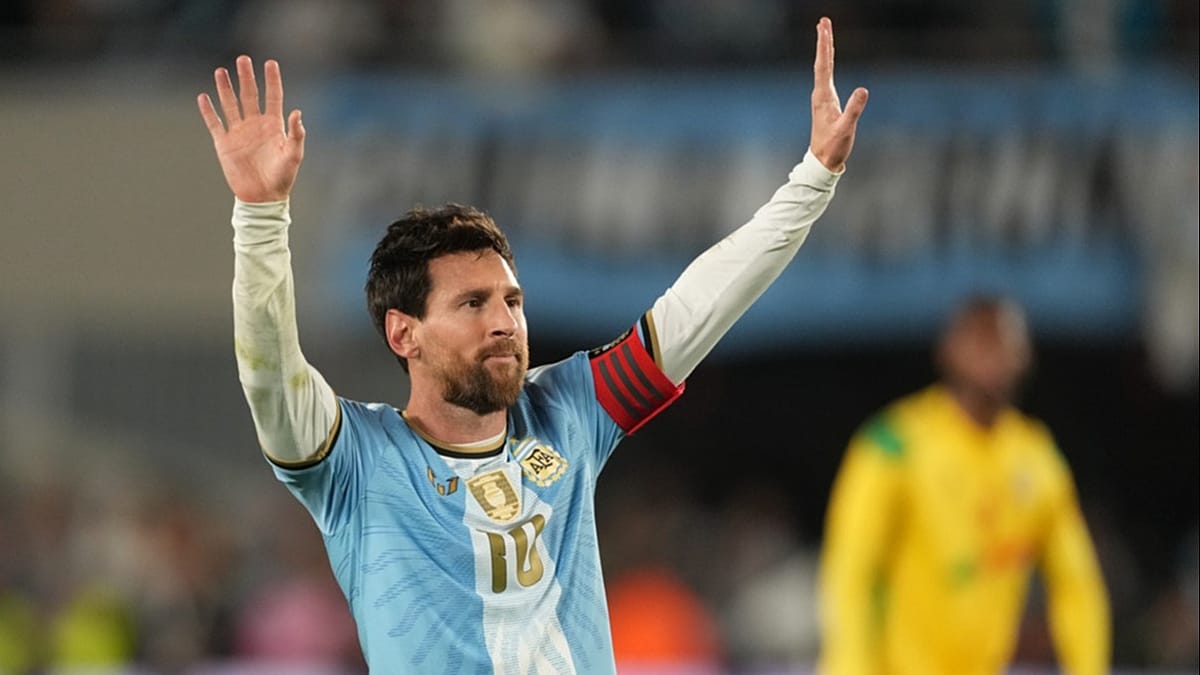
All-time footballing icon Lionel Messi bids an emotional farewell to international duty after guiding Argentina to a 3-0 win over visitors Benin in Buenos Aires. The little magician produced a final breathtaking performance for his white and blue stripes, scoring one goal and assisting two others.
Argentina is confronting a once-unimaginable reality; a national team without football great Lionel Messi.
On Tuesday, 39-year-old Messi bid farewell to international football after 21 years, 126 goals, two Copa Américas and a World Cup title, scoring a penalty and setting up Argentina’s other two goals for a 3-0 victory over visitors Benin.
What was otherwise an unremarkable friendly against the West African nation became a moment that this football-crazed country had long dreaded.
“It feels like an era is ending, knowing he won’t play for the national team anymore,” said Valentino Ruso, 17, who was heading to a friend’s house in Buenos Aires to watch the game. “I’m sad. I think everyone is upset today. He will be missed.”
Argentines had an intense, often unforgiving relationship with the shy boy who left his hometown of Rosario at 13 for the youth academy of Spanish club Barcelona.
As he grew into a global icon of near-mythical stature, his compatriots adored and abused him, sometimes questioning his commitment to his home country and accusing him of indifference to it.
But by the time he ended his dazzling international career, his devotion to Argentina was no longer in question. Nor was Argentina’s devotion to its most famous export, whose triumphs reminded the country of its capacity for greatness through years of political and economic instability.
“Argentines often say, ‘Thank God I was born at a time when I could experience the miracle of watching Messi play,’” said Andrés Rabinovich, a University of Chicago scholar who has researched football’s role in Argentine culture.
“It’s hard living in Argentina. football is often one of the few things that offers you some respite, some joy.”
For years, Argentines had debated when and how Messi should leave the world stage. His 31 August announcement that he’d be retiring from the national team, weeks after Argentina’s loss to Spain in the World Cup final, prompted an outpouring of gratitude and grief — even as Messi will continue to light up Major League Soccer with Inter Miami.
“I don’t know if there has ever been a love story between a player and a nation as great as the one you built,” his teammate Rodrigo De Paul wrote on Instagram.
The Argentine football federation turned Tuesday’s game — Messi’s 208th — into a national farewell billed as “the last tango.”
More than 85,000 tickets to Buenos Aires’ largest stadium sold out in 90 minutes, seats that were originally priced around $60-$300 (€53-267) later fetching over $2,500 (€2,226) on resale sites.
Players from Argentina’s 1978, 1986 and 2022 World Cup-winning squads returned to see him off.
After the final whistle, Messi’s eyes glistened as his teammates gathered around him, applauding. A rumbling chorus of “Olé, olé, olé, olé, Messi, Messi” rose from the stands as tens of thousands of fans jumped, sang and bowed toward him as if in worship.
A banner at midfield proclaimed him the "Eternal Captain.”
“The truth is, I'm talking more than I ever have. I don't want to leave here, I don't want to leave this field,” Messi told the crowd, which roared as if he had scored. “I just want to tell you that I love you, I'm going to miss you, and I'm grateful to God to be Argentine."
During the 2000s and 2010s, Messi amassed trophies with his club and won diehard fans from Barcelona to Bangladesh. Yet a major championship for his own country eluded him. After Argentina lost a third consecutive final in 2016, Messi briefly quit the national team.
The turning point came in 2021, when Argentina beat Brazil to win the Copa América, South America’s championship, for the first time in 28 years. Messi collapsed to the turf as his teammates, delirious, ran to hug him. The player long accused of feeling too little could not stop sobbing.
The World Cup victory the following year in Qatar sealed his place as a national hero. Messi had delivered the one prize that had eluded him, and millions of Argentines poured into the streets in collective ecstasy, his name in their chants and his No. 10 on their backs.
When Tuesday’s match finally ended, the crowd remained, their ovation roaring through the stadium. Messi took a final lap, a tiny figure beneath the lights, soaking it in. At the tunnel, he paused to lift his arms toward his fans one last time. Then he was gone.
His contract with Inter Miami runs through the 2028 season, but the ritual of watching him carry Argentina’s hopes and anxieties into every match is over.