Is curtailing AI an illusion for the EU, despite von der Leyen's pledge?
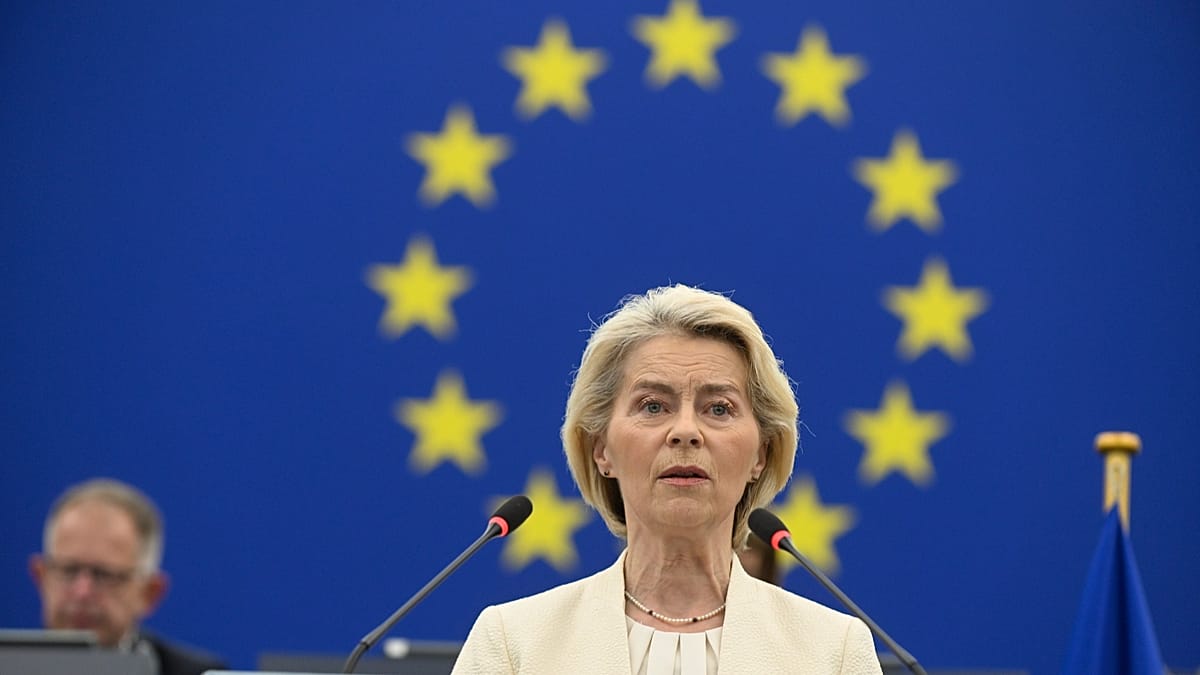
The European Commission president's vision of Europe shaping the AI race has drawn a mixed response from MEPs, with sceptics noting that most of the world's leading AI developers are based outside Europe.
Ursula von der Leyen wants the world to believe Brussels will set the pace of the rapid AI development that is threatening to reshape economies and labour markets, as well as security infrastructures, faster than governments can respond.
The trouble is, the EU is barely part of the race.
In her State of the European Union address this week, the European Commission president vowed that Europe would help write the rules for artificial intelligence, positioning the bloc as a rule-setter on a par with Washington and Beijing.
But the EU has no dominant model, no equivalent to OpenAI, Claude or DeepSeek, and precious little leverage over the companies actually building the technology.
Michael McNamara, an independent Irish MEP from the Renew group says Von der Leyen's pledge is little more than "lip-service" at the moment.
"Many of the most significant AI developers are outside of Europe, and will have little regard whatsoever to her comments," the MEP, who is co-chair of the European Parliament's working group on the implementation and enforcement of the AI Act, said.
McNamara pointed to what he calls a wildly inconsistent record from von der Leyen's Commission on AI safety.
It championed the AI Act, the bloc's risk-based rulebook for AI systems, and an AI Liability Directive, which would have made it easier to sue over AI-caused harm, in the last mandate, then withdrew the liability proposal in this one.
Later, it pushed to strip safeguards and pressured the Council and Parliament to carve entire sectors out of the AI Act during the recent Omnibus trilogues, only to reverse course again in the State of the European Union speech.
"Given the contradictory positions she has advanced in quick step, it’s hard to expect AI developers to pay much regard to her latest position," McNamara continued.
He did however agree with Von der Leyen's pledge to work with "like-minded partners like Canada, the United Kingdom and others, particularly on model evaluation, verification and security."
Meanwhile, Italian MEP Brando Benifei, who also co-chairs Parliament's AI working group and was co-rapporteur of the AI Act, praised von der Leyen, saying she is right to claim "the AI Act positions Europe to lead on AI safety".
"It binds every frontier model offered here, American or Chinese. Allied cooperation with Canada and the UK on safety is a welcome step that must be backed by sovereign capacity: European cloud, chips, unified capital, and a public CERN for AI to turn regulatory leadership into technological power."
Is the EU even part of the race?
In yesterday’s State of the European Union speech, Commission President Ursula von der Leyen set out EU plans for the AI industry and called for a slowdown in the development of AI models to “pace the frontier".
Her wording on the issue matches pleas issued by Anthropic’s Dario Amodei in an essay published earlier this week.
“If the people developing the technology are clear, then we should be too,” she told the European Parliament.
Europe currently lags behind the US and China in the AI race and in a number of ways.
The continent captures less than 5% of the estimated $1 trillion (€871.6tn) global AI investment, compared to 75-80% going to the US and another 10-14% to China.
Its only significant AI company, Mistral AI, is valued at just $24 billion (€20.9bn), a figure dwarfed by US firms OpenAI and Anthropic, each valued at $852 billion (€741.2bn) and $965 billion (€839.6bn) respectively.
Even China’s AI scene, which is more pluralistic than America’s, has market leaders such as DeepSeek, valued at $52 billion (€45.2bn), Moonshot AI, at $31.5 billion (€27.4bn) and Zhipu AI at $141 billion (€122.7bn).
The only area it can reasonably be argued that the EU is leading is regulation, with the introduction of the EU AI Act in 2024 and transparency and governance rules coming into effect in August this year.
The Commission president, however, believes the EU AI Act is “a crucial piece to putting guardrails in place” that “puts Europe in the position to shape global efforts on how to tackle this”.
She also announced that the EU would seek to work with its allies, including Canada, the United Kingdom and others. “We want to team up on model evaluation, verification, early warning, AI security and much more.”
Plans for talks in November with industry leaders, entrepreneurs and government officials to see how AI can be implemented in key sectors including health, transport, agri-food, advanced manufacturing and defence and space were also mentioned.
Von der Leyen also promised to table a "Quality Jobs Act" by the end of 2026, to "help develop skills, improve the quality of jobs and give workers a fair chance".