Europe's obsession with return hubs may not live up to the hype
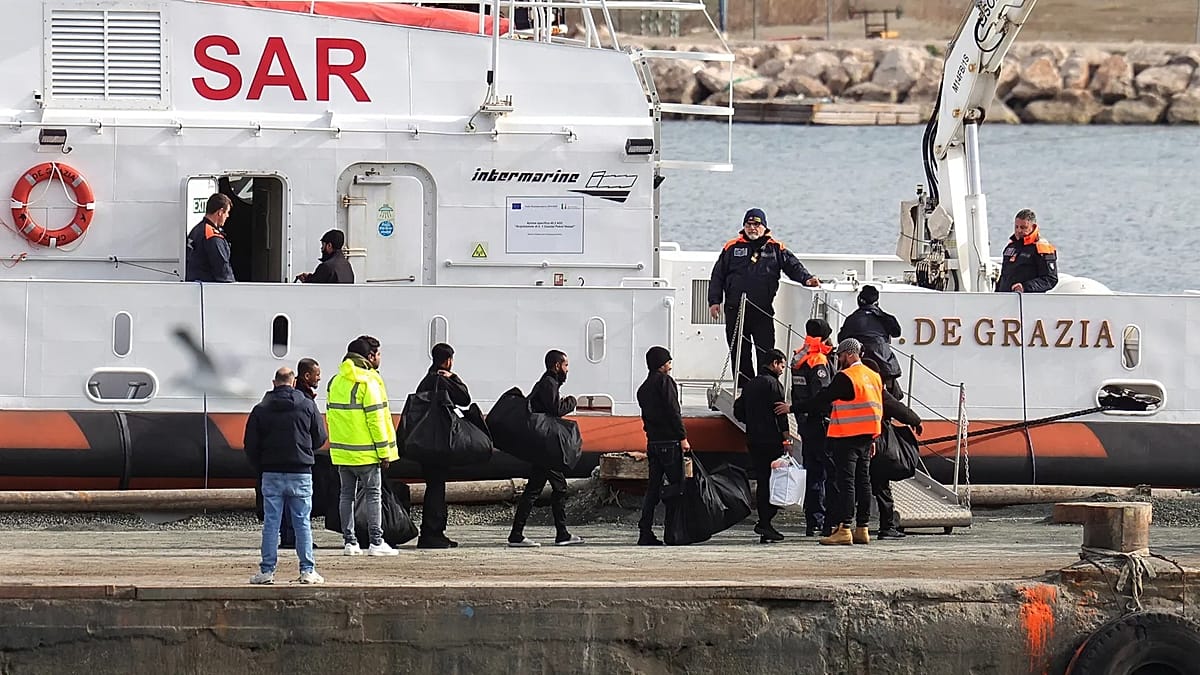
Five EU states are racing to build migrant 'return hubs' before new rules are put in place, with Uganda and Rwanda rumoured as the most likely sites – but recent cases point to significant legal and practical obstacles, while the actual numbers do not match the expectations.
The EU's migration policy has increasingly centred on the controversial notion of using "return hubs" to externalise irregular migrants to third countries, as enshrined in the recently adopted Return Regulation.
"We need to set up repatriation centres in third countries, as well as other innovative solutions outside Europe. We are working hard on this," Italian Prime Minister Giorgia Meloni and her Danish counterpart Mette Frederiksen wrote in a joint statement earlier this month.
Nineteen EU countries are convinced this is an "innovative solution" to pursue for migration management, as made clear in a joint letter sent to EU leaders last June, suggesting the centres would become a reality sooner rather than later.
A crucial debate on migration will take place at the next European Council summit, with return hubs set to be one of the main points of discussion.
Yet fundamental questions about how the policy would be implemented remain unanswered. How would return hubs work? Where would they be located? And which problems have they run into so far? Here, Euronews breaks down the main issues around the new migration mantra – and why the reality might not match the political narrative.
What are return hubs?
Return hubs are facilities in a "third country" – a non-EU country with which an EU member state has reached an agreement to transfer people even when they have no connection to that country. The people to be transferred will be those with no legal right to remain on European territory who are subject to a return decision.
Hubs can be either places of transit, where a person is placed waiting to be returned to their country of origin, or locations where a person is expected to stay with no guarantee of onward returns.
While the term “return hubs” is not specifically used in the text of the regulation, the law reframes an original proposal from the European Commission, outlining the conditions to set up centres outside the EU. Each hub requires “an agreement or arrangement” to be concluded by the EU, or one or more of its member states, with a non-EU country.
Italy has spearheaded this approach with Albania, where centres opened in October 2024 are used to house migrants rescued or intercepted at sea by Italian authorities. Rome is now pitching this as the model for the rest of the EU to follow.
Ironically, the Albanian facility is not technically a return hub. For one thing, it was meant to host only asylum seekers, externalising the asylum procedure, which was run by Italian authorities on Albanian soil.
After being confronted with legal challenges, in March 2025, the Meloni government turned the centre into a deportation hub for irregular migrants who had already received a return decision. This change made the Albanian facility an early precursor to a return hub, but it is still the Italian authorities who manage the centre and who are responsible for the migrants’ final repatriation.
The European model could yet go further and externalise the entire management and responsibility for the asylum and deportation process to a non-EU country.
Italy's processing and detention centres in Albania would need to be reconsidered once the country joins the EU. Albania is the second-closest candidate to accession after Montenegro.
Which countries are being considered?
The Return Regulation has been politically agreed, but the EU institutions still have to complete its formal adoption: the law has yet to enter into force, as it still has to be published in the bloc's Official Journal.
According to an EU official, the language of the regulation is undergoing legal review and the final adoption is likely to take place in the autumn.
Meanwhile, European governments have reportedly already been working to set up return hubs in third countries, negotiating either bilaterally or as a group.
Germany, Austria, Denmark, Greece and the Netherlands have confirmed they are negotiating the establishment of such facilities. Their goal is to have the first partnership agreed by the end of the year, to be signed in early 2027, a diplomat told Euronews. The European Commission is informed, but not involved.
According to Greek daily Kathimerini, the five EU countries are in advanced discussions with Uganda, aiming to make a facility operational by next year. The countries involved have declined to confirm this, citing the risk that media disclosures could harm the negotiations.
Rwanda is another African country under discussion with the group of five, according to Germany's Der Spiegel. Rwanda was also at the centre of a highly controversial and now abandoned UK scheme to relocate asylum seekers while their applications were processed.
Immigration ministers from the five countries are due to take stock of progress at a meeting in Copenhagen on 4 September.
In April, meanwhile, the Austrian government announced a migration and readmission agreement with Uzbekistan, which does not include a return hub. Media reports and national MPs have named the country as a potential location, but Uzbekistan's Ministry of Foreign Affairs denied it in a statement to Euronews, saying "there are currently no negotiations taking place on this matter".
What are the legal and practical problems?
In a letter published last month, the Council of Europe's Commissioner for Human Rights, Michael O'Flaherty, asked the five EU countries to ensure that "any relevant initiative be preceded by a comprehensive ex ante assessment of potential direct or indirect human rights risks associated with the proposed co-operation".
The Return Regulation does not explicitly require a human rights impact assessment, but it does state that "such an agreement or arrangement may only be concluded with a third country where international human rights standards and principles in accordance with international law, including the principle of non-refoulement, are respected".
In 2024, the EU Ombudsman criticised the Commission for signing a Memorandum of Understanding with Tunisia on border control and migration management without conducting a human rights impact assessment.
Even though the UK is no longer an EU member, the reasoning behind its Supreme Court ruling against the Rwanda asylum-transfer scheme in November 2023 is instructive: the court found Rwanda was not sufficiently safe given the risk of persecution or ill-treatment. The incoming Labour government abandoned the scheme as a result.
Meloni's own relocation scheme in Albania has run into similar judicial trouble, with Italian judges questioning the designation of countries such as Bangladesh and Egypt as "safe" – a designation Italian authorities had relied on to examine asylum applications through an accelerated procedure.
Crucially, the court cases stemming from the Albanian centres have now reached the EU Court of Justice, which has yet to rule on a central question: whether Italy can transfer someone subject to a detention order outside the EU.
Will the hubs work?
"A human rights assessment - that should be carried out for all this kind of agreements - takes time, whilst EU countries are rushing to sign agreements with third countries even when the rules are not yet in place," Sara Prestianni, advocacy director at the NGO Euromed Rights, told Euronews.
Prestianni described the countries being floated to host return hubs as "characterised by human rights violations" and questioned what methodology is being used to carry out the required human rights impact assessments.
Even so, transferring irregular migrants outside the EU's borders is likely to require lengthy negotiations with host countries, and past cases show legal challenges can easily sink the project if human rights safeguards are not in place.
"I definitely see questions as to what the third country might ask in return for hosting people who are not nationals of that country," Davide Colombi, researcher on migration at Brussels-based think tank CEPS, told Euronews.
In the meantime, relocating irregular migrants within the Union has proved far more straightforward, though this piles more pressure on frontline countries like Italy to uphold the country-of-first-arrival principle.
Advocates of the return-hub approach counter that the legal and practical obstacles are not insurmountable, and that European capitals simply need time to build a functioning system capable of removing irregular migrants once the hubs are operational.
But past cases raise doubts over whether reality will match ambition.
"The previous experiences of externalisation or offshoring of migration management have been extremely costly, legally contested, and operationally very limited," Colombi said.
Despite years of preparation and massive financial investment, a total of four people were voluntarily relocated from the UK to Rwanda before that scheme was scrapped. Italy initially projected housing around 3,000 migrants a month in its Albanian centres; the actual figure has reportedly been a mere 500 in total since the conversion into a deportation centre in March 2025.
The entire bill amounts to over €670 million, and according to a recent study from an Italian University, detaining migrants in these centres has proven much more expensive for Italy than hosting them on its own territory.