Bread, from dough to table – tracing a living tradition
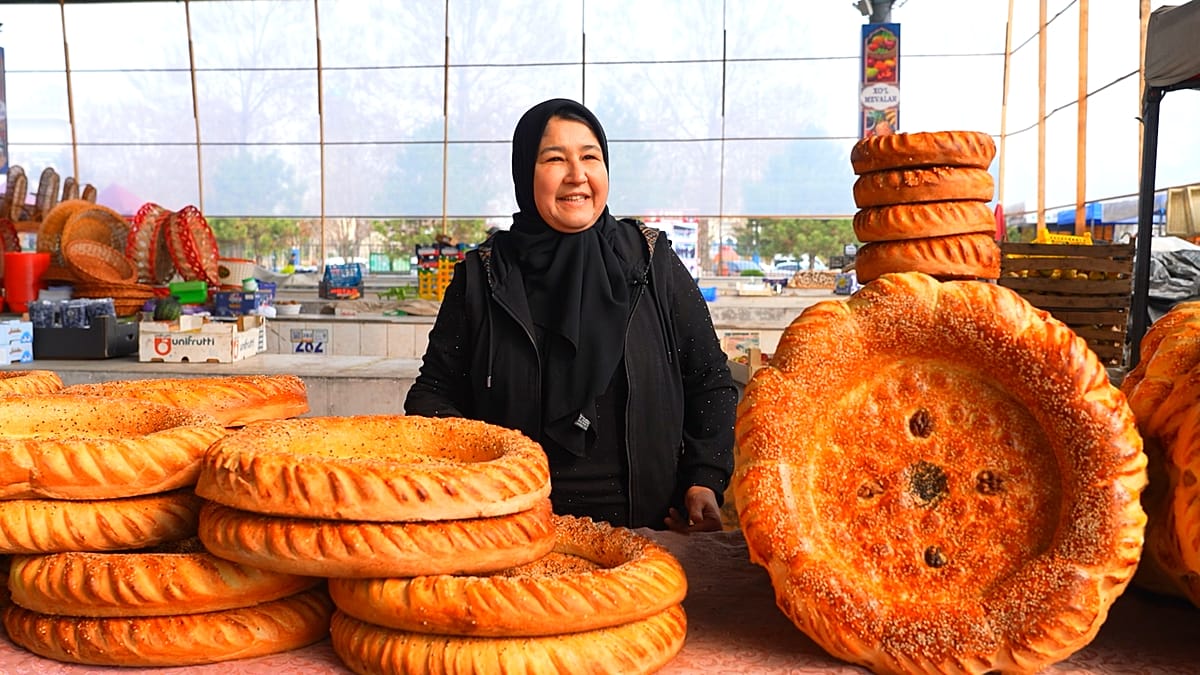
In Uzbekistan, bread is a symbol of life, respect and hospitality. No table is complete without it. Bread is treated with care, never wasted, and always shared. Across the country, each region has developed...
In Uzbekistan, bread is a symbol of life, respect and hospitality. No table is complete without it. Bread is treated with care, never wasted, and always shared.
Across the country, each region has developed its own varieties, shaped by local conditions, techniques and traditions. From dense loaves to lighter breads, each type carries its own identity.
Khiva and the craft of tandir baking
Our journey begins in Khiva, where bread-making remains closely tied to tradition.
Khorezm bread is thick and dense, baked in a tandir until the crust becomes crisp. Locals say it should never be cut with a knife, only broken by hand and shared.
The process follows several stages. The dough is first prepared, then divided and shaped. Patterns are stamped onto the surface before the bread is placed inside the tandir to bake. Once ready, it is carefully removed.
Baker Ayshajan Rakhmanova explains that each step requires attention.
“The process has several stages. First we prepare the dough, then divide and shape it. After that we stamp the pattern and bake it in the tandir,” she says.
She adds that Khorezm bread differs from other regions.
“Our bread is large and has its own taste. Recipes are different everywhere. We don’t add milk or oil inside, our method is different.”
While the process has evolved, its core remains unchanged. In the past, tandirs were heated with firewood. Today, many bakeries use gas to maintain a stable temperature, while preserving traditional methods.
Bread is prepared fresh every day, often in response to demand.
“We make different types depending on orders. Right now, we are preparing bread for weddings,” she says.
Much of the work remains manual, even as some stages such as mixing are supported by machines.
“What matters most is the baker’s hands,” she adds. “Bread must be made with care.”
A local product with strong demand
In Khiva, bakeries are found on nearly every street, many operating for decades. Baker Manzura Masharipova says Khorezm bread attracts both locals and visitors.
“Tourists come specifically to try our bread. Its taste is unique,” she says.
She explains that traditional methods shape both flavour and texture.
“We prepare the dough using fermentation, butter and sometimes milk. That’s why it tastes different.”
Demand remains high, and production is often limited.
“We don’t supply to shops. People come directly to the bakery. Once they try it, they come back again.”
For many, bread carries deeper meaning.
“For our people, bread is sacred. I cannot imagine life without it,” she says.
Samarkand and distinctive baking techniques
From Khiva, the journey continues to Samarkand, where bread has its own distinctive identity.
Fourth-generation baker Hamza Haydarov explains that both technique and environment influence the final product.
“Our bread has a special taste. Even after two or three days, it stays soft,” he says.
One key factor is fermentation. Some varieties, such as gallasio bread, are left to ferment for up to 12-13 hours before baking, resulting in a dense texture and rich flavour.
Other types require shorter fermentation, around three to five hours, producing lighter bread for everyday consumption.
Haydarov also highlights the role of local conditions.
“Climate is very important. People try to replicate this bread elsewhere, but the taste is never quite the same,” he explains.
Another distinctive feature is the use of water during baking.
“We apply water so the bread absorbs it and develops a shine. This helps create layers inside and improves the taste,” he says.
Production runs continuously, starting late at night and continuing throughout the day.
At a single location, more than 1,000 loaves can be produced daily. Despite demand, maintaining skilled labour remains a challenge.
“Training a baker takes time. It’s a profession that requires experience and responsibility,” he says.
Bread as a product and a gift
In local bazaars, bread is one of the most visible products. Seller Shoira Sharipova, who has worked in the trade for decades, says quality drives demand.
“Customers choose bread based on its colour, taste and quality,” she says.
Bread is also often bought as a gift.
“People take it to others because of its taste. We sell large, medium and small loaves,” she explains.
Some variations include milk and butter, adding richness to the flavour.
The Fergana Valley and ceremonial bread
Further east, in the Fergana Valley, bread plays a central role in daily life and ceremonies. In Andijan, patir bread is widely produced and used in family traditions.
Large and rich, often weighing several kilograms, patir is baked in tandir ovens and prepared in advance, sometimes overnight.
Seller Masudakhon Egamberiyeva explains that bread is closely tied to social customs.
“Patir is used during weddings and important family events. It is part of our traditions,” she says.
Preparation follows a structured process. Dough is made in the evening, shaped and decorated, then baked over several hours.
Because of its size and ingredients, patir remains fresh for an extended period when stored properly.
“It is made with milk and butter, which gives it a rich taste,” she adds.
For many families, bread is a constant presence, and customer Nargiza Abdurayimova says patir is part of everyday life.
“We always have it at home. Wherever we go, we take it with us so others can taste it,” she says.
Bread in daily life and tradition
Across regions, bread continues to reflect local identity through taste, texture and method.
Despite changes in technology, the core principles remain the same. Bread is made daily, shared widely and valued beyond its function as food.
It remains a living tradition, connecting everyday practice with cultural meaning across generations.