Will Cristiano Ronaldo finally win the World Cup?
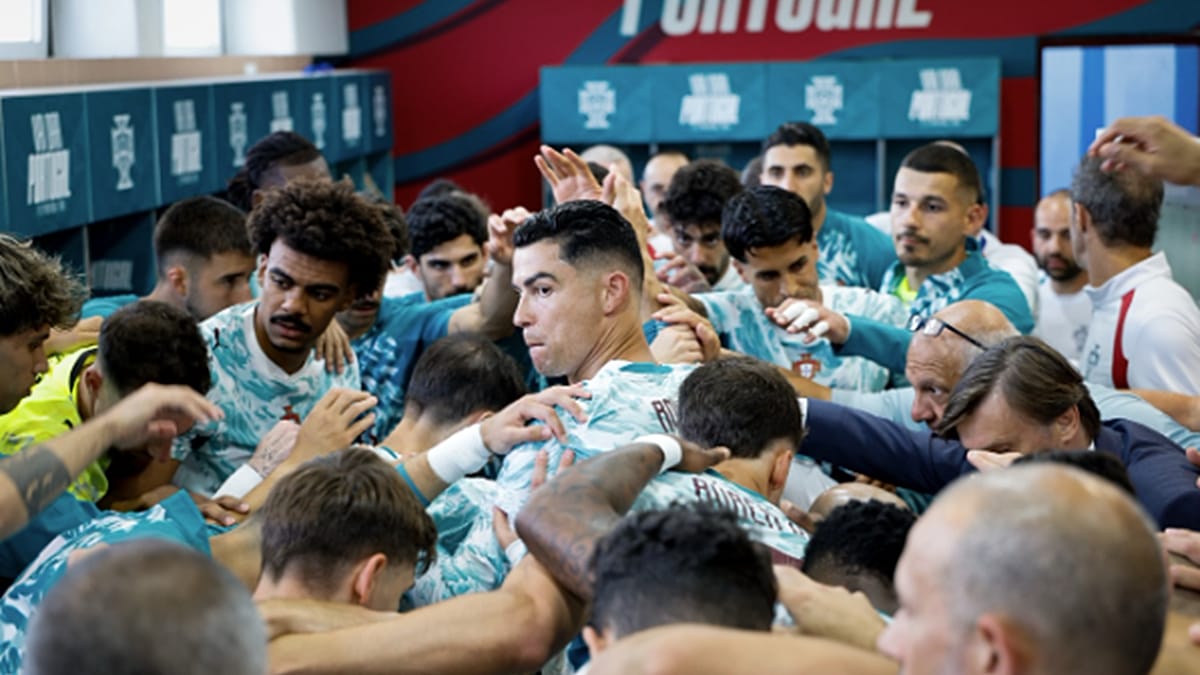
The Portuguese national team may have its best ever chance to claim a maiden World Cup title in 2026. Entering the tournament on the back of a second Nations League win and strong seasons for many of its...
The Portuguese national team may have its best ever chance to claim a maiden World Cup title in 2026.
Entering the tournament on the back of a second Nations League win and strong seasons for many of its stars, Portugal look likely to go far in the tournament, which is set to be Cristiano Ronaldo's final World Cup appearance.
"Vai Dar Portugal" (Portugal Will Do It) was the slogan chosen by the Portuguese Football Federation (FPF) in the build-up to the competition. The official campaign, unveiled at the end of March, shows the tugboat "Esperança" (Hope) navigating stormy seas, with references to the "unshakeable belief of the Portuguese".
"Come what may, whatever happens, we have never been this close." That is part of the message that accompanies the video and captures the optimism within the Portuguese camp.
Bernardo Silva, one of the 26 players called up by coach Roberto Martínez for the tournament, has embodied the team’s ambitious approach, insisting that Portugal will not be overawed by anyone.
"We’re confident, determined and we’re going there to win," the midfielder told reporters after a warm-up win against Chile in June. "There are other teams going with the same ambition and they’re neither more nor less of a favourite than we are," he added.
The coach has leaned on superstition to further feed this winning mentality, pointing to the symbolism of the number six, associated with Portugal’s most notable campaigns at major international tournaments.
In 1966, the "Magriços" led by Eusébio finished third at the World Cup in England, still Portugal’s best result, while the so‑called "golden generation", captained by Luís Figo, came fourth at the 2006 World Cup in Germany. Portuguese fans will be hoping that this year's tournament, another ending in a six, could therefore see another strong finish.
"I have great faith in numerology. I think the number six could bring something very special to the group," Roberto Martínez told RTP Notícias in May. Just to add to the drama, it also happens to be Cristiano Ronaldo’s sixth World Cup.
Brazilian Michael Bruno, known as the "World Cup Seer" for correctly predicting the winners of three of the last four World Cups, has also declared that Portugal will be world champions, beating Spain in the final scheduled for 19 July in MetLife stadium.
However much you read into such things, it has undoubtedly led to a buzz around the national side's chances.
The "golden generation" that, under Carlos Queiroz, won back‑to‑back Under‑20 World Cups (1989 and 1991), restored to Portuguese football an international profile not seen since Eusébio’s era, even if it ultimately fell short of a major senior title.
Fernando Couto, Figo, Rui Costa, Paulo Sousa and João Vieira Pinto stood out in a group that left its mark, but it still lacked the depth of the current side.
At the 2006 World Cup, even with some of those players already retired, the starting XI was solid: Ricardo Carvalho, a key figure in the Chelsea side that dominated the Premier League, marshalled the back line; the "magician" Deco, Spanish and European champion with Barcelona, orchestrated a team powered by a still‑developing but already central Cristiano Ronaldo at Manchester United and by the know‑how of Figo, who had just won Serie A with Inter.
However, in clashes with heavyweight opponents, limitations in several positions became evident. From 2010 onwards, Pepe’s intensity and mentality raised the national team’s competitive edge, helping to deliver the Euro 2016 title and the inaugural Nations League in 2019. Yet across the pitch, especially in attack, Portugal still lacked the squad depth to impose themselves on the world football's elite.
This was underlined by their exit in the last 16 of the 2018 World Cup in Russia in a 2–1 defeat to Uruguay, a side who were nowhere near the list of title contenders.
At the 2022 tournament, a generational transition was underway, with a number of young players picked who have since developed into stars at their club sides.
The squad
In goal is Diogo Costa, buoyed by his third league title with FC Porto. Accustomed to high‑pressure occasions, Portugal’s number one is also a penalty specialist. In 2024, he became the first goalkeeper in European Championship history to save three penalties in a shootout.
Pepe’s departure left a void at the back, but the team will be in capable hands with Gonçalo Inácio, a mainstay of a Sporting side that has recently dominated domestically, and Renato Veiga, one of the most used players at Villarreal, who finished third in La Liga, behind only Barcelona and Real Madrid.
Both played key roles in the victorious recent Nations League campaign and are emerging as reliable partners for defensive linchpin Rúben Dias, who is heading to his third World Cup.
In the full-back positions, Portugal boasts more aggression and attacking threat, with Nuno Mendes having made big strides since Qatar 2022.
He is now one of the starters at back‑to‑back European champions Paris Saint‑Germain (PSG), alongside star midfielders João Neves, making his World Cup debut, and Vitinha, who has developed into one of the most highly regarded players in world football.
In the final third, Francisco Conceição of Juventus, Francisco Trincão of Sporting, and Chelsea's Pedro Neto are new faces who bring the ability to unsettle defences and create chances. They strengthen an attack that this time includes a more mature Gonçalo Ramos, now established as a world‑class centre‑forward.
Portugal’s driving force lies in the centre of the pitch. Bernardo Silva, preparing for his third World Cup, continues to produce at a high level despite being in his thirties, with the ability to keep the ball under pressure in tight spaces, link the lines and dictate play.
He is an immensely valuable piece alongside Rúben Neves, a holding midfielder by trade who can also slot in at centre‑back and has the ability to come up with a goal.
With such a strong platform behind him, Bruno Fernandes will have the freedom to set his sights firmly on opposing goals. At 31, the Manchester United playmaker approaches his third World Cup on the back of what is arguably the best season of his career. He was voted best player in the latest Premier League campaign, in which he delivered 21 assists and created 32 chances.
João Neves, Vitinha and Bruno Fernandes complement each other well and have the tools to shape a team capable of imposing itself in possession and breaking down deep‑lying defences. The biggest question marks concern the forward line and the man on the bench.
The CR7 dilemma
The role of Cristiano Ronaldo, who has never scored in a World Cup knockout match, remains a sensitive issue. There is no denying that the captain’s longevity is remarkable, as reflected in the records he continues to amass.
On the road to Portugal’s ninth World Cup – their seventh in a row – CR7 scored five goals and cemented his status as the country’s most prolific player. In the home draw against Hungary, he netted a brace that made him all‑time top scorer in World Cup qualifying, with 41 goals.
Ronaldo is a man of milestones and is throwing everything at this tournament in a bid to complete his personal trophy collection. The competition in the Americas is, or appears to be, his last chance to get his hands on the most coveted trophy in international football – the only one missing from his cabinet – as he himself acknowledged at an event in Saudi Arabia last year.
This comes despite rumours that he could carry on playing in order to bow out of football, at 45, at the 2030 World Cup, co‑hosted by Portugal, alongside his son Cristiano Jr, who currently plays for Al Nassr’s under‑16s and already wears the Portuguese shirt at youth level.
The national coach himself does not rule out that scenario. "He’ll fight for it. I don’t think anyone should doubt that – he’s earned that right," Roberto Martínez told Spanish radio station Cadena SER a few weeks ago. Even so, that is a decision which may well end up being out of Ronaldo’s hands.
When Portugal lost to Morocco four years ago in Qatar, Cristiano Ronaldo seemed to have said farewell to the national team.
The frustration of a tournament in which he scored just once – from the penalty spot – in five games was amplified by the fact he started two matches on the bench. Against Switzerland in the last 16, Ronaldo’s absence went unnoticed, with the team storming to a 6–1 win on the back of a Gonçalo Ramos hat‑trick.
Everything pointed to the end of an era, but the appointment of Roberto Martínez in January 2023 marked a turning point in this story.
Under the Spaniard’s guidance, the Portuguese forward rebuilt his confidence and his hopes, scoring ten goals in nine games on the way to Euro 2024. It was the first time Portugal had qualified for a tournament with a perfect record of ten wins from ten.
Although the Euros proved a let‑down – Ronaldo failed to score and the team went out on penalties in the quarter‑finals – the triumphant Nations League run re‑energised the Madeira‑born star, who found the net in the semi‑final against Germany and the final against Spain.
Yet questions remain over the condition in which, at 41, he will be able to compete in the United States, Mexico and Canada. The captain has rejected suggestions of physical decline, but it is evident that his influence on the team’s overall play has diminished. The final World Cup qualifier, on 16 November, ended in Portugal’s biggest win of the campaign (9–1), and Ronaldo was not on the pitch.
His mobility is inevitably affected by age, but inside the box Cristiano still has his killer instinct and remains a threat to any opponent. The debate centres on whether Roberto Martínez will have the courage to leave him on the bench if his performances clearly fall short.
In the second and final World Cup warm‑up match, against Nigeria in Leiria, Martínez replaced every outfield player at half‑time except Cristiano Ronaldo. Previously, in the third group game at the Qatar World Cup against South Korea – with qualification already secured – he had also rotated almost the entire starting XI, keeping only Ronaldo in the line‑up.
Martínez’s past as Belgium coach is another source of scepticism for doubters. Even with talents such as Thibaut Courtois, Kevin De Bruyne, Eden Hazard and Romelu Lukaku, the Spaniard failed to win a major trophy with the so‑called golden generation of the Red Devils across three tournaments (2018 World Cup, Euro 2020 and 2022 World Cup).
For now, Portuguese fans prefer to focus on the positives – Martínez is the Portugal coach with the highest win percentage, and under him the team has its best ever goals‑per‑game average. The remaining question is whether he can pass the test of the latter stages on the biggest stages.
"When things start to get tough, that’s when we’ll see the real champions," Ronaldo told journalists before the squad’s departure for the United States.
Portugal’s World Cup group-stage fixtures:
17 June
Portugal - DR Congo 18:00 (19:00 CEST) Houston
23 June
Portugal - Uzbekistan 18:00 (19:00 CEST) Houston
28 June
Colombia - Portugal 00:30 (01:30 CEST) Miami