Extreme heat strains Italy's 'cheese banks,' where Parmigiano backs farm loans
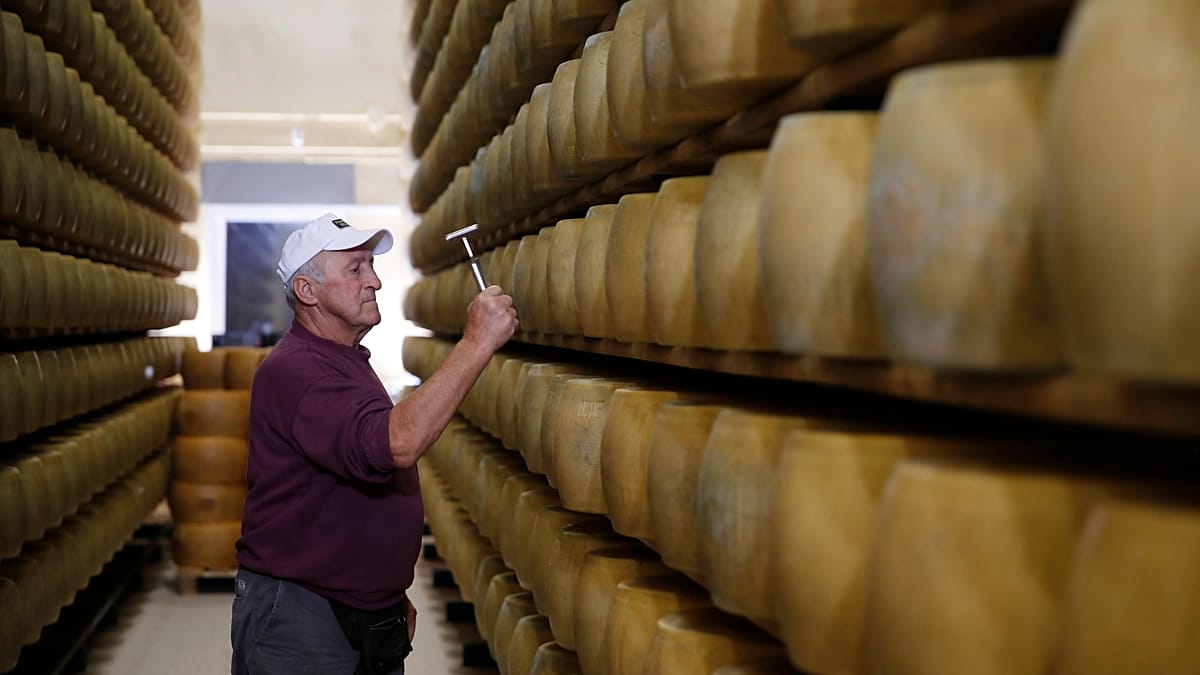
Extreme heat is squeezing Italy's "cheese banks", the climate-controlled vaults in Emilia-Romagna where hundreds of thousands of Parmigiano Reggiano wheels sit as collateral for farm loans, pushing up energy bills and thinning the milk supply that fills them.
Published on 11/08/2026 - 16:23 GMT+2
This summer's heat waves in northern Italy have reached an unlikely balance sheet, namely, the warehouses where regional lenders store ageing cheese as security for the money they advance to dairy farmers.
Credito Emiliano, known as Credem, has taken unmatured or young wheels of Parmigiano Reggiano as collateral since 1953. Its subsidiary, Magazzini Generali delle Tagliate, matures the cheese in Reggio Emilia and Modena, holding more than half a million wheels worth well over €300 million.
Producers receive 60% to 80% of a wheel's value upfront because Parmigiano must age at least 12 months and often 24 or 36, tying up cash small dairies cannot spare.
Blockchain now lets farmers pledge wheels while the cheese stays in their own facilities, doubling the bank's lending capacity.
However, keeping that inventory at the right temperature has become markedly riskier.
Daily power consumption at the vaults climbed roughly 30% at the peak of this year's heat, forcing the bank to upgrade cooling systems and boilers, add insulation and expand renewable power generation.
With wheels sometimes maturing for three years, every hot summer compounds the cost long before the cheese can be sold, and the summer of 2026 is tracking to be one of the hottest in Italy's recorded history.
Where the damage surfaces
The strain from the extreme heat begins in the barn.
Once temperatures top 40°C, cows lie down more and eat less, cutting milk yields by as much as 10%.
"Extreme heat impacts milk's quality and quantity," said Nicola Bertinelli, president of the Parmigiano Reggiano Consortium.
The rules leave little room for manoeuvre, the cheese may only be made in five provinces from cows fed on grass and hay grown there, so a dry season hits the feed and the herd.
The stakes are large, with Italy turning out 4.19 million wheels in 2025 representing a consumer turnover of around €4 billion, as per the Parmigiano Reggiano Consortium.
Economists say heat usually shows up this way, indirectly and with a lag.
R. Jisung Park, a labour economist at the Wharton School, said heat upstream produces "measurable downstream firm valuation impacts", the pattern visible when a hot spell in a cowshed becomes a cost problem for a bank months later.
A European Central Bank working paper published in March found the growth hit from extreme heat is smaller in Italy and Spain than in Germany, as southern economies are better adapted, but a modest headline figure can conceal sharp losses down the chain.