An influencer, a PR specialist and a bishop: Who are the latest EU-sanctioned disinformation actors?
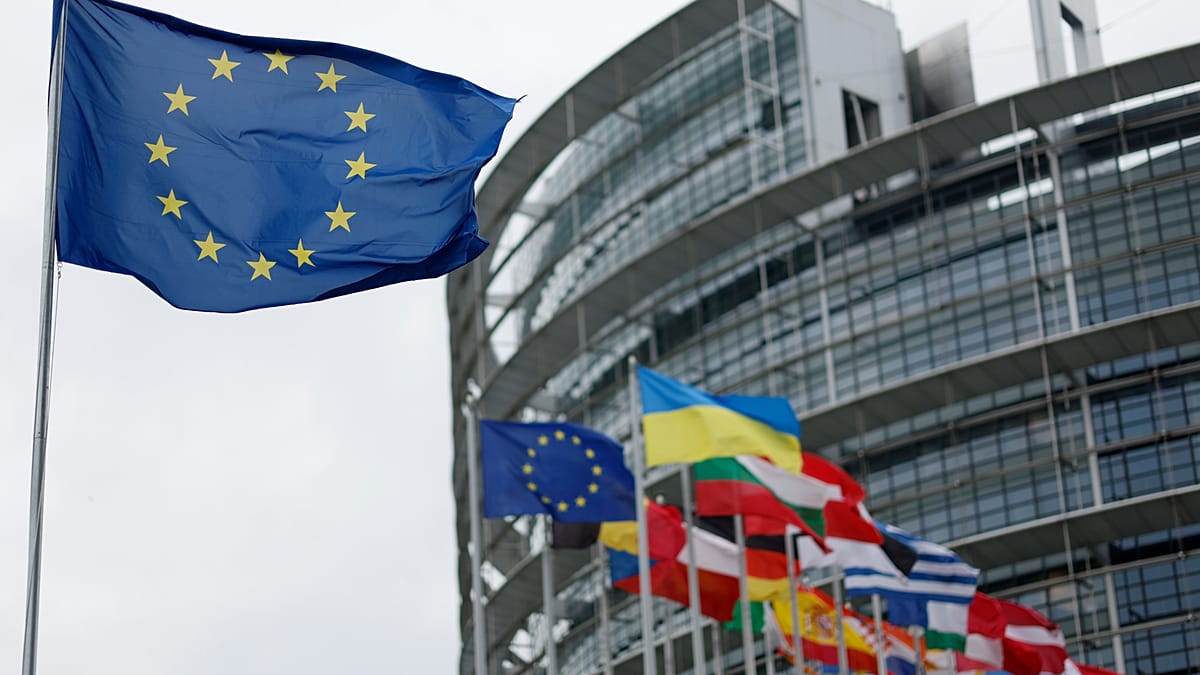
The Council of the European Union added a further 10 individuals and one entity to its sanctions list on 15 June, accusing them of conducting hybrid manipulation and foreign interference activities on behalf of Russia.
The Council of the European Union added 34 individuals and 47 entities to its sanctions list on 15 June — including 10 individuals and one entity accused of "spreading disinformation aimed at justifying, promoting or legitimising Russia's war of aggression against Ukraine."
In practice, this means their assets will be frozen, while EU citizens and companies will be forbidden from providing them with funds or financial assets.
At first glance, some of these individuals — such as Russian-American travel influencer Alexandra Jost — may strike observers as unconventional sanction targets.
Jost, who was born in Hong Kong, goes by the name Sasha Meets Russia on social media, where she shares content about Russian traditions and culture, alongside travel vlogs.
Yet, under this seemingly innocent veneer, she inserts pro-Russian propaganda and messaging, with the Council of the European Union stating that she "built an extensive base of followers under the guise of cultural coverage, while focusing on pro-war and pro-Kremlin propaganda with regard to Ukraine, and supporting the Kremlin's political establishment and the Russian armed forces."
Prior to the implementation of these recent sanctions, YouTube and Instagram took measures to shut down Jost's accounts on their platforms in March 2025, "in particular, she has been disseminating disinformation and supporting Russia's neo-colonial territorial claims about Ukraine and the military invasion of Ukraine."
"For example, when addressing Ukraine’s president, Volodymyr Zelenskyy, she claimed that Crimea is Russia and soon all of Ukraine will be too," the Council said.
On 15 June, Jost responded to the sanction measures in a video shared on X.
"They did include an interesting reason as to why they sanctioned me, and they wrote that I responded to Volodymyr Zelenskyy on X and said that Crimea is Russia and soon all of Ukraine will be too," she told her followers. "Okay, where is the lie in that? What about it?"
Other pro-Russian talking points relayed by Jost include references to the war in Ukraine as a "special military operation" — rather than Moscow's full-scale invasion.
On the fourth anniversary of the invasion, Jost took to X to spread similar statements, writing, "four years on, it has become clear to me that this conflict is no longer just about Russia vs Ukraine. It's about Good vs Evil. Morality vs Degeneracy. It's a war both on the physical and spiritual front."
"Together, we will stand strong. To defend, to deter, to defeat", she added.
In other posts, she also falsely claimed that, unlike Russia, Ukraine is a dictatorship.
"People love to tell me that I live in a 'dictatorship'. Yet Russia's president was elected, unlike neighbouring Ukraine, where elections are cancelled altogether…so which one's the dictatorship again?", she posted on 26 May.
Due to Russia's invasion, Ukraine is under martial law, and under Ukraine's constitution, the country cannot hold elections while that is the case.
In April 2025, Jost claimed on Telegram that she had never been paid to speak about her love for Russia and described herself as a patriot.
Yet, according to the EU, she produced content while being paid by TV-Novosti, the legal entity behind the EU-sanctioned Russian state media outlet Russia Today.
Jost's Instagram and YouTube channels were shut down in March 2025, making it more difficult for her to spread her messaging to Western audiences.
Other sanctioned individuals: A PR specialist and a bishop
Maria Dudko, the director of the Russian public relations firm "Limitless" (Bezgranichnye), is also among the individuals sanctioned by the European Union on 15 June.
Unlike influencers such as Alexandra Jost, Dudko operates behind the scenes to manage "Western influencers who echo Kremlin narratives and pro-war propaganda talking points, thereby destabilising Ukraine and Ukrainian allies by flooding the information space with disinformation", according to the Council of the European Union.
Dudko's organisation is funded by the Russian government through the Presidential Foundation for Cultural Initiatives — the latest sanctioned entity for foreign manipulation and interference operations.
Georgiy Shevkunov, who has been referred to as Putin's "personal confessor", was also sanctioned. A bishop of the Russian Orthodox Church,he is known as Tikhon Shevkunov.
The Council also stated that "Shevkunov systematically spreads pro-Kremlin disinformation, including claims of 'Nazism' in Ukraine. He also denies Ukraine's sovereignty, and justifies Russia's invasion of Ukraine as necessary, defensive and divinely sanctioned."
"Through sermons, media platforms, state-funded cultural projects, and direct fundraising for Russian troops in occupied Crimea, he promotes and enables Russia’s military actions," it added.