934 silver coins found: questions over Germany's biggest Roman hoard
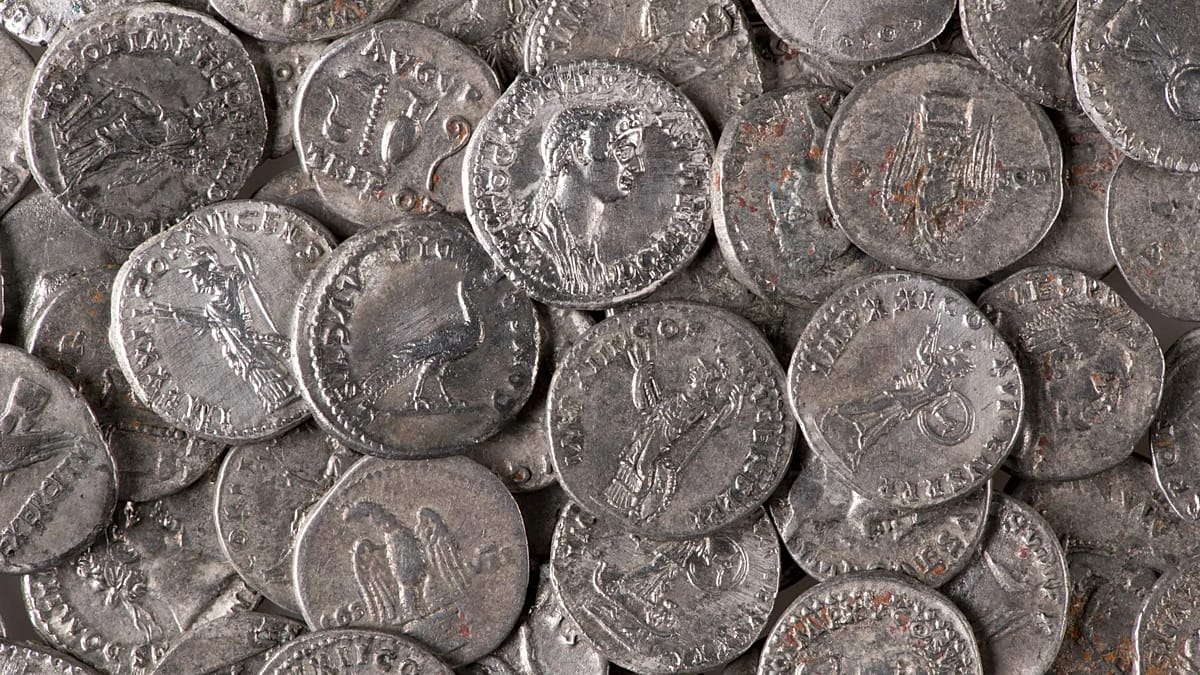
In autumn 2025, a father from the Rhineland only meant to briefly sleep a field near Wesseling, south of Cologne, with his metal detector. Then it became and he unearthed a Roman silver coin - and it was not the only one.
Published on 29 / 09 / 2026 - 6: 44 GMT + 2
It has probably been the finding of his life: the treasure-loving seeker, a father of the family of Renania, did not expect anything special that day when, suddenly, his metal detector sounded. He located a Roman coin of silver, then more. When he reached 15 pieces and the device continued to mark signs, he understood: "This is something greater."
What the archaeologists recovered then exceeded all expectations: 934 Roman silver denaries with a total weight of 3.1 kilos. The Landschaftsverband Rheinland (LVR) qualifies the finding as the greatest known numismatic treasure of the time of Emperor Adriano in the territory of today's Germany. All over the world there would be only four Roman monetary treasures of this time that are greater.
The site of the find is located in the south of Cologne, in a region that played an important role during the time of the Roman emperors. The nearby Colonia Claudia Ara Agrippinensium, the current Colonia, was then an important political, military and economic center on the banks of the Rhine.
A heritage that was probably transmitted for generations
The time arc that covers the coins is especially fascinating. The oldest dates from the year 148 a. C., that is, the time of the Roman Republic. The most recent one was coined in 124 / 125 d. C. Between both there are more than 270 years. When, probably in the second quarter of the second century, the treasure was buried, the oldest currency was already more than two and a half centuries and, apparently, remained valid as a means of payment. The finding thus illustrates the time that ancient pieces could remain in circulation in the Roman monetary system.
The value of the treasure is difficult to translate into monetary terms today. A reference is provided by the salary of a Roman legion: at that time a soldier received about 300 denariums per year, of which about half were retained for maintenance and equipment. To save a comparable amount, you would have had to book for about six years all your available income.
Why did he never recover the treasure?
Archaeologists consider that the money was deliberately buried to keep it safe. The person who hid him probably died before he could reveal someone where he was hiding.
The way the treasure has been recovered provides at least a few clues: some of the coins were moved in a compact block of land to the restoration workshop of the LVR-Landesmuseums Bonn. There, the X-rays revealed, among other elements, fragments of a ceramic container and straw remains. It all indicates that someone deposited the coins in a straw-padded container in his day.
Everything points to the fact that the heritage was accumulated around 100 d. C., but that it was not buried until several decades later, already during the reign of Emperor Adriano.
A brief journey to the time of the treasure: the Emperor Adriano (76-138 d. C.) ruled the Roman Empire from 117 to his death, at the age of 62. It is considered to be one of the so-called "five good emperors" and was committed to ensuring and consolidating the enormous empire. Adriano went through large areas of the territory, ordered to expand roads, temples and cities and is known especially for the Adriano wall in Britain, raised to protect the Roman border from the northern tribes.
However, his reign was not peaceful: between 132 and 135 took place in the Roman province of Judea, which was being extended by the present Israel and the Palestinian territories, an uprising against the rule of Rome. Under the leadership of Simon Bar Kokhba, Jewish rebels fought against the Roman troops. The revolt was crushed with great hardness by Rome.
The silver coins that this neighbor of Rhineland found now become the property of the North Rhine-Westphalia federal state, and the discoverer is expected to receive a reward.
Some of the coins were first presented to the public this September in Bonn. From March 2027 it is planned that the treasure will be displayed at the permanent archaeological exhibition of the Bonner LVR-LandesMuseums.