Behind the scenes: How the C8 summit and an oil deal exposed fragile Hungary-Ukraine ties
A dispute over Hungary’s role in Ukraine’s Carpathian Eight summit and the disclosure of an oil-storage deal between MOL and Naftogaz have further strained ties between Budapest and Kyiv, as a separate row over minority rights continues to hold up Ukraine’s EU accession talks.
A diplomatic dispute over Hungary’s participation in a Ukrainian-led regional summit, followed by the disclosure of an oil-storage agreement between Hungarian energy group MOL and Ukraine’s Naftogaz, has driven relations between Budapest and Kyiv to a new low.
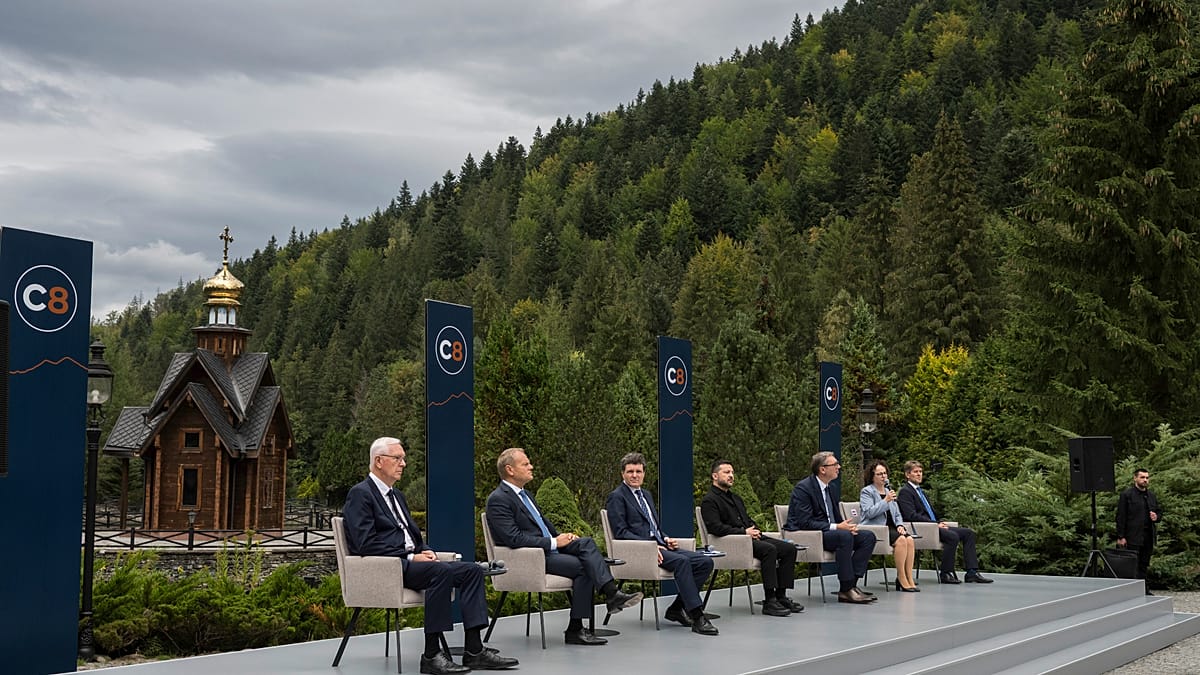
The Carpathian Eight (C8) summit, a new regional cooperation framework bringing together eight neighbouring countries, was held last week with the aim of strengthening investment and regional ties.
Instead, it reignited long-standing tensions between Hungary and Ukraine just as the two countries were working to repair relations and pave the way for Ukraine to open more negotiating chapters in its EU accession talks.
Both governments had hoped to ease tensions after years of hostility under Magyar's predecessor, Viktor Orbán, who built his election campaign on portraying Ukrainian President Volodymyr Zelenskyy as a threat.
Instead, Hungarian Prime Minister Péter Magyar and Ukrainian Foreign Minister Andrii Sybiha clashed publicly on X on Monday night. The Ukrainian foreign minister accused Magyar of following in Orbán’s footsteps after the Hungarian prime minister told parliament that Hungary had been added to the C8 initiative against its will.
"What we've been hearing from Budapest lately leaves us confused," Sybiha wrote. "It seems that while Viktor Orbán is gone, his policies of obstructionism and isolationism continue to thrive."
Magyar rejected the accusation.
"To claim that a sovereign country is a member of an international cooperation (Carpathian Integration) without prior consultation or consent of the country concerned is completely unacceptable," he replied.
The exchange made headlines in both countries. It marked a serious setback after months of work to repair ties and to allow Ukraine to open more negotiating chapters with the EU.
Carpathian Eight or Carpathian Seven?
Zelenskyy opened the summit last Thursday in Bukovel, Western Ukraine, with regional leaders including Polish Prime Minister Donald Tusk and Serbian President Aleksandar Vučić. He listed eight participating countries: Ukraine, Romania, Serbia, Poland, Slovakia, the Czech Republic, Austria and Hungary. But the family photo he posted showed only six foreign leaders, without Magyar.
Hungary was represented by its chargé d'affaires in Ukraine, a low-level diplomat, who did not sign the summit's closing statement. Kyiv nevertheless regarded the attendance as formal participation.
Ukraine had lobbied intensively for Magyar to attend and had invited him repeatedly.
"Very active consultations took place at the level of Foreign Ministers Andrii Sybiha and Anita Orbán, as well as at the level of our representatives in Brussels and between the capitals” a Ukrainian diplomat said, speaking on the condition of anonymity, because of the sensitivity of the matter.
The diplomat told Euronews that Kyiv considered Hungary a participating member because it was officially represented by a diplomat.
"They informed us in Budapest that they would be represented at this summit by the Chargé d'Affaires of the Hungarian Embassy in Ukraine. It is not a high-level representation – let's be frank, it is a low-level one – but they will be taking part" the source added.
A Hungarian diplomat involved in the preparations gave a different account, saying Budapest had made clear before the summit that Magyar would not attend and that Hungary did not consider itself a member of the initiative without the presence and signature of its leader.
"The story is about Ukrainians being unashamed. They were lobbying very hard in Budapest for weeks for Magyar's presence," the source said. "Magyar made it clear beforehand that he is not going. The membership is only approved by the presence of leaders and their signature. The Chargé d'Affaires was just an observer."
In Hungarian government circles, portraying the country as a C8 member was seen as a mistake, but Sybiha's comparison of Magyar with Orbán inflamed the situation. The Hungarian Foreign Ministry said in a statement to Euronews:
"Since taking office, the new Hungarian Government has repeatedly demonstrated its willingness to rebuild pragmatic, constructive and mutually respectful relations with Ukraine. Against that background, we do not believe that comparisons with the obstructionist policies of the previous Hungarian government are accurate or helpful."
The Hungarian diplomatic source said Magyar's government had no intention of harming Ukraine, and that the recent tensions had damaged bilateral ties.
"Now there is bad blood. Hungary does not want to harm Ukraine in any way; we understand that they are at war, and the situation today is much better compared to the Orbán era. What we have now, after the C8 mashup, is cold peace between the two countries. Under Orbán, we had a cold war."
Minority rights at the heart of the dispute
The row also revived a long-running dispute over the language and cultural rights of Ukraine’s Hungarian minority, which numbers around 100,000 people in the Transcarpathia region. Magyar, according to our sources, made it clear that he is only interested in the Carpathian summit if there is real progress on the minority file, which he could present as a success at home.
In June, Kyiv and Budapest agreed on an action plan to broaden minority rights. In response, Hungary approved the opening of two negotiating chapters in Ukraine's EU accession talks.
Since then, Budapest has blocked the opening of further clusters and is demanding that Ukraine's parliament, the Rada, adopt the relevant legislation. Under the joint action plan, the Rada must adopt the laws by the end of the year.
"The ball is in Ukraine's court. They need to solve the minority issue. If this law had been adopted earlier, Magyar could have been at the Carpathian summit," the Hungarian diplomatic source said.
Magyar and Zelenskyy had earlier planned a bilateral meeting, but Magyar made any meeting with the Ukrainian President conditional on the settlement of the minority legislation. After years of anti-Ukrainian campaigning in Hungary, conservative voters are still largely sceptical about fostering ties with Kyiv, but the promotion of the rights of Hungarians living abroad is very popular in the same segment.
Ukraine says it has already delivered on the minority issue by signing the joint declaration with Hungary.
"Ukraine considers that it has fulfilled its part of the agreement. And we expect that Hungary, as it promised, will fulfil its part of the agreement, which consists of unblocking all negotiation clusters with the European Union, rather than coming up with additional conditions on the go and inventing further obstacles as to why it cannot do so," the Ukrainian source told Euronews.
Oil storage row inflamed tensions
In addition, the disclosure of talks between MOL and Naftogaz on the sidelines of the summit quickly caused a political stir and prompted Magyar to respond.
On Saturday, the two companies signed a memorandum of understanding to explore storing Ukrainian crude oil at facilities in Hungary. The arrangement could benefit both sides: MOL has spare storage capacity, while Ukraine could protect its supplies from potential Russian strikes by storing them in a NATO member state.
Such memorandums are typically confidential, but Naftogaz disclosed the plans on its Telegram channel. Magyar, who had not been informed of the agreement, was caught off guard and reacted angrily, mostly because of political risks.
Orbán’s Fidesz opposition party quickly seized on the issue, accusing Magyar of putting Ukraine’s interests ahead of Hungary’s and jeopardising the country’s security.
"Under my government, no such storage will be built at the Hungarian-Ukrainian border, or anywhere else," the prime minister said on Monday.
He also warned MOL to consult the government before pursuing similar deals, noting that the Hungarian state holds a 25% stake in the company. "MOL's practice is completely unacceptable; from now on, I expect the company to treat the Hungarian state as a 25% owner. We'll see what the consequences of this will be," Magyar said.
MOL Group said in a statement to Euronews that the memorandum was part of normal business practice to explore potential opportunities.
"MOL Group, like many other industry players, has several non-binding memoranda of understanding in the energy sector. Such agreements typically represent the first step in exploring potential areas of cooperation and launching a preparatory process that may or may not lead to a concrete project," the group said.
MOL's spokesperson, Ambrus Halász, said it would consult the Hungarian government on any future steps.
"No decision has been made, and MOL fully understands the standpoint of the Hungarian Government. Should the preliminary assessments and feasibility studies move forward, and should the project receive the necessary support from relevant decision-makers, any subsequent steps would be taken in close consultation with all relevant stakeholders and Governments and in full compliance with the applicable regulatory framework," Halász told Euronews.
A Ukrainian source, speaking on condition of anonymity, argued that such deals would benefit Hungary as well.
"If Hungarian businesses see this value for themselves, then why is the Hungarian government stating so categorically and bluntly that they do not need it, that it is, in fact, incomprehensible, and that they do not wish to participate in it?"
Russian threats in the background
The risk of provoking Moscow and disrupting Hungary’s energy supplies may also be a factor behind Magyar’s firm opposition to storing Ukrainian oil in Hungary, according to sources with an overview of Hungary's energy policy.
Hungary and Slovakia still consume large volumes of Russian oil and gas through the Soviet-era pipeline network. Any cut in Russian supplies would push up prices in Hungary and could damage the government's support.
Responding to the MOL–Naftogaz memorandum, Igor Yushkov, a leading analyst at Russia's National Energy Security Fund, warned that it could trigger a cut-off.
"Theoretically, we could halt supplies, especially now that Hungary has seen a significant leadership change and maintaining diplomatic contact with the local government is becoming increasingly difficult," Yushkov said in an interview with Russia's Absatz Media. "A memorandum from the Hungarians in this context could serve as a trigger to halt domestic supplies to them."
Earlier this summer, Andrei Kolesnik, a member of Russia's State Duma, threatened Hungary with an energy blockade in response to a new Hungarian foreign policy doctrine that describes Russia as a security threat.
"I think oil and energy supplies to Hungary from Russia are now in doubt following such statements," Kolesnik told Gazeta.ru.
Ties between Budapest and Moscow, which were close under Orbán, have deteriorated quickly under the new government. Hungary expelled 10 Russian diplomats from the Russian embassy in Budapest for "unacceptable activities", which analysts largely regard as spying. Moscow promised strong countermeasures.
Last week, Hungarian Economy Minister István Kapitány said the country would be ready to decouple from Russian supplies within a year.
Dialogue to continue
Despite the latest tensions, both governments stressed their willingness to keep channels of dialogue open.
"Despite these statements, we still reiterate Ukraine's willingness and openness to developing mutually beneficial, pragmatic, and respectful bilateral cooperation with Hungary," Sybiha said.
Hungarian Foreign Minister Anita Orbán told Index.hu that she had resolved the misunderstandings surrounding the C8 summit with her Ukrainian counterpart in New York, and did not rule out Hungary joining the initiative at a later stage.