‘Canada is handing people over to ICE’: refugees rejected at border face US detention

As each day in US detention passes, Markens Appolon can feel the life he had dreamed of slipping away.The 25-year-old fled Haiti to escape the rampant gang violence that upended his university studies in...
As each day in US detention passes, Markens Appolon can feel the life he had dreamed of slipping away.
The 25-year-old fled Haiti to escape the rampant gang violence that upended his university studies in economics, and planned to join family in Montreal.
But for the last four and a half months, Appolon has been incarcerated in a US Immigration and Customs Enforcement (ICE) facility. He wonders how he would even begin to rebuild, if he is released.
“Every day that passes, my mental heath is just getting worse. You see the world going on and you’re just stuck here, watching,” he said. “I’m here, and even when I get out, the problem is going to be worse.”
Appolon had sought refugee in Canada, believing that it offered a haven to those at risk. The fact that he had Canadian family should have meant he was eligible to claim asylum. Yet it was Canadian officials who handed him over to the ICE agents who detained him.
“This is what is so shocking about this case and others like it,” said Erin Simpson, a Toronto-based immigration lawyer who is representing Appolon. “Canada is participating in this. Canada is handing people over to ICE.”

Simpson and other Canadian immigration lawyers say they have been inundated with cases like Appolon’s since the start of Donald Trump’s second term in office.
Refugees like Appolon attempt to claim asylum in Canada through an exception to the country’s Safe Third Country Agreement with the US. Under the agreement, refugees must seek asylum in the first “safe country” they arrive in.
But legal experts argue that the US should not be considered a safe third country. They argue that the country’s long-term detention of those seeking refuge and threats to deport asylum seekers to countries where they could be harmed or killed indicate that the US is not safe.
Meanwhile, Canada is tightening its own asylum system. New legislation enacted in March has created further ineligibility rules for refugee claimants, prompting critics to accuse Mark Carney’s government of introducing Trump-style immigration policies.
Refugees like Appolon remain jailed in the US “because Canada conducted proceedings at the border in a manner that was rigid and, frankly, unfair”, said Simpson.
“The consequences for him couldn’t be more serious,” she said.
Appolon fled Haiti in 2023 when the country was mired in devastating gang warfare, a political power vacuum, economic collapse and famine. He moved to Florida where he lived with an uncle on a special humanitarian visa program granted by the Biden administration that allowed him to work and study.
When Trump returned to power and threatened to end the program, Appolon decided to claim asylum in Canada.
A refugee attempting to enter Canada from the US must prove they have Canadian family members in the country to be allowed in. Otherwise, they are meant to make use of the US system.
Appolon reached the Quebec-Vermont border on 28 December, but was rejected and turned over to ICE. His aunt, a Canadian citizen, was temporarily out of the country for a family emergency, and border agents told him without her physically present in the country, he could not enter.
According to Simpson, Canadian border guards have been more lenient in previous cases and should have given Appolon’s aunt time to return. Canadian legislation does not specify that a relative must be physically in the country at the time a refugee is making a claim, she said.
Despite recent legislation, Canada still enjoys a global reputation as a welcoming country for refugees and immigrants. But the consequences for rejection have become more severe, according to several immigration lawyers.
While people seeking refugee status have in the past been turned away at the Canadian border, immigration lawyers say the situation has become significantly worse since Trump returned to power.
The Trump administration has created turmoil for those who previously entered the US before 2025 under humanitarian visas and other temporary immigration statuses that are now under threat.
As a result, more are considering Canada. This has prompted a tightening of controls at the border as Canada seeks to ward off a potential cascade of claims, even if the country is capable of receiving claimants.
Tenzin, a refugee from Tibet, said Canada’s willingness to send him into ICE incarceration seemed entirely antithetical to its international image. The 29-year-old tried to claim asylum in Canada at the US border in August. His Canadian family was waiting for his arrival.
“I thought Canadians are better than the US … but when I was treated like that, I thought there are some bad people in Canada,” he said.
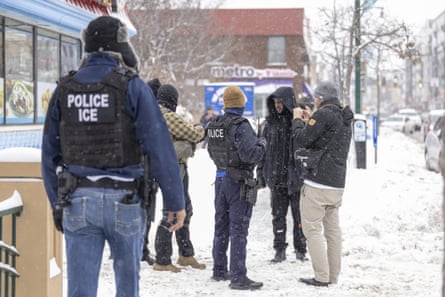
He was soon placed in ICE’s Buffalo facility. By December, Tenzin started to lose control of the muscles on the left side of his face.
After begging to be seen by a doctor for days, he said ICE agents finally took him to a hospital. His hands and ankles were handcuffed and he was transported in the middle of a snowstorm wearing a thin sweatsuit. The agents told him they had run out of coats.
A doctor diagnosed him with Bell’s palsy, an illness that causes sudden facial paralysis.
The Guardian is only using Tenzin’s first name as he fears that speaking publicly about his time in ICE detention will affect employment opportunities.
Heather Neufeld, an Ottawa immigration lawyer who represents Tenzin, said as a stateless refugee in Nepal, he did not qualify for travel documents. His only chance to leave Nepal was through obtaining a fraudulent passport from India in order to reach Canada from the US border.
When he tried to claim asylum, she said border officials refused to interview Tenzin’s family.
“The officer was not willing to consider the possibility that he really was a Tibetan refugee,” she said.
Neufeld was able to successfully argue that Tenzin’s treatment at the Canadian border was riddled with procedural. He was freed in February, and joined family in Toronto.
Canada could afford to take in many more refugees coming from the US, said Audrey Macklin, an immigration and refugee law professor at the University of Toronto.
Yet the country’s upholding of the Safe Third Country Agreement and the recent tightening of its asylum system shatters that image, she said.
“[Canada] constantly intones how generous it is to refugees,” she said. “But clearly, there’s no political will there,” she said.
Immigration, Refugees and Citizenship Canada, the federal department that manages the arrival of asylum seekers, said the US Safe Third Country Agreement was an “important tool for the orderly management of asylum claims”.
Canadian law requires a Safe Third Country to uphold a commitment to human rights. The agency said the US was “continuously monitored” to ensure it meets those standards.
Gurbir Singh said he fled India after receiving death threats from the police, and attempted to seek asylum in Canada on 25 March, planning to join family in Brampton, a city on the outskirts of Toronto.
But Canadian border officials did not believe he was Singh, despite his documents, and the fact that his fingerprints matched those already in the system. He was turned over to ICE and held in the agency’s Buffalo detention centre before Simpson managed to convince Canadian officials of his identity. He was released and allowed to enter Canada in late April.
“I’ve certainly never seen that. But we are seeing a real rigidity in the exceptions at the border and a real failure to recognize the extraordinary cost of erroneous decision making,” said Simpson.
“I felt that Canada is known for its human rights. But they did not give me any rights … they said ‘you cannot stay here,’” said Singh.
Canadian Border Service Agency, the federal organization responsible for border control, said it could not comment on Appolon, Tenzin and Singh’s cases due to privacy concerns. But it maintained that border services officers process claims “impartially” and that claimants “understand their rights”.
Refugees are responsible for proving their eligibility to enter Canada, the agency said. Border officials must be “satisfied” that it is “more likely than not that a family relationship exists”.
The spokesperson said CBSA agents can reconsider a refugee’s claim in “exceptional” cases.
US ICE did not respond to a request for comment.