Ebola: Uganda restricts travel as Nigerian case evacuated to Europe
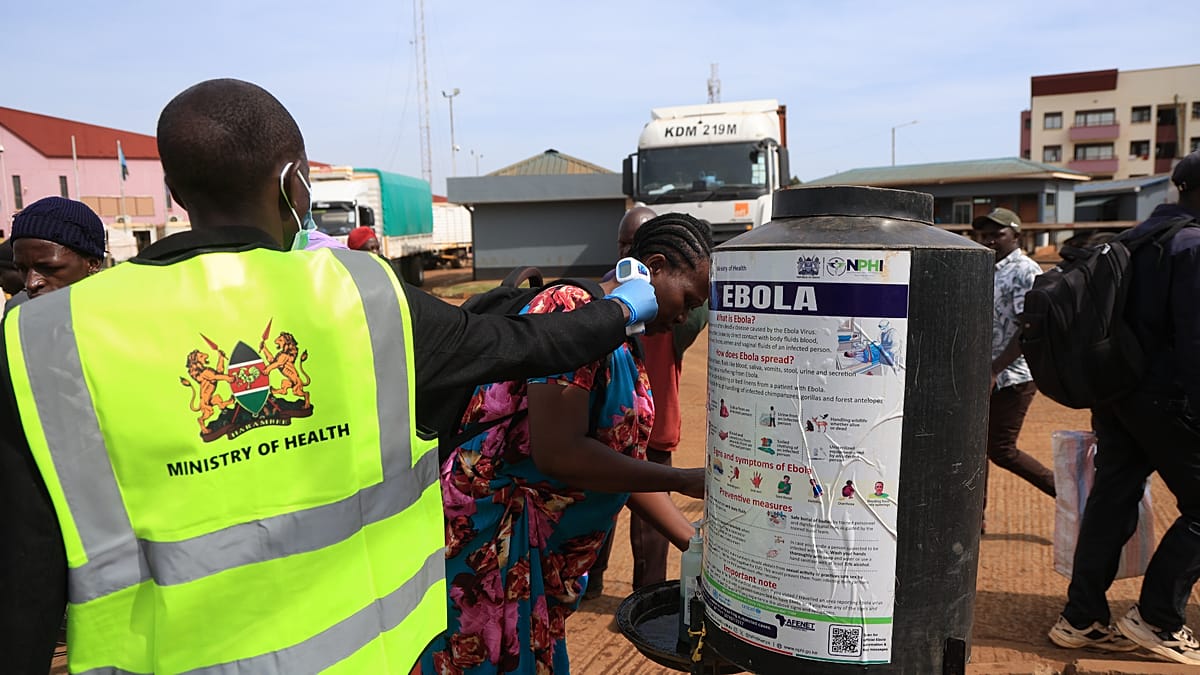
The Ebola outbreak that began in the Democratic Republic of Congo in May, now the fastest-growing and most widespread on record, has caused nearly 10,000 confirmed cases across Africa.
Nigeria’s only confirmed case in Africa’s latest deadly Ebola outbreak was flown from the capital, Abuja, to Switzerland on Monday. Uganda, which was declared free of the disease in August, tightened its border controls on Sunday in response.
The evacuated patient, a 42-year-old Swiss citizen and wife of an embassy worker based in Abuja, had travelled to Uganda with her husband before returning to Nigeria. She did not visit the DRC and is believed to have contracted the virus in Uganda, Switzerland’s Federal Department of Foreign Affairs told The Associated Press on Friday.
Uganda’s Ministry of Health said on 23 October that the patient had no symptoms when she left Uganda, adding that investigations were ongoing to establish when her symptoms began and how she became infected.
Her condition was “much improved, stable, conscious, communicating, and her clinical laboratory test results closing towards baseline”, Nigeria’s health minister, Muhammad Ali Pate, said in a post on X. “This does not mean she is not still infectious,” he added.
Nigerian health authorities have identified 53 of the patient’s contacts, including health workers, relatives and household staff. On Sunday, they said they had widened the search for potential cases, tracing a further nine contacts. Her husband has not shown any symptoms and remains in isolation.
Pate said on Friday that the woman’s infection appeared closely linked to Kenya’s first case, but cautioned that this did not necessarily establish the route of transmission.
This is not the first case where a patient is transported to Europe for treatment.
Since May 2026, three people infected with Ebola linked to the outbreak have been medically evacuated to Europe for specialised care: two to Germany and one to the Netherlands. All three were healthcare or humanitarian workers in affected areas of Congo.
In July, another person was evacuated to the United Kingdom following potential exposure to the virus while treating Ebola patients in Congo.
Travel restrictions in Uganda
The Africa CDC earlier said the first patients in Nigeria and Kenya had both travelled through Uganda’s Entebbe International Airport on 3 October.
The country is reinforcing border controls to stop the spread of the virus and now requires citizens returning from neighbouring the DRC to spend 21 days in quarantine at their own expense, the ministry said.
Anyone who has been in the DRC cannot transit through Uganda, including on chartered flights. Under the new measures, non-essential Congolese travellers will be sent back through the nearest border crossing at their own expense, while those entering illegally face prosecution, the ministry said.
“The end of local transmission does not mean the risk has ended. We share a border with the DRC, where transmission continues, and our communities remain closely connected through trade, travel and family ties,” the Ugandan health ministry said in a statement on Sunday.
“The recent cases involving travellers from the region further underscore the need to remain vigilant.”
Uganda recorded 20 cases, including two deaths. The most recent was confirmed on 21 June. On 27 August, the World Health Organization (WHO) declared the end of the Ebola outbreak in Uganda after 42 consecutive days without new cases.
Deadliest outbreak in Congo history
The outbreak that began in the Democratic Republic of Congo (DRC) in May has infected nearly 10,000 people and killed more than 4,700, according to the country’s latest data from 21 October, making it the fastest-growing and most widespread Ebola outbreak on record.
It is now the deadliest outbreak in the DRC’s history, with 9,800 cases, including more than 4,700 deaths.
The epicentre is Ituri province, in the north of the country, where 3,298 people have died. The virus has so far spread to seven other provinces.
The outbreak has outrun the response, which has been hampered by instability in the area and the difficulty of reaching some of the worst-affected communities.
The DRC has also reported growing violence against health workers, hindering efforts to slow the virus’s spread. In the latest incident, a nurse was killed and another health worker seriously injured while responding to an Ebola alert, according to the WHO.
Cases have been reported in Kenya, Uganda and Nigeria.
Kenya reported its first-ever Ebola case at the end of the month and has since recorded two deaths, while seven other patients are being treated in isolation.