Ukraine responds as Kazakh president Tokayev urges Putin to freeze the war in Ukraine
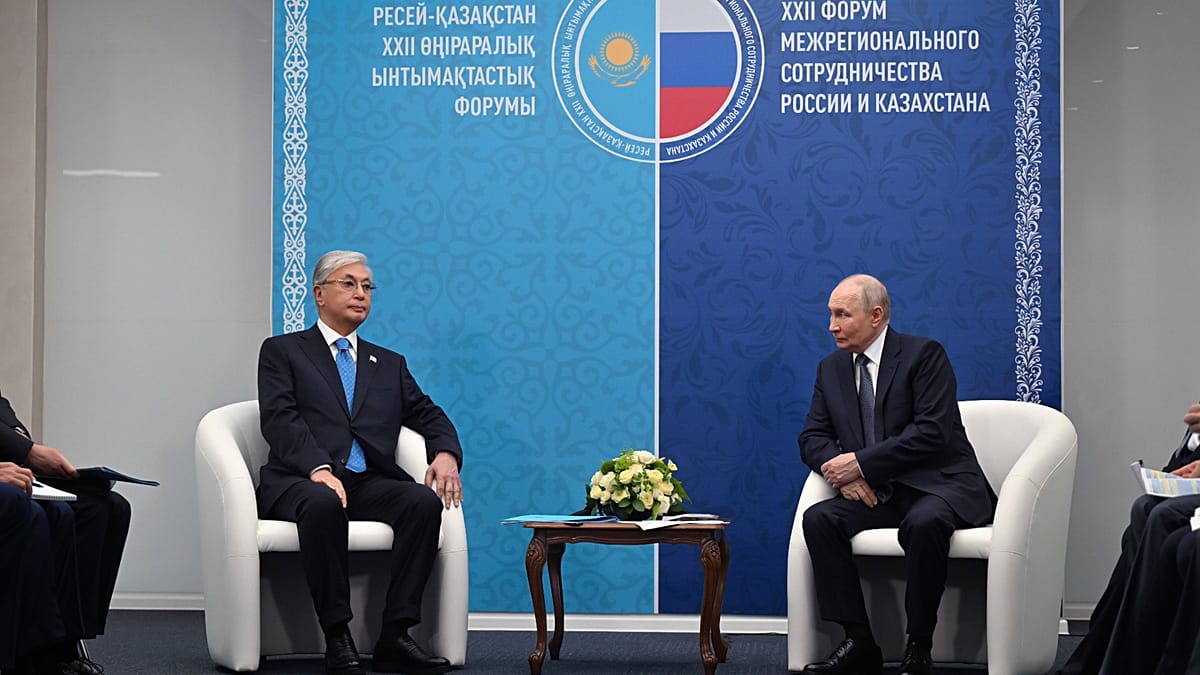
Kazakh president Kassym-Jomart Tokayev urged Vladimir Putin in a face-to-face meeting to freeze the war in Ukraine and return to negotiations as "it is a shame, young people are dying". Ukrainian Foreign Minister Andrii Sybiha called it "a realistic, timely, and wise message."
Ukraine's Foreign Minister said his country "appreciated" Kazakh president Kassym-Jomart Tokayev after he suggested to his Russian counterpart Vladimir Putin to freeze the war in Ukraine and revive what he called the "Istanbul 2.0" format, in a face to face meeting in Omsk.
"Perhaps it is time to freeze this conflict and return to the Istanbul Formula 2.0, because significant results were achieved there. Then, under guarantees from the great powers, including Russia, we could move toward the long-awaited peace," Tokayev told Putin during the Russia-Kazakhstan Interregional Cooperation Forum in Omsk on Saturday.
In a post on X, Ukrainian Foreign Minister Andrii Sybiha wrote: "We appreciate President Kassym-Jomart Tokayev telling Putin it is time to stop the war. A realistic, timely, and wise message."
"Ukraine has proposed stopping the war along current frontlines and turning to diplomacy, but the Kremlin continues to reject this clear path to peace," he added.
Tokayev also told Putin that Kazakhstan has always respected the Ukrainian people, their language and culture, adding that the nature of the war is "not entirely clear to many, including us."
"No one knows how to resolve this situation because both sides have their own positions. It is a shame, young people are dying," Tokayev said as Putin looked on.
The Kazakh president also said he has received "many signals from Europe and the US regarding the conflict between the Russian Federation and Ukraine."
At the same time, Tokayev also underlined what he called Putin's "diplomatic flexibility," referring to Putin's meeting with US President Donald Trump in Anchorage in August 2025.
"I know that you demonstrated the utmost diplomatic flexibility during the meeting in Anchorage," Tokayev said.
Putin listened on and replied that he would keep Tokayev informed of the developments on the Ukrainian front.
Later on, the Kremlin rejected Tokayev's proposal to freeze the conflict with Kremlin spokesman Dmitry Peskov stating that "Tokayev has repeatedly spoken about the issue of Ukraine. He has a consistent position. This does not mean that we agree. But Kazakhstan is our closest partner and our closest ally."
"It means we have not been effective enough in explaining the root causes. We will continue to do so with twice the energy. Our partners should know our position," he added.
Economic cooperation remains central
The meeting in Omsk this Saturday followed Putin's visit to Kazakhstan in May, where the two presidents discussed expanding trade, investment and regional cooperation.
During their meeting, Tokayev and Putin discussed a broad range of issues, including trade, investment, industrial cooperation, transport and cross-border development.
Tokayev said the bilateral meeting in Omsk provided an opportunity to continue discussions on key areas of bilateral cooperation and identify new avenues for expanding economic ties.
Putin described the interregional forum as an important mechanism for strengthening relations between the neighbouring countries.
"Last year, trade turnover reached almost $28 billion, and during the first five months of this year it increased by more than 4%, according to our statistics. Our cooperation is well diversified, covering metallurgy, mechanical engineering, energy, pharmaceuticals and many other sectors," Putin said.
Tokayev highlighted Russia's role as one of Kazakhstan's largest trading partners.
"In 2025, bilateral trade reached around $28 billion, and this year's trend remains very positive. This is a significant volume, especially given today's difficult geopolitical environment," he said.
The Kazakh president also said progress had been made on the joint project to build Kazakhstan's first nuclear power plant, one of the flagship initiatives in bilateral economic cooperation.