
Inconclusive sparring at EU summit puts budget timeline into question
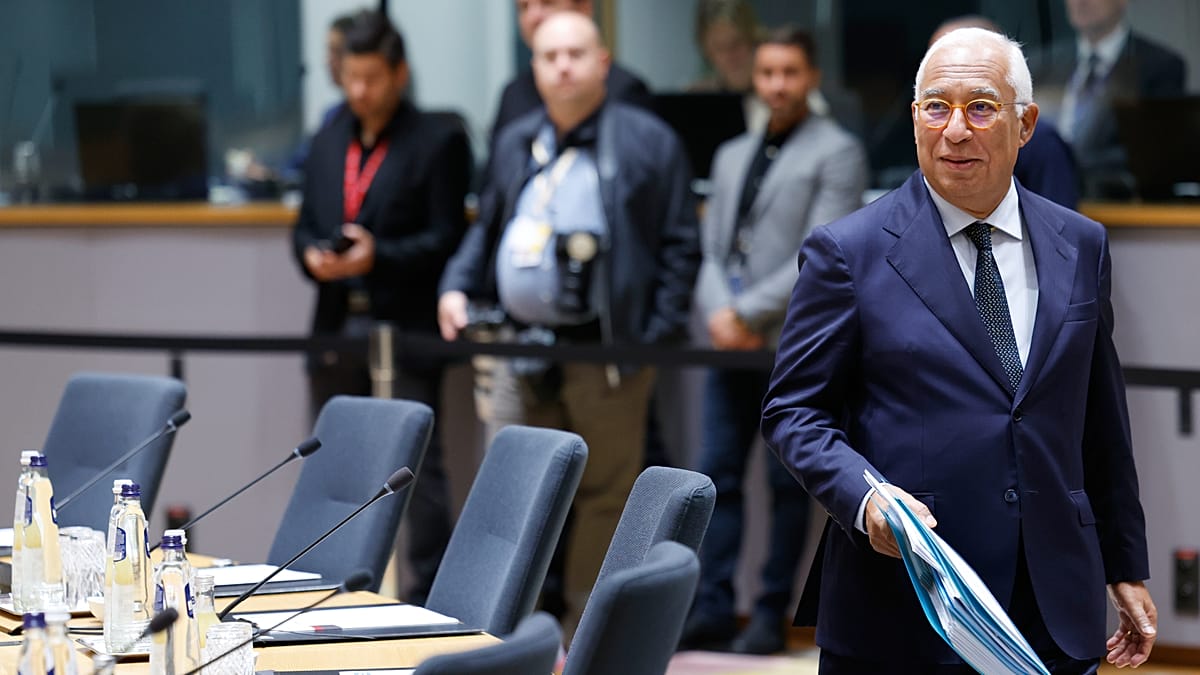
EU leaders stuck to their red lines on the next long-term budget at Thursday's summit, with several now rejecting the presumed December deadline. Council President António Costa is now expected to take over the negotiations, with a new compromise due in a few weeks.
EU leaders have refused to budge on the bloc’s next long-term budget and openly cast doubt on whether a deal can be sealed by the end of the year, a slippage that would mean significant delays and a collision with a string of national elections.
Until now, capitals were committed to reaching a final agreement by December 2026. But at Thursday’s summit in Brussels, where talks dragged longer than expected, a growing number of governments are asking whether that is really necessary.
"We are not reaching an agreement this month. Not next month. I don’t know even if it’s possible to reach an agreement before the end of the year," said caretaker Swedish Prime Minister Ulf Kristersson. "I think we are not in a hurry."
For months, European Council President António Costa has repeated that leaders must unanimously agree the next seven-year budget, the Multiannual Financial Framework (MFF), by December at the very latest.
If talks spill into 2027, he warns, there will not be enough time to complete the complex legislative work needed to get the budget up and running by 1 January 2028.
Following the inconclusive summit, where the Irish presidency’s compromise proposal to cut the overall volume by €141 billion was largely rejected, Costa will take over the negotiations, which was largely expected.
The European Council President is due to present a new negotiating proposal in a few weeks, which is bound to follow a completely different logic from the Irish one. EU leaders have been called in for a special summit on 26 November.
In particular, Costa's proposal is due to keep the national contributions low, a new package of EU-wide taxes to finance the budget, and maintain sufficient flexibility for unforeseen expenses, a budget line the Irish proposal significantly cut down.
Already before the summit, the draft joint conclusions were watered down concerning the deadline, softening language that explicitly set out “the aim of reaching a final agreement by the end of the year.”
By contrast, the final language says that "an agreement before the end of 2026 would allow for the adoption of legislative acts in 2027, which is necessary to ensure that EU funding reaches beneficiaries without interruption in January 2028."
Speaking before the summit, several leaders made clear that they do not feel bound by an end-of-year timeline, as it would be extremely difficult to explain to their domestic audiences that they accepted a bad deal because of an artificial deadline.
"The date cannot become more important than the content," Prime Minister Giorgia Meloni told the Senate on Wednesday.
"We will not sign an agreement that is not advantageous to us just to meet a deadline. We will sign an agreement only when it is right for Italy."
There is, however, no consensus on what a “good deal” looks like. Every government wants to take as much as possible from the EU budget while paying in as little as possible.
The main battle line runs between two camps: the so-called “frugals,” a German-led coalition of six net contributors pushing for steep cuts to the overall volume, and the Friends of Cohesion, a 17-strong bloc of southern and eastern countries fighting to preserve traditional funding programmes for the poorest regions.
But the camps are not monolithic. Some Friends of Cohesion, like Spain and Italy, have a vested interest in agricultural funds. Others, like the Baltic states, want to boost defence spending due to their proximity to Russia.
Among the frugals, Germany and Sweden are seen as the most radical, while Finland is keen on farming subsidies. France, the bloc’s second-largest economy, has yet to pick a side, trapped between its European ambitions and a runaway budget deficit.
Belgium and Luxembourg are somewhere dithering between the factions.
"In the end, we need a good Multiannual Financial Framework. So, of course, everyone wants to make speed. But it’s more important to have a good deal than a bad deal," Dutch Prime Minister Rob Jetten said.
In other words, the red lines are so entrenched, and the room for compromise so slim, that a landing zone currently looks like a mirage.
In Brussels circles, deals on sensitive topics are only struck under intense time pressure, because neither side feels compelled to make concessions until the last minute. Signalling that one does not feel bound by a timeline may therefore be a negotiating tactic to stand one’s ground.
For EU officials, even more worrying than the potential delay to funding programmes are the string of elections due in 2027 in France, Italy, Poland, Finland, Estonia, Slovakia and Greece. Some fear that if no deal is reached by the end of this year, it could slip to autumn 2027.
Paris is a particular concern. Far-right candidate Marine Le Pen is currently the favourite to win the presidential race, and she has promised to cap France’s contribution at €5 billion a year, a sharp cut from the current level of around €8 billion.
Meanwhile, elections in Spain, where voters go to the polls on 29 November, and Sweden, which voted in September, "are likely to create some issues", said Cypriot President Nikos Christodoulides.
Christodoulides reiterated the need to reach an agreement by the end of the year. He is one of the few EU leaders still saying so.