Ukraine's €23 billion funding gap puts EU in a bind as Zelenskyy seeks fast cash
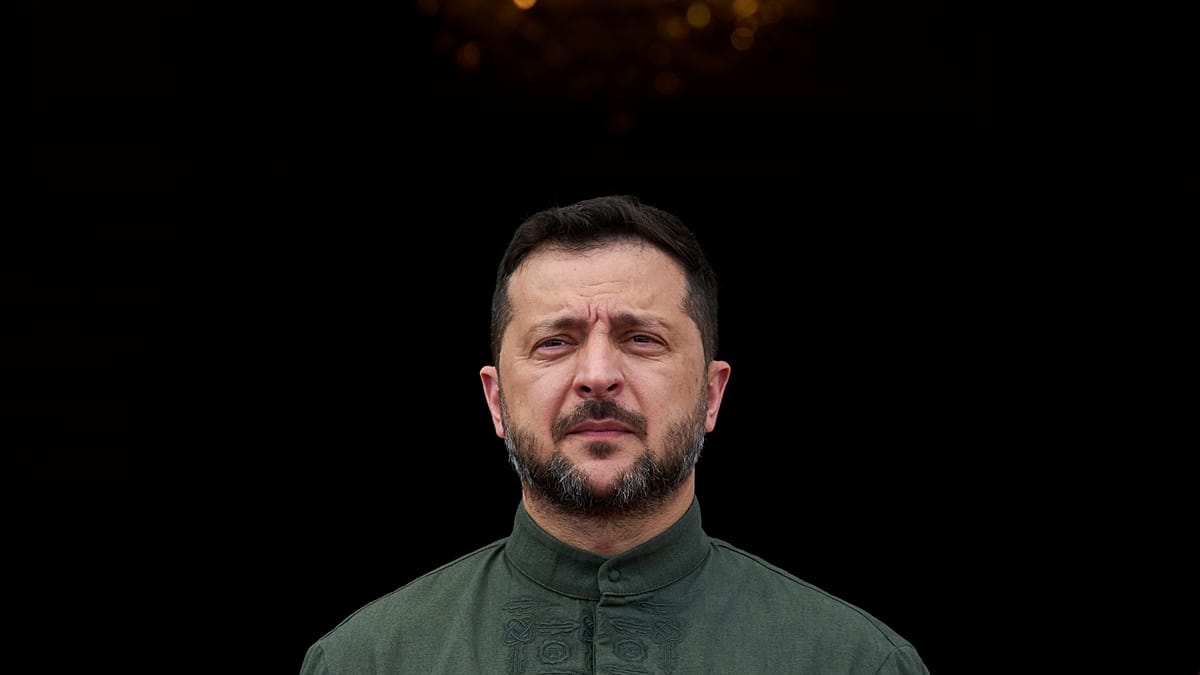
President Volodymyr Zelenskyy has asked the EU to bring forward part of its €90 billion Ukraine loan to plug a funding gap at the Defence Ministry. But Brussels fears the move could unravel a fragile compromise struck by EU leaders to finance Kyiv through 2027 in gradual instalments.
Ukraine's growing budget shortfall is putting the European Union under pressure as the bloc finds itself increasingly alone in shouldering the cost of supporting the country.
The issue came to the fore on Monday at a meeting of the "Coalition of the Willing" in Kyiv, held as Ukraine marked its 35th Independence Day.
President Volodymyr Zelenskyy said Ukraine's Defence Ministry faces a $27 billion (€23.1 billion) funding gap that must be covered to maintain the war effort.
The shortfall is not the result of unexpected spending. Ukraine brought forward funds earmarked for the second half of the year to cover costs in the first six months. The €23 billion is needed for personnel, social support and weapons purchases, including around €6 billion in advance payments for deliveries due at the beginning of 2027.
Zelenskyy said filling the gap was essential for Ukraine to remain "competitive with the number of deep strikes" against Russia and "make it painful for them", increasing pressure on President Vladimir Putin to enter meaningful peace talks.
"We need more money, much more," Zelenskyy said.
His proposed solution is for the EU to bring forward part of its €90 billion loan.
Brussels has divided the loan into two €45 billion tranches for 2026 and 2027 each. Zelenskyy's proposal would bring forward part of next year's funding to help cover this year's €23 billion shortfall, alongside contributions from other allies.
The European Commission's initial response has been cautious.
"We have not been told in bilateral channels officially yet that there is this intention to frontload the funding," a Commission spokesperson said on Tuesday.
"We stand ready to accommodate requests to the largest extent possible, but again, for now, this is the plan we have put in place. Exchanges with Ukraine continue, and we will look at future operations on the basis."
Brussels has so far disbursed €3.2 billion in budgetary aid and €8.35 billion in military aid.
Overall, €22 billion has been allocated for weapons purchases, such as fighter jets and drones. But those funds become available only once defence contracts submitted by Kyiv have been verified, a process that can be delayed by errors and last-minute changes. A further €6 billion remains unallocated.
Almost €14 billion in budgetary assistance is also pending, with some payments conditional on reforms. In recent months, Ukraine's parliament has slowed the approval of key draft laws, raising concerns in Brussels.
The Commission says it is ready to accelerate disbursements this year, but within the €45 billion ceiling.
One immediate priority is air defence systems, which Ukraine urgently needs to counter Russia's continuing ballistic missile strikes.
"In the next couple of weeks, we'll be looking very busy on the defence front because we know what is at stake," the spokesperson said. "We know that there is an incredible amount of urgency, and we are speeding up our operations accordingly."
When money meets politics
Privately, EU officials question whether frontloading the loan would be either feasible or desirable. Changing the timetable would require legal amendments to the original plan and force the European Commission to adjust its borrowing schedule.
It would also carry significant political risks.
The 27 EU leaders agreed to the extraordinary loan on the understanding that it would provide stable financing throughout 2026 and 2027, until the bloc's next long-term budget takes effect in 2028.
Bringing forward part of the 2027 funding could therefore leave Ukraine facing a financing gap later that year, with no immediate replacement. Nothing suggests that Kyiv's needs would be any less next year, as Moscow ramps up attacks.
Persuading EU leaders to approve a new credit line in 2027, a year packed with high-stakes elections, is viewed by some as politically unpalatable.
An alternative would be for other Western allies to help plug Ukraine's shortfall.
EU officials, however, complain that — with the notable exceptions of the United Kingdom and Norway — other allies have not contributed as much as expected, leaving the bloc to shoulder a growing share of the burden.
Support from the United States, previously a major donor, has effectively stopped.
A more ambitious option, which Zelenskyy raised at Monday's "Coalition of the Willing" meeting, would be to use frozen Russian Central Bank assets.
The EU holds around €210 billion in Russian assets, most of them in Belgium.
"Wherever these assets are, we need to find a fair way to use them for protection against Russia's war," Zelenskyy said.
The assets were originally the Commission's Plan A for financing Ukraine in 2026 and 2027. But opposition, led by Belgium, derailed the plan last December. The 27 leaders ultimately turned to Plan B: joint borrowing to back a €90 billion loan to Ukraine.
Despite the collapse of Plan A, some member states remain convinced that the Russian assets are the ultimate solution and are preparing to revive the idea.
"We have to agree to use Russian frozen assets, not the EU citizens' money, but Russian frozen in order to pay this bill," Latvia's Prime Minister Andris Kulbergs said on Monday, speaking alongside Zelenskyy.
"The bill is very high. That is huge money that has to be paid. Why do European citizens have to pay the full bill? It is Russian."
Opponents, however, remain firmly against using the assets.
Belgium continues to demand sweeping solidarity measures as a condition for any move, while Euroclear, the Belgian-based financial institution holding the bulk of the assets, faces legal challenges from Russia.
"Looking back at last year, I don't see at the moment any appetite to reopen that issue. The obstacles and reservations from some member states haven't changed," a senior EU official said.
"We will have to cross the bridge when we get there."