Industrial sovereignty: Five sectors where the EU is critically dependent on China
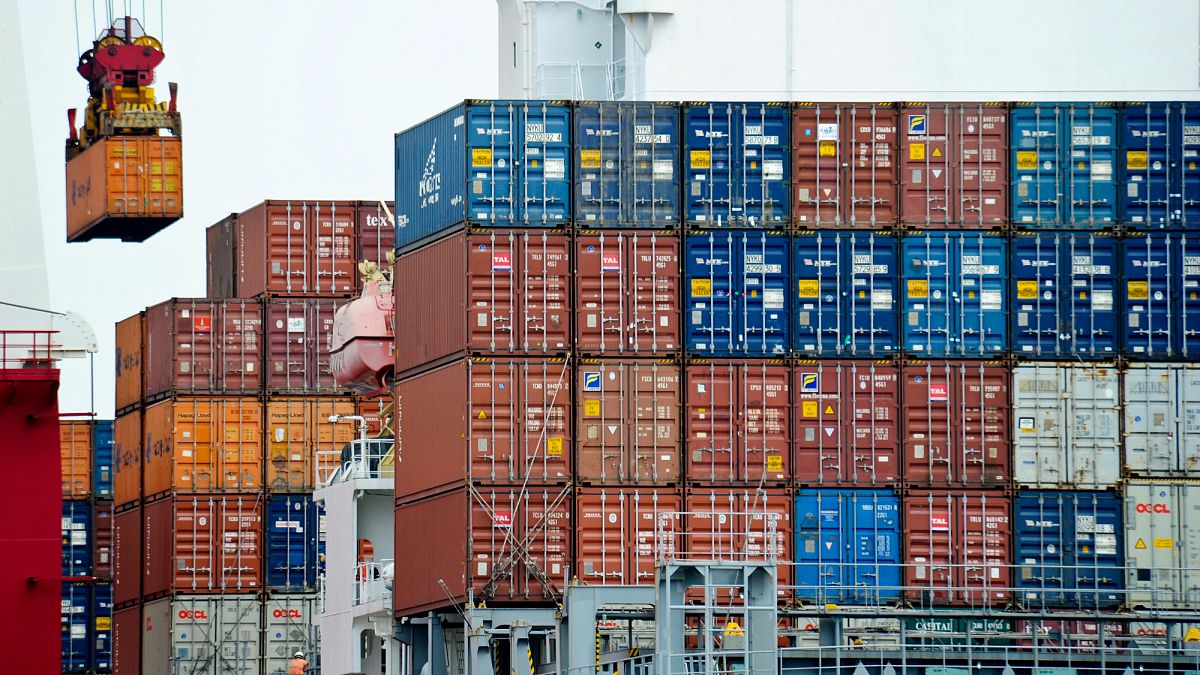
From solar panels to rare earths and industrial robots, Chinese firms have quietly become the dominant, sometimes sole, supplier across a growing number of European industries as fears of another "China shock" rise.
Europe's reliance on Chinese goods has grown so structurally embedded in certain sectors that credible alternatives have all but disappeared.
The pressure intensified in 2025, when Washington imposed sweeping tariffs on Chinese goods, prompting fears that Beijing would redirect surplus production into European markets at slashed prices.
Commission President Ursula von der Leyen described it as "a new China shock" at the G7 summit in Canada last year, warning that Beijing was flooding global markets with subsidised overcapacity that its own consumers could not absorb.
Last week, EU Industry Commissioner Stéphane Séjourné also called for EU businesses to diversify their suppliers as trade tensions with China are ramping up with Beijing making repeated threats towards the EU while Brussels seeks to strengthen legislation to protect its markets from Chinese dependence.
According to Eurostat, EU imports from China totalled €559.4 billion in 2025, a figure that has grown 89% since 2015, generating a trade deficit of €359.8 billion. In 2025 alone, EU exports to China fell by 6.5% while imports rose by 6.4%.
China is, by a wide margin, the EU's single largest source of imports and the primary supplier of dependent products, exporting 47% of the category to the bloc and roughly half of its total import value representing around €206 billion out of €404 billion.
Dependent products refer to parts and raw materials that are needed to build a final product. For example, the demand for a smartphone battery is dependent on the number of finished smartphones a company plans to manufacture.
The US is the second-largest supplier of dependent products to the EU, but it accounts for less than 10% of the category and only 11% of of total import value, as per the latest analysis of the Centre for Economic Policy Research (CEPR) released this month.
Taken together with other data indicating broader strategic dependency, five sectors emerge where the EU's exposure to Beijing is structural: solar energy, critical raw materials, industrial robotics, chemicals, as well as textiles and wood products.
Euronews compiled an overview of some of the reasons for the extraordinary dependence of the EU on China in each of these sectors.
Green transition, made in China
Of all the EU's dependencies on Beijing, the one buried deepest inside its green agenda is arguably the most consequential.
According to Eurostat, China accounted for 98% of all solar panel imports into the EU in 2024. The total value of those imports fell from €19.7 billion in 2023 to €10.9 billion in 2024, not because volumes declined but because Chinese prices collapsed.
The full numbers for solar panel imports last year have not yet been released.
A report published this year by the think tank Loom also indicated that China supplies 88% of EU lithium-ion battery imports for electric vehicles in 2025, up from 75% in 2019.
The vulnerability extends well beyond finished products.
The European Parliament's research department found that the EU sources 98% of its rare-earth magnets from China, including materials essential to electric vehicle motors, wind turbines and defence systems.
Data from the European Commission also puts EU reliance on Beijing for magnesium at 97%. The mineral is essential for next-generation batteries that are an alternative to lithium-ion technologies, while also being used for hydrogen storage and lightweight renewable infrastructure.
Due to this overwhelming single-country dependency, the European Commission has placed it on the bloc's Critical Raw Materials list to accelerate domestic extraction, processing and recycling initiatives.
Finally, Chinese firms control over 80% of global solar photovoltaic manufacturing capacity, from polysilicon production to finished modules, according to a Geopolitical Intelligence Services report.
In short, Europe's green transition rests on foundations it does not control.
The robot surge
Industrial robotics tells a story not just of dependency but of accelerating displacement.
Between early 2025 and early 2026, EU imports of industrial robots from China rose by 315%, with average prices falling 29%, according to data published by the European Commission's import surveillance task force.
China's dominance in this sector is not accidental.
Its "Made in China 2025" industrial strategy, sustained by state subsidies, cheap credit and tax incentives, helped grow the country's advanced robotics sector to triple the number of companies recorded since 2020.
Domestic overproduction has pushed Chinese manufacturers to export aggressively, at prices European competitors cannot match.
According to the International Federation of Robotics, China now produces more industrial robots than Germany, South Korea, Japan and the US combined.
Chemicals, textiles and wood: old dependencies, new depths
In the chemicals sector, the European Commission's surveillance data revealed that certain chemical compounds were being imported from China at rates 36 times higher than the previous year, with prices as much as 95% lower.
In March 2025, the Commission launched dedicated monitoring of specific ethylene and ammonia-based chemicals, citing production overcapacity in China and a sharp rise in their EU market share.
Textiles and wood products tell a similar story.
Clothing and footwear from China still represent a substantial portion of the EU's non-domestic supply, even as some production has shifted to lower-cost Southeast Asian competitors such as Vietnam.
China supplies approximately 30%to 35% of the European Union's total non-domestic clothing and footwear imports by value, according to Eurostat.
Wood products have become a newer flashpoint as assembled parquet flooring imports from China rose more than tenfold in a single year, with prices collapsing by 77%, prompting the Commission to impose duties of between 21.3% and 36.1% in July 2025, to protect an industry employing more than 10,000 people and worth €1.3 billion.
Decor paper followed in August 2025, when duties of between 26.4% and 26.9% were applied to safeguard over 2,000 European jobs.
Across all five sectors, the Commission's response has been largely reactive, applying tariffs after damage has already materialised.
The deeper question is whether Europe retains the industrial capacity, and the political will, to build genuine alternatives before its dependency becomes irreversible and therefore a lever Beijing can freely use.