The key global economic risks to watch in the second half of 2026
After six months defined by war, an oil shock and a frenzied AI trade, economists say the rest of the year hangs on a chain of interlocking risks, with the fragile peace between the US and Iran as the key factor.
The second half of the year rests on a delicate chain of dominoes, according to a new briefing from Oxford Economics, and whether the US-Iran peace agreement holds is the factor that determines how the rest fall.
"Its durability will determine whether the global economy gets an energy-driven disinflation tailwind or absorbs a second oil shock," stated chief global economist Ryan Sweet in the report, calling the deal "the key domino that will determine whether other risks are amplified or dampened".
The consultancy expects the global economy to accelerate, forecasting annualised growth of 3.1% in the second half against an estimated 1.6% in the first, powered chiefly by cheaper oil feeding through to household incomes, although Sweet puts the odds of reaching a durable deal at "a coin flip".
If the truce holds, Oxford Economics sees Brent crude averaging in the low $70s per barrel, easing inflation and financial conditions across emerging markets and tech valuations.
If it breaks, the consequences would not stay contained to the oil market.
Early on Wednesday, the US military attacked Iran after it said Tehran struck three ships in the Strait of Hormuz. Iran retaliated with strikes targeting Bahrain and Kuwait. The regional crossfire raised the risk that the interim agreement to halt fighting in the war could break down. However, the exchange of fire followed a pattern of similar attacks during the deal's shaky ceasefire, and neither country immediately signalled it would step away from the negotiating table.
Oil prices reacted to the attacks by increasing more than 3% by Wednesday morning, with international benchmark Brent trading above $76 a barrel.
"A peace deal breakdown won't just raise oil prices, it would also increase pressure on AI supply chains in Asia, force central banks to be hawkish, tighten financial conditions, and could shift the outcome of the US midterms and Israeli elections [...] the cascade runs fast," Sweet stated.
A coinflip with a $20 spread
Not everyone shares Oxford Economics' outlook for oil prices.
Morgan Stanley's mid-year outlook, published in May, forecast crude climbing back to roughly $90 a barrel by the end of the year, a gap of some $20 compared with Oxford Economics' forecast that amounts to two different bets on the same peace process.
The World Bank is also more cautious, forecasting Brent crude to average about $94 a barrel this year while warning that global GDP growth will slow to 2.5% in 2026.
Reflecting on how the recent exchange of attacks is testing the fragile truce, Sweet said, "Traffic through the Strait of Hormuz is a good bellwether. The deal committed to fully restoring traffic through the chokepoint within 30 days, making mid-July the first hard deadline," he explained.
"A sustained return to 75% or more of pre-war traffic by mid-July would increase the odds that the agreement is holding and vice versa," Sweet concluded.
The other indicator, he says, is whether Iran formally invokes the accord's Lebanon clause over Israeli strikes, and whether its response comes in military or rhetorical form.
Tariffs, trade and AI
Trade is another risk that could reshape the outlook.
US Section 122 tariffs are due to expire on 24 July, but Washington has already lined up replacement levies under Section 301. Oxford Economics expects the changes to push effective tariff rates higher from late July as the US seeks to maintain monthly tariff revenues of between $25 billion (€21.8bn) and $30 billion (€26.2bn).
Europe is also taking a tougher stance. The European Commission has more than 50 trade-defence investigations open against China, up from 17 a year ago, and plans to unveil a broader economic security strategy by September.
These trade tensions also feed into the AI boom that has powered financial markets this year.
Oxford Economics notes the US AI industry depends heavily on semiconductors and other hardware shipped from Northeast and Southeast Asia, the regions with the most to lose from any further disruption to commodities passing through the Strait of Hormuz.
Meanwhile, the Bank for International Settlements (BIS), the umbrella body for central banks, warned that the AI boom increasingly rests on opaque "circular financing" between chipmakers, cloud giants and artificial intelligence labs, as well as lightly regulated private credit, where lending to the sector has quadrupled in five years.
The BIS's Asia-Pacific chief, Zhang Tao, cautioned that the sector's reliance on non-bank funding means an AI downturn could trigger a sharper and faster correction than a traditional banking crisis.
Sweet modelled what such a reversal could look like.
"We have created a so-called tech bust scenario where US technology stocks fall by 25% over the course of a year," he told Euronews.
According to Sweet, such a shock would cause the US economy to "grind to a halt", spilling over to technology exporters and investor sentiment worldwide, leaving global growth 1.1 percentage points below Oxford Economics' baseline next year.
Central banks, ballots and the calendar
The final dominoes are policy and politics.
Oxford Economics expects the major central banks to prove more dovish than financial markets currently anticipate, though they could pivot quickly if traffic through the Strait of Hormuz falters or AI-input prices signal supply stress.
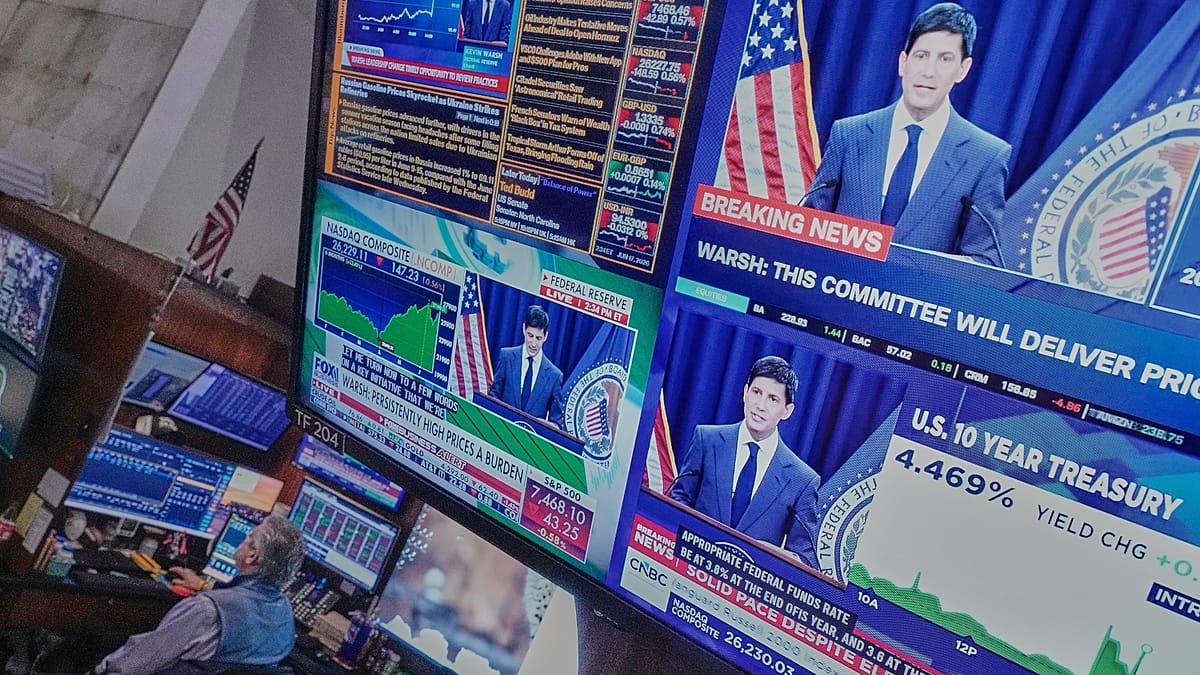
The nearest test is the Federal Reserve's rate decision under chair Kevin Warsh later this month, coming on the heels of June's soft jobs report.
Beyond that lie November's US midterms and Israel's general election, due by late October, both of which could influence the Middle East peace process. In September, German state elections could also test the coalition behind Germany's fiscal policy, a key driver of the eurozone economy.
Oxford Economics also flags genuine upside, from stronger AI-driven productivity to an EU economy that weathered the second quarter surprisingly well.
Whether the resilience in Europe is real will show up first in Germany and in credit data, Sweet argues.
"If corporates were absorbing margin compression from the jump in energy prices without cutting investment and drawing down credit lines, that would strengthen the case that underlying momentum in the economy is better than we expected," he told Euronews, adding that a contraction in eurozone bank lending would push the other way.
It is important to highlight that the typical Oxford Economics forecast miss is nearly a full percentage point, and the range around this assessment in particular is wider than usual.