Dinner diplomacy: Von der Leyen and Erdoğan’s working dinner comes with a side of tension
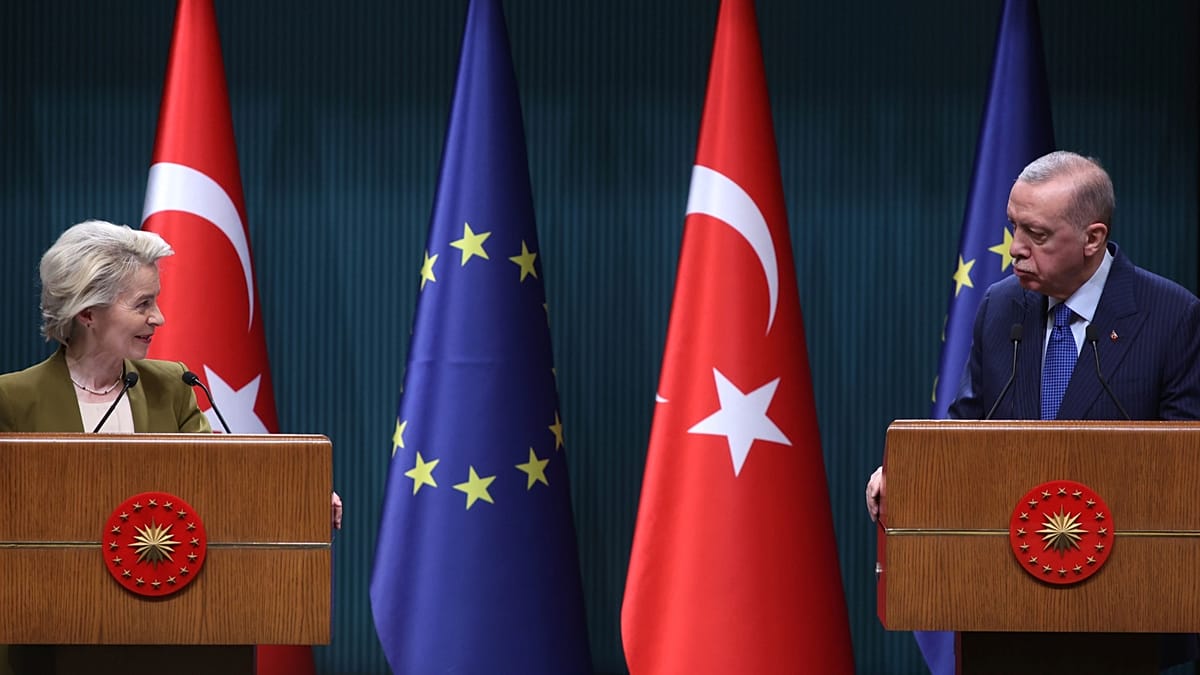
European Commission President Ursula von der Leyen will have to chew over much more than just hors d'oeuvres Wednesday evening at a working dinner with Turkish President Recep Tayyip Erdoğan. Observers expect her to weigh papering over disputes from both sides with the country's geostrategic value.
European Commission President Ursula von der Leyen will meet Turkish President Recep Tayyip Erdoğan for a working dinner on Wednesday night in Ankara, at a sensitive moment for both sides.
At the meeting, held after the NATO summit in Ankara, von der Leyen will have to balance closer ties with Turkey against ongoing rule-of-law concerns and other disputes.
They will be joined by European Council President António Costa, with the dinner expected to carry a degree of tension.
At a public event in April, von der Leyen reportedly placed Turkey — an EU candidate country since 1999 — alongside Russia and China when discussing foreign influence across Europe.
Euronews asked the EU executive whether this remark and other issues would be raised during Wednesday’s meeting.
“Turkey is an important partner for the European Union. We share strategic interests across a wide range of areas. I expect those are the topics they will cover,” European Commission Deputy Chief Spokesperson Olof Gill said.
Von der Leyen has also been bruised by previous visits to Ankara, with the infamous 2021 seat snub — also known as sofagate — leaving her sidelined and seatless from a major political meeting. A month after the incident, she said she was "hurt".
When Euronews asked where she would sit at this meeting, Gill said: “I expect they will be sitting at the dinner table, as is usually appropriate for dinner.”
A fresh start
German MEP Engin Eroglu, who is of Turkish heritage, said the meeting offered a chance for a fresh start. “After the disputes of the past, this meeting is above all an attempt to reset relations,” he said.
“I think Ursula von der Leyen and António Costa will try to smooth things over and elevate the relationship to a more pragmatic and security-oriented level.”
He referenced the possibility of Turkish involvement in the €150 billion Security Action For Europe (SAFE) defence loan programme.
Turkey's full participation has been made impossible due to blocking from Greece and Cyprus. This mean the country can only provide up to 35% of the total component costs for any project, like any other country without a security and defence partnership with the EU.
On Tuesday, speaking alongside Rutte at the NATO summit, von der Leyen said, "There's a wide opportunity to have a very close cooperation with each other." She did not clarify in what capacity.
This willingness to bring Brussels and Ankara closer together through defence cooperation has been made public previously.
The EU’s foreign policy chief Kaja Kallas visited the capital last week. She was accompanied by European Commissioner for Enlargement Marta Kos and European Commissioner for Migration Magnus Brunner, in what was described by one EU official as a “jumbo meeting”.
The talks resulted in a joint statement stressing a shared commitment to multilateralism, the rules-based order, and joint responsibility for global and regional issues. Following the trip, Kallas posted on X that, “Turkey is a key partner on security, migration, and energy, as well as an EU candidate country”.
Core principles
Polish MEP Joanna Scheuring-Wielgussits on the EU-Turkey Joint Parliamentary Committee in the European Parliament. She told Euronews that Turkey is a key NATO ally, and its cooperation on security and regional stability remains essential.
With the United States pulling some support from the continent, and Ankara playing a key role in providing certain weapons for Ukraine to repel Russia’s full-scale invasion, Europe’s relationship with the nation of almost 90 million people has become increasingly important.
“At the same time, this engagement cannot come at the expense of the European Union’s core principles,” Scheuring-Wielguswarned.
She listed the country's democratic backsliding, and the years-long suppression of press, criticism and the opposition parties, as examples. This reached boiling point last March when Turkish police arrested one of Erdoğan's rivals and Istanbul's mayor, Ekrem İmamoğlu.
"Any credible path forward in EU–Türkiye relations depends on tangible progress in these areas, especially now, after the worrying developments and further crack downs on the main opposition party, the CHP (Republican People's Party)," she said.
“These are not a ‘cherry on top’ of our partnerships, but the very foundation of the European project. This must be clearly and consistently emphasized, both in our internal policies and in our relations with allies and candidate countries alike."
The Associate Director and Turkey Director of Human Rights Watch, the not-for-profit watchdog group based in New York, Emma Sinclair-Webb, wrote that roughly 200 people were detained before the NATO summit kicked off.
She wrote that Erdoğan “is able to count on there being barely a murmur from the country’s European partners.”