Gulf between Hezbollah and Lebanese state grows wider as Israeli occupation continues
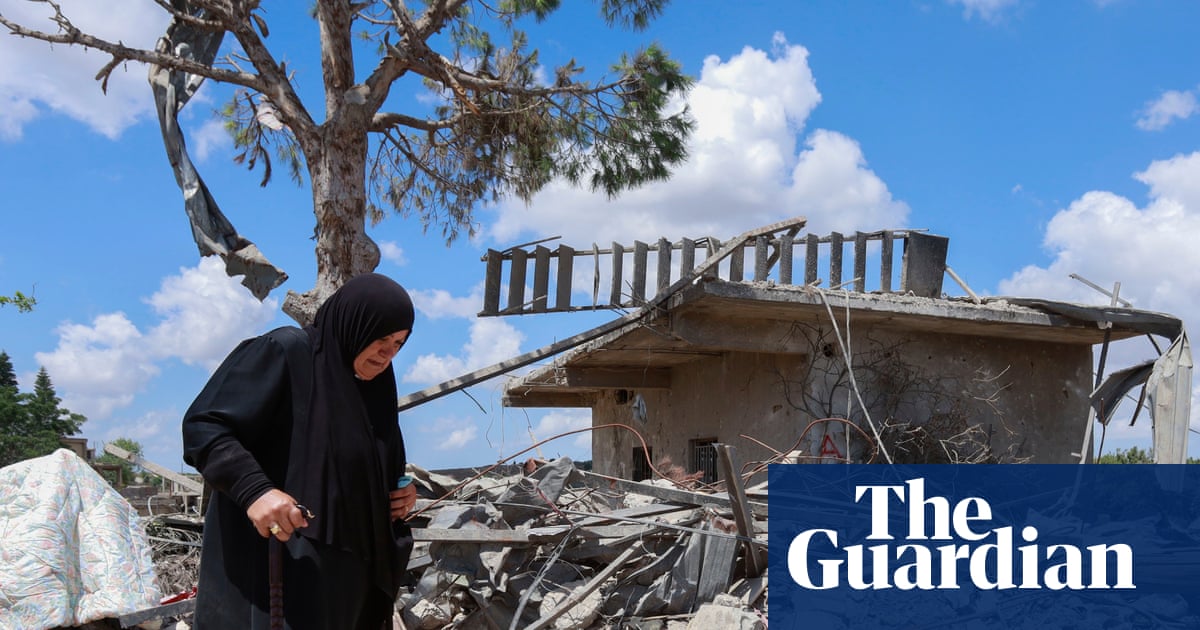
Fatima al-Ashkar used toys to explain to her children that their father had been killed. She arranged toy soldiers in a mock battle and picked up an airplane, miming an air raid on the plastic men below.“I...
Fatima al-Ashkar used toys to explain to her children that their father had been killed. She arranged toy soldiers in a mock battle and picked up an airplane, miming an air raid on the plastic men below.
“I started explaining to them: ‘Israel came and bombed here. Daddy was here. Daddy was martyred. Daddy was protecting us from Israel,’” said al-Ashkar, a 26-year-old resident of Markaba, south Lebanon. Her husband, Mohammed Ali, who was a member of Hezbollah, was killed fighting Israel in the region in early April.
But the young widow was not alone in shouldering the burden of her sudden loss. The sophisticated machinery of Hezbollah’s social support system soon stepped in.
Hezbollah’s martyr foundation found and furnished an apartment for al-Ashkar and her children in the southern suburbs of Beirut, covering the rent in full. It continues to provide stipends for each child, pay for their school fees and cover all healthcare costs for the family.
Every so often, representatives of the foundation will visit al-Ashkar’s home and sit with her and the children for psychological support sessions.
“[Hezbollah] is standing by us. They do everything for us,” said al-Ashkar.
It was not the state that al-Ashkar, and other residents of south Lebanon who were displaced or lost loved ones in the war, turned to, it was Hezbollah. Many did so because they believed in it; others because the absence of the state left them little alternative.
As the Lebanese state tries to reassert its authority, it finds the country deeply divided. It faces a challenge that extends far beyond disarming Hezbollah, which the US and Israel are pushing it to do.
The state must contend with Hezbollah’s deep-rooted social welfare system and persuade its supporters that it can provide security – even as continuing Israeli occupation and attacks undermine the state’s claim that it can protect Lebanon.
The latest round of war has hardened existing divisions over Hezbollah. The group’s supporters accuse the government of humiliating Lebanon by negotiating directly with Israel and not responding to its attacks. Hezbollah’s opponents blame the group for provoking a war by launching rockets at Israel on 2 March, triggering Israel’s invasion and current occupation.
“Honestly, I don’t care about the state. Before, we used to say: ‘They should speak, they should do something.’ Now, whether they speak, or don’t speak, it makes no difference to us,” said al-Ashkar. Her home was blown up during a nominal ceasefire between Hezbollah and Israel in 2024, and her village was occupied by Israel until its withdrawal in 2000.
For Mustapha Hamze, a 66-year-old doctor from the outskirts of Nabatieh, a stronger state would make a difference. Neither Hezbollah’s weapons nor the government’s diplomacy has helped him access his home, which he fled in the early days of the war. The last time he tried, an Israeli drone fired on him.
“Israel says it wants peace, that’s a lie. But Hezbollah also needs wars, these groups live through war. They have weapons and they take everything from you. They resemble one another,” said Hamze. “There is no other strong political organisation. [Hezbollah] wants everyone to be with them and under their wing, anything else is unacceptable.”
But he also has little faith in the Lebanese state’s ability to defend his rights. He has applied for safe passage to visit his home through the Lebanese army, which has a place in a deconfliction mechanism that includes Israel, but has yet to receive it.
Lebanese officials know one of their biggest challenges will be convincing people to place their faith in the state – particularly supporters of Hezbollah.
“This needs to be a whole-of-government approach. For supporters of Hezbollah, you are talking about three generations of social indoctrination. You have to start with the culture, then inclusion in government, and then we can talk about security,” a senior Lebanese security official said on condition of anonymity.
The Lebanese government is using the three “pilot zones” – areas handed back to the Lebanese army from Israeli occupation – as prototypes of communities where it is trying to rebuild trust in the state.
Reconstruction in these areas, mostly destroyed by Israeli shelling, is following a different blueprint from previous wars. The army is not allowing the southern council, a government body closely tied to the Hezbollah-allied Amal movement, to conduct reconstruction as was the case in the past.
Instead, it is the Lebanese army taking charge of rebuilding roads and repairing infrastructure. This way, the security official said, the state is visible and citizens will turn to Beirut, rather than Hezbollah. And, the army can fulfil its obligations under the pilot zone agreement by ensuring that infrastructure projects are not being used for military purposes.
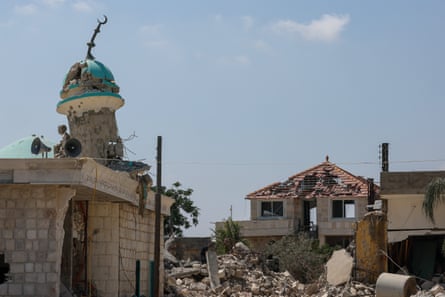
But the state’s narrative is undermined every time Israel shells Lebanese land – which happens several times a day – and it does not respond. Last week, Israeli troops blew up the municipal building, a public school and a clinic in eastern Zawtar, in view of one of the three pilot zones, Zawtar al-Gharbiyah.
The cash-strapped state also cannot match the extensive social services Hezbollah has to offer.
“We got medical treatment, free medicine, blood tests from Hezbollah and Samidoun [an affiliated aid group]. As for the state, we haven’t gotten anything from them. And the army’s hands were tied by the government,” said Tia Abdalah, a displaced resident from the border village of Aitaroun. Although she was not affiliated with Hezbollah, she said the group gave her family monthly cash stipends, as well as aid boxes.
Lebanese officials are painfully aware of the limits of their ability to stop Israeli bombing; they are determined to go through the diplomatic process regardless. But without Israel’s withdrawal from south Lebanon, they fear the legitimacy of the state will collapse.
“The pilot zones won’t work unless there is a clear timetable for withdrawal. We want to push out Hezbollah, but we don’t want to appear as if we are playing the role of the South Lebanese Army,” said the security official, referencing Israel’s proxy that aided its occupation of south Lebanon from the 1980s until 2000.
To people such as al-Ashkar, whose husband died in what she sees as the fight to defend Lebanon from Israel, the state offers little promise of security.
“[Israel] calls [the army] on the telephone and tells them: ‘Leave the village,’ so they leave the village. Then there’s nobody left defending it … Sometimes you feel they’re working for the Israelis,” she said.