
France's Mélenchon to stage major campaign rally for manifesto launch
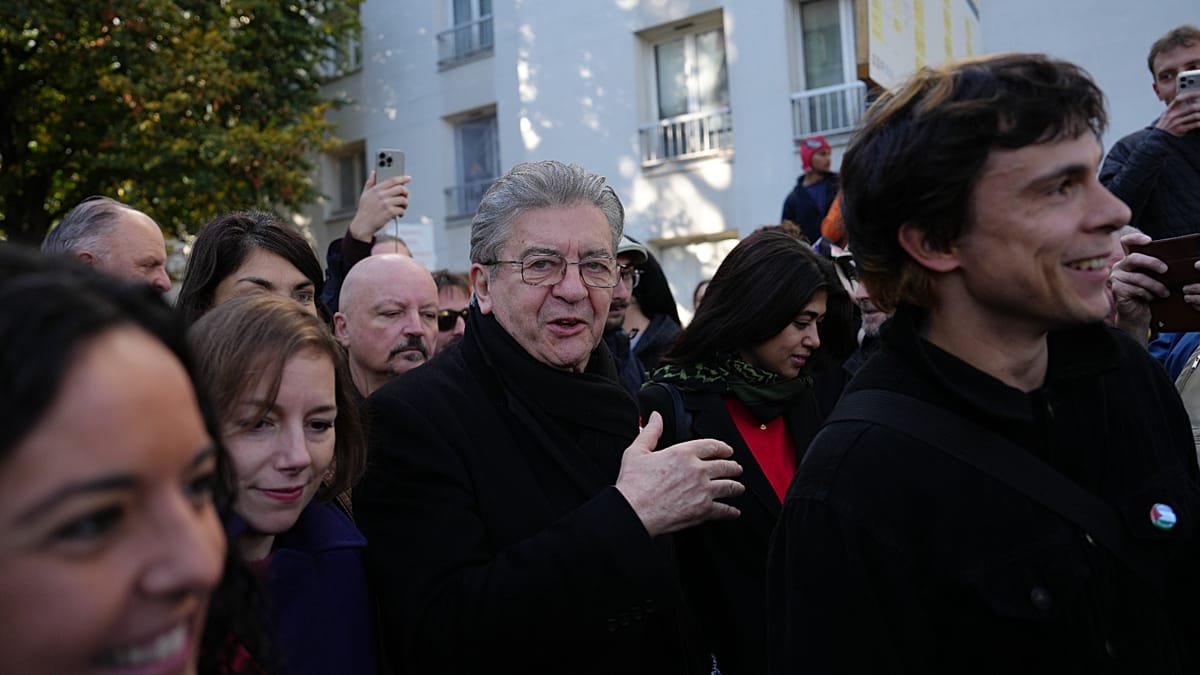
The leader of the hard-left France Unbowed party, Jean-Luc Mélenchon, is currently polling second ahead of next spring's presidential elections, according to a poll conducted in late October.
French presidential candidate Jean-Luc Mélenchon published his book and manifesto, "L’Avenir en commun" (A Shared Future), on 6 November, the day before a major campaign rally organised by his far-left France Unbowed party near Paris.
Mélenchon is currently polling in second place, with 17.6% of voting intentions ahead of next spring's presidential election. He trails far-right National Rally candidate Marine Le Pen, who is polling at 36%, according to an IFOP poll for broadcaster LCI conducted from 27 to 29 October.
On the question of Europe, the manifesto backs scrapping rules and regulations that do not align with French interests, including those concerning the EU migration pact and European defence.
Mélenchon's party La France insoumise (LFI), known in English as France Unbowed, has also called for reducing France's net contribution to the EU budget by around €9 billion, a proposal reiterated by the party's finance spokesman Eric Coquerel in October.
This eurosceptic stance bears some parallels with that of the National Rally, which has pledged to scrap a number of EU regulations and standards, particularly those tied to the business sector, agriculture, energy and environmental policy.
However, while both parties advocate greater national sovereignty and challenge aspects of European integration, their positions are underpinned by different ideological priorities.
The manifesto gives less prominence to Russia's war against Ukraine than to France's relationship with Israel, accusing the government of allowing "a genocide to be committed" in Gaza and condemning what it describes as "diplomatic double standards".
On Ukraine, the manifesto backs "a diplomatic framework that would make it possible to secure a ceasefire and the withdrawal of Russian troops", as well as a gradual withdrawal from NATO, as part of a broader foreign policy based on military independence and non-alignment.
In terms of domestic policies, the party backs retirement at the age of 60, an increase in the minimum wage, legislation to curb the concentration of media ownership, as well as expanded public services.
France Unbowed also proposes tax increases targeting wealthy individuals and major corporations, alongside the removal of several tax breaks.
The measures are expected to generate an estimated €106.4 billion in additional annual revenue, according to the party's proposed 2027 budget, of which €81.7 billion would finance additional public spending, with the remainder contributing to a reduction in the country's public deficit.
This comes as France faces one of the highest levels of public debt in the eurozone, with its financial situation raising concerns among financial markets and drawing scrutiny from the European Union.
In recent months, Mélenchon's proposal to freeze or effectively cancel part of France's public debt held by the Banque de France, as part of the wider Eurosystem overseen by the European Central Bank, has sparked controversy.
The proposal would require a coordinated decision at European level. Both Banque de France Governor Emmanuel Moulin and ECB President Christine Lagarde have argued that such a move would violate EU treaties, particularly Article 123, which prohibits monetary financing of governments.