Five pressing tasks for Ireland as it takes over EU Council presidency
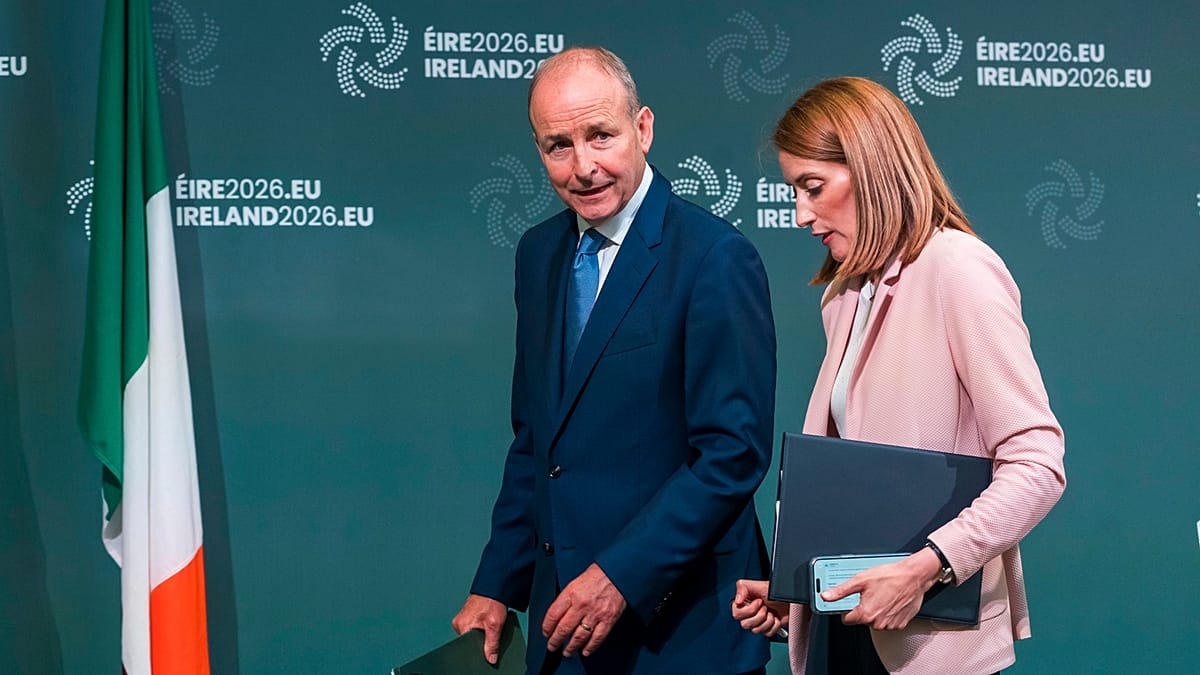
The harps are ringing out in Brussels as Ireland takes over the six-month rotating presidency of the EU Council, succeeding Cyprus. It marks the eighth time that the nation of 5.4 million people which joined...
The harps are ringing out in Brussels as Ireland takes over the six-month rotating presidency of the EU Council, succeeding Cyprus.
It marks the eighth time that the nation of 5.4 million people which joined the bloc in 1972, has assumed the unenviable role of “honest broker”.
"We do so at a critical time for the EU, with greater uncertainty and unpredictability in the world," Taoiseach Micheál Martin has said.
Under the Gaelic slogan of "Ní neart go cur le chéile" ("Strength with unity"), Ireland will steer negotiations among the other 26 member states and craft delicate, sometimes fragile, compromises that can satisfy all the disparate voices in the room.
With several files nearing an inflexion point, Dublin has its work cut out. Here are the five most pressing tasks for the Irish presidency.
Pressure on Moscow
At the very top of Ireland's to-do list is a new package of sanctions against Russia, which this time comes with a hard deadline: 15 July.
If there is no deal by then, the EU will automatically revise its price cap on Russian oil. Because of ongoing disruption in the energy market, the formula will push the cap well beyond the current $44 per barrel, possibly even beyond the original $60 figure, and grant Moscow economic relief – a politically untenable scenario.
Diplomats are confident that the deadline will be met and the cap will be frozen, but there might be a high price to pay. Bulgaria, under its new government, has publicly threatened to veto the package if two names are added: Patriarch Kirill, the head of Russia's Orthodox Church, and Vagit Alekperov, the billionaire founder of Lukoil.
Prime Minister Rumen Radev has also raised concerns about the impact that the proposed sanctions could have on fertilisers and spare parts for the Sofia metro.
"We will not allow the sanctions package to pass in this form. We have a vote, and we will use it," Radev said last month.
But Bulgaria is not the only obstacle: other friction points include imports of cod and pollack, sales of LNG tankers, and a far-reaching entry ban on Russian soldiers.
Road to enlargement
Ireland has read the room and made accession one of its key priorities.
The change in power in Hungary created, for the first time in two years, a real possibility to make progress on Ukraine's and Moldova's membership applications. Cyprus deftly seized the moment to open the first cluster of accession talks, known as fundamentals, with the two candidates, which are informally paired.
However, Hungary's new prime minister, Péter Magyar, has told his peers to curb their enthusiasm. The country is biding its time before agreeing on next steps.
Ireland is keen to unblock the five remaining clusters with Ukraine and Moldova, but is aware of Budapest's entrenched reluctance. Dublin hopes that one or two clusters could be opened before the summer break, with the remaining ones addressed gradually afterwards.
Meanwhile, Montenegro, the frontrunner in the waiting line, is determined to close negotiations by the end of the year to focus on drafting its accession treaty, which is already in the early stages. As the presidency, Ireland will spearhead the works.
The stakes are sky-high: Brussels wants to set a new precedent with Montenegro and make its accession treaty the reference point for future member states. This suggests the drafting will be particularly intense, with countries pushing for different clauses, safeguards and transitional periods to allay their sceptical voters.
Budget crunch
Among the hundreds of compromises that Ireland will write across its presidency, none will be as consequential and controversial as the next seven-year EU budget.
The previous presidency, Cyprus, drew the ire of the frugal countries after proposing a moderate 2% cut to the Commission's original €2 trillion blueprint. The Netherlands and Sweden quickly slammed the Cypriot "nego-box" as a "no-go box".
Ireland will be tasked with coming up with revised numbers for each heading, hoping to find a sustainable middle ground between those who want to preserve the traditional envelope, namely agriculture and cohesion, and those who want to bolster the modern priorities, such as climate action, innovation, technology and defence.
Crucially, the Irish "nego-box" will have to address the question of new own resources, EU-wide taxes that can help bring additional revenue. Though member states were initially opposed to expanding the bloc's fiscal firepower, the winds have shifted and capitals have realised that taxes, one way or another, are indispensable to fill the gap.
The Irish "nego-box", expected to arrive in October, will usher in the last phase of the process. Leaders will then step in to take matters into their own hands.
António Costa, the president of the European Council, wants to have the final deal in December at the latest to prevent the budget talks from spilling into 2027, where crucial elections in France, Italy, Spain and Poland risk a derailment.
Tariff threats and tariff wars
It has become almost a ritual for each new presidency to face a tariff threat from US President Donald Trump.
Last July, Denmark had to deal with a 30% tariff, which never materialised. In January, Cyprus had to deal with a 15% tariff, which never materialised. And this July, Ireland has to deal with a 100% tariff on European countries that tax digital services.
If Trump were to go ahead with his maximalist threat, the EU-US deal would fall apart, and a tariff war would break out. While trade is the Commission's exclusive competence, the Irish presidency would be responsible for keeping all member states firmly on the same page, a difficult task when economic ties hang by a thread.
In parallel, a trade war is brewing between Brussels and Beijing.
After an eye-popping €360 billion deficit in 2025, officials have concluded that the status quo is unsustainable. The Commission has given China until October to show "tangible results" to rebalance the relationship and curtail the flow of low-cost, subsidised goods.
Given Beijing's notorious unwillingness to make concessions, Brussels is preparing new tools to take the action that dialogue has failed to deliver. But despite the dramatic stats, member states remain sharply split on how hard the EU should go.
One market for all
The EU is in a race against time to revive its sluggish economy and boost its competitiveness before falling into inevitable decline versus the US and China.
During the Cyprus presidency, the three institutions – Commission, Council and Parliament – agreed on a detailed timeline to finalise all pending pieces of economic legislation, which they titled "One Europe, One Market Roadmap".
Ireland will need to pull its weight to meet the ambitious targets, as several proposals have been pencilled for "end of 2026". Among them are the Savings and Investments Union, the Cybersecurity Act, the so-called 28th regime and the digital euro.
The Industrial Accelerator Act, a contentious proposal that aims to impose stricter conditions on foreign companies seeking access to EU public procurement and investment, has also been marked for the end of the year, even if capitals cannot make up their minds on what "Made in Europe" means in practice.
China, which fears being cut off from the wealthy European market, has threatened to retaliate against the Industrial Accelerator Act.
Bonus task: alumina
Ireland takes over the presidency with some uncomfortable baggage.
The country has been battling damaging headlines since a media consortium published an investigation in March about the business ties between Aughinish Alumina, Europe's largest alumina refinery, and the Russian economy.
According to the findings, the sprawling plant, based in western Ireland, sells alumina to Russian smelters owned by its parent company, United Company Rusal, which in turn sells the metal to a trader that supplies aluminium to sanctioned defence manufacturers.
The weapons made by these manufacturers have been, allegedly deployed to kill Ukrainian civilians and bombard civilian infrastructure. (The media investigation traced Irish alumina to the Russian trader, but not to a specific product.)
Aughinish insists its activities are entirely legal because alumina has been spared from EU sanctions. The company saysalumina exports to Russia represented about 45% of all sales in 2025 and expects the share to be similar at the end of 2026.
Faced with mounting pressure, the Irish government has launched a probe to clarify the allegations and promised to share the findings with the Commission.
It is therefore possible that, in a few months, Dublin will have to choose between allowing sanctions on alumina and protecting a local employer.