Bad Bunny in Lisbon: 'While we live, let us love as much as we can'
If the name Benito Antonio Martínez Ocasio meant little, it won’t now. “DMTF”, “NUEVAYOL” and “El Apagón” may be the biggest hits, but Bad Bunny has brought Puerto Rico’s history and culture to Portugal.
The world tour "DeBÍ TiRAR MáS FOToS" marked Bad Bunny's debut in Portugal. After a stop in Barcelona, the Puerto Rican singer, winner of three Grammys and eleven Latin Grammys, performed for two nights at the Estádio da Luz in front of thousands of fans.
On the unofficial setlist for the two concerts, Benito brought around 30 songs to Lisbon, most of them from his sixth album, “Debí Tirar Más Fotos”, released in January 2025 and one of his most awarded. In fact, DTMF is the first entirely Spanish-language album to win the Grammy for Album of the Year, the record that cemented the global popularity of the 32-year-old singer.
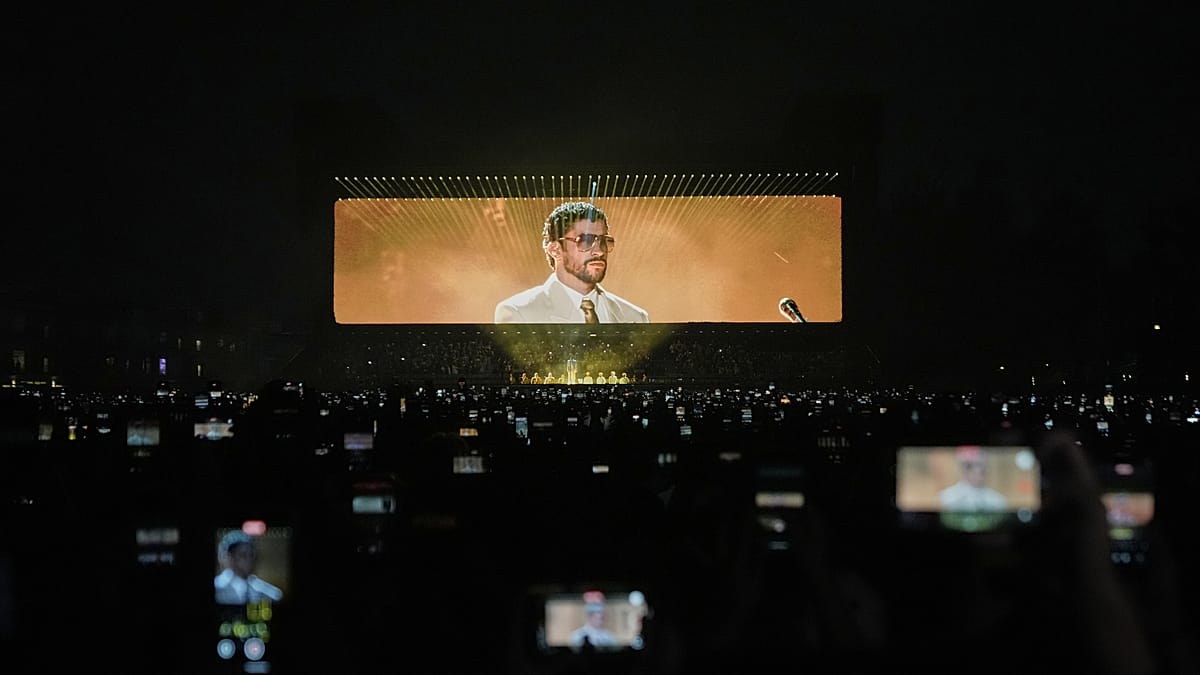
Light, colour and a lot of love spread through the stadium over the two nights of the Puerto Rican singer's concerts in Portugal. Bad Bunny did not just sing: he also shared messages of affection and hope with the 120,000 fans who packed the venue, dressed to the nines. “As long as we are alive, let us love as much as we can,” Benito said.
At the second concert, Bad Bunny stretched out his opening greeting for several minutes. The singer and his Latin salsa band simply stared at the audience, motionless and in silence, taking in an exuberant crowd that left the stadium reeling with light, colour and sound. “It's happening again tonight. Yesterday was crazy. I tell the whole city: the second night is almost always better,” Benito said in Spanish.
The Estádio da Luz turned into a tropical island dancing salsa, under unseasonably warm May temperatures that added a tropical feel to the Lisbon night. Almost all of the rapper's hits were played. “LO QUE LE PASÓ A HAWAii” may have been missing, but there was a special section with a guest singer and an ode to Xutos & Pontapés. But let's start at the beginning.
On the aforementioned unofficial setlist for Lisbon's second night there were also tracks such as “Callaíta”, “PIToRRO DE COCO”, “WELTiTA”, “TURiSTA”, “BAILE INoLVIDABLE”, “NUEVAYoL”, among others, with many stories of Puerto Rico's struggle being chanted by the 60,000 fans at the second night at the Luz, but do they know the stories and the meaning of those songs?
“I think Portuguese fans, although they know the songs, especially the reggaeton ones, are not very familiar with the political history and the events that have taken place in Puerto Rico, and I think now is the time to start talking about these issues,” replied Gustavo Garcia-Lopez, a Puerto Rican researcher at the University of Coimbra, in a phone conversation with Euronews.
Euronews was at the second night of the concert and asked a few fans.
“I know he's Puerto Rican, I know DTMF, “NUEVAYoL” and “BAILE INoLVIDABLE”,” says Rosa at one of the entrances to the venue. “I know very little about the history of Puerto Rico,” she adds.
“I know his songs and I like them a lot. I came from Mozambique just to see him, he is very humane, he does a lot for his country,” said Patrícia. “I know that ten years ago he was working in a supermarket and now he's filling stages on world tours,” Carolina says.
“I really like his latest album, DTMF, and I know he talks a lot about the history of Puerto Rico and that, in his YouTube videos, he explains different parts of the country. He's someone who talks a lot about the resilience of Puerto Rican people and tells us to always believe in ourselves,” Carolina added before the concert.
It all starts with "Mudanza"
“LA MUDANZA” opened both Lisbon shows, but it also tells the life story of Benito Antonio Martínez Ocasio and how, as a baby, he had to move with his parents to another city. In this track, Benito refers to the Vieques uprisings in the 1970s, protests against the occupation of the island by US Armed Forces military bases, and to the Gag Law, which banned and criminalised raising the Puerto Rican flag.
In the video, Bad Bunny weaves in black-and-white images of Puerto Ricans protesting against the US armed forces stationed in the city of Vieques. The Vieques naval base, Roosevelt Roads, was decommissioned and abandoned in 2004. Since then it has become just a tourist spot. It was reactivated by the Trump administration in mid-2025, under the pretext of the fight against drug trafficking, and is believed to have been used in the capture of Venezuela's Nicolás Maduro. It is one of the largest naval bases outside the US.
On the "DeBÍ TiRAR MáS FOToS ToUr", the Puerto Rican rapper built into the show references to energy crises — “El Apagón” —, corruption and tourism — “Turista” — which have pushed citizens into mass emigration, also reflected in tracks such as “NUEVAYoL” and “DTMF”.
In “El Apagón”, sung near the end of the concert, Benito evokes the memory of a devastating hurricane, Maria, whose recovery effort was mired in corruption. The result is rolling blackouts across the island, sparking anger and protests.
In “TURiSTA”, overtourism, gentrification and the forced exodus of a diaspora determined not to lose its identity are laid bare.
The US invaded Puerto Rico more than a hundred years ago
“They occupied Puerto Rico — annexed it — through the Treaty of Paris in 1898, which gave them possession of Puerto Rico and forced Spain to transfer some of its last colonies,” explains Gustavo Garcia-Lopez, the Puerto Rican researcher at the University of Coimbra, after attending the first night of Bad Bunny's concert in Lisbon.
Alongside the occupation of Puerto Rico in 1898, Washington also took control of the Polynesian island of Hawaii – annexed, militarised, turned into a tourist playground, gentrified. Hence the song “LO QUE LE PASÓ A HAWAii”, which was not performed in Lisbon, but in which Benito warns of the risks of annexation and cultural assimilation for Puerto Rico: the extinction of boricua identity, of the traditional “lelolai” music, but also the extinction of endemic species on the island such as the concho toad, the same one that appears in the DTMF album's videos and that popped up on the stadium's big screen to explain what sets Puerto Rican Spanish apart.
“Puerto Rican Spanish is our language. I would call it boricua Spanish, which is our origin. The island used to be called Boriquen by the Indigenous people and that's why we call Puerto Ricans boricuas, and Benito brings a lot of that flair into his performances, on top of his own identity,” the researcher explains. The concho toad “is part of an environmental struggle to save this endangered species in Puerto Rico,” adds Gustavo Garcia-Lopez, explaining that one of the causes of its near-extinction was the massive construction of tourist developments and the resulting destruction of green areas.
“First, Puerto Rico was turned into an area of agricultural exploitation and then of industrial exploitation and, because it is an island, the concentration of naval military bases turned the region into a space of geopolitical control. There were many military bases, with frequent exercises and bombing, as in Vieques and Culebra, and that caused a great deal of pollution,” the researcher recalls, speaking to Euronews.
“Getting used to colonialism is a way of dying slowly”
“Getting used to colonialism is a way of dying slowly,” adds Gustavo Garcia-Lopez. “This colonial situation, on the one hand, entails violence in the exploitation of land and people and, on the other, generates pollution.
And even when fans sing the lyrics in unison without understanding every word, they carry a meaning that speaks directly about neocolonialism, austerity and identity. “Puerto Rico is the world's oldest colony,” the researcher reminds Euronews. Puerto Ricans are US citizens, but it's only a formality, as they do not vote in elections and do not have access to basic rights. There is a strong anti-colonial strand running through Bad Bunny's songs.
“NUEVAYoL” was another of the night's big numbers and also served as a bridge between Benito's performance on the main stage and in “La Casita”.
“There is a strong Puerto Rican community in the US, in New York. The song NUEVAYoL reflects that; it is an ode to the Puerto Rican diaspora,” says the Puerto Rican researcher. It also nods to a march held every year in New York, the Puerto Rican Day Parade, which is huge. Millions of Puerto Ricans live in New York and have built their own local economy and culture, such as salsa, which emerged in New York together with Cubans, explains Gustavo Garcia-Lopez.
“Puerto Ricans living in Puerto Rico have no rights and cannot vote in US elections, which means that all US laws, from the US Congress, override those of Puerto Rico. And another example [of neocolonialism] is that we pay US Social Security and other taxes, but we do not have access to them and receive nothing in return. So there is extraction of people's labour and inequality; as we cannot vote, we cannot change the policies,” he explains.
In “NUEVAYoL”, Bad Bunny references the diaspora, 4 July, the US national day, and Puerto Rican movements such as the Young Lords, against the Vieques base. Hence the flag over the Statue of Liberty, which alludes to those Young Lords protests, when they occupied it with the Puerto Rican flag.
Before stepping into the Estádio da Luz’s “La Casita”, one of the band's guitarists walks onto the main stage with his cuatro (a Puerto Rican guitar) and starts playing “A minha casinha”, by Xutos & Pontapés, getting the whole stadium to sing along as one.
This was followed by the surprise track announced by Benito, performed by Panamanian musician Sech, who climbed up to La Casita to sing “Ignorantes” with Bad Bunny and “Otro Trago” solo.
DTMF almost at the end
One of the things Benito does when he performs DTMF “is pay tribute to ancestral culture and, particularly, to the jíbaro, who is the Puerto Rican peasant with his straw hat and his machete,” the professor says.
“They are people who work the land, in sugar cane, in coffee and in ancestral agroecological practices of living off the land.” Those references are equally evident in “PIToRRO DE COCO”. Benito does that a lot and uses “lelolai”, which comes from jíbara music. And in “CAFé CON RON”, performed in La Casita, “he makes that reference too,” he explains.
“Bringing Puerto Rico to Portugal and showcasing that diversity of our country, from reggaeton to salsa to plena, to people who knew little about Puerto Rico, was very good. It was beautiful to see that at the concert,” concludes the Puerto Rican professor and researcher at the University of Coimbra.
Benito Antonio Martínez Ocasio, who worked in a supermarket while uploading songs to SoundCloud and studying Audiovisual Communication, became Bad Bunny. At 32, he is now one of the most popular voices in the world, with tracks breaking audience records on Spotify.
All of that, mixed into reggaeton and Latin trap rhythms, to the sound of bomba and plena, results in perreo, a dance (and musical) style that was once banned, in the 1990s, but has re-emerged as a form of urban struggle and self-determination.
The struggle for Puerto Rican self-determination, emblazoned in the activism of his albums, contrasts with the rapper's silence on other struggles around the world and has not spared him from taking part in events sponsored by tycoons such as Jeff Bezos, or from signing multi-million-dollar contracts with brands such as Calvin Klein and, more recently, Zara, part of clothing giant Inditex.
On Thursday, the rapper returns to Spain for a series of ten concerts in Madrid. Then come Germany, the Netherlands, the United Kingdom, France, Sweden, Poland, Italy and Belgium.