Peace is possible, Aliyev tells global media forum in Shusha
Azerbaijan's president also told the Shusha Global Media Forum that long-term gas contracts were needed for Baku to expand production, and said that Baku was considering leaving the Council of Europe.
Azerbaijan borders two of the world's most active war zones, but President Ilham Aliyev said at the conference gathering the world's top media professionals on Monday that peace remains achievable.
“We believe peace is possible," Aliyev said in his opening remarks at the Shusha Global Media Forum.
Aliyev reflected on alternative transport and connectivity routes, noting that instability elsewhere had increased the importance of corridors passing through his country.
“The situation in the Middle East now makes this corridor more attractive,” Azerbaijan's president said, referring to the increasingly key route's continuing development.
Aliyev said Azerbaijan had begun supplying natural gas to Germany and Austria as part of a broader effort to expand exports across Europe.
“We started to supply Germany and Austria this year as part of our overall strategy to expand our presence on the European gas market," he explained.
According to Aliyev, Azerbaijan now supplies pipeline gas to 16 countries, including 14 in Europe, while negotiations continue with additional EU member states.
“We are number one in the world with this geography of supplying gas by pipeline, and we are still in negotiations with some members of the European Union in order to start supply and increase supply.”
He argued that future growth would depend on investment in transport infrastructure and greater certainty from European partners.
“We need long-term contracts. Because in order to increase production dramatically, we need to invest largely," Aliyev said.
"And if at a certain point we will be told that, ‘Thank you, goodbye, we don’t need you guys any longer,’ then what are we going to do?”
Aliyev also turned to the war in the Middle East, saying Azerbaijan hoped the latest escalation would be short-lived.
“I hope that this current eruption of conflict will not last long," Azerbaijan's president said.
Drawing on Azerbaijan’s own experience, he said lasting peace could only be achieved through respect for international law.
“Peace must be just and fair and based on international law and not based on someone’s ambitions and agenda.”
He concluded with an appeal for restraint across the region.
“My message to our neighbours is to be responsible and to stop as soon as possible, and to try to normalise relations and not to escalate this process," Aliyev said.
In the same address, Aliyev said Azerbaijan was considering leaving the Council of Europe entirely, not just suspending its membership, after the Parliamentary Assembly stripped Baku's delegation of its voting rights in 2024.
"We are unequivocally considering leaving that structure," he said, adding that the organisation's secretary general had personally asked him to reconsider.
Aliyev said Azerbaijan would only return to the Parliamentary Assembly once its delegation's voting rights were restored. "We have not taken any wrong steps," he said. "They have made an unjust decision. Therefore, they must step back and acknowledge their mistakes."
'Media must be a bridge'
Secretary General of the D-8 Organisation for Economic Cooperation Sohail Mahmood said reporting with greater responsibility “was increasingly important.
According to Mahmood, “credibility remains uppermost in people’s minds” as audiences seek reliable information in an increasingly crowded media environment.
For Secretary General of Jordan’s Ministry of Government Communication Dr Zaid AlNawaiseh, journalism itself represents an important instrument of diplomacy.
Dr AlNawaiseh told Euronews that “media is soft power".
“The media must be a bridge ...so peace can be achieved," he explained. "The real mission of the real media is not to lose the truth. Rather its mission is to shed light on the truth.”
Disinformation was a recurring theme throughout the event, with many of the participants, including journalists, policymakers and experts, speaking about the challenges of navigating the truth.
Founder of the London-based strategic communications consultancy Atticus Partners Leon Cook spoke of disinformation as the key challenge of the 21st century.
“Media is both a problem and a solution," Cook told Euronews. "Disinformation, unfortunately, is here to stay."
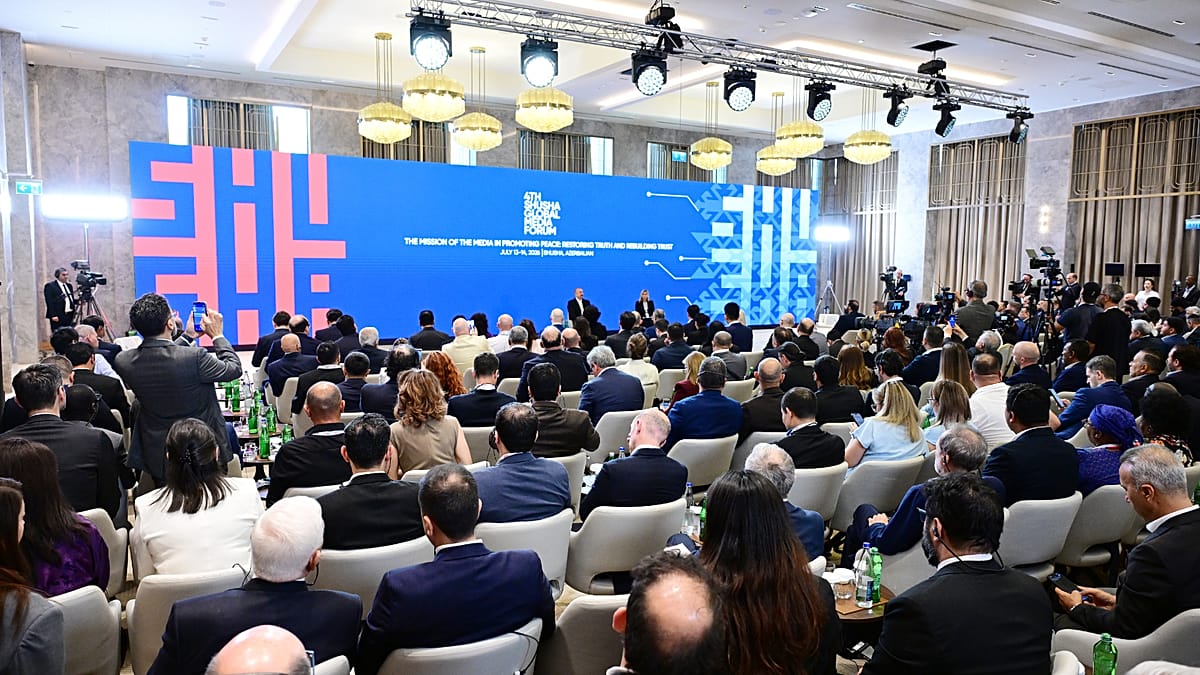
Held under the theme “The Mission of the Media in Promoting Peace: Restoring Truth and Rebuilding Trust,” the forum brought together broadcasters, editors, government officials and communications specialists to discuss the media’s role in peacebuilding and navigating the growing influence of artificial intelligence.
The Shusha Global Media Forum will continue until Tuesday to discuss how journalism can respond to conflict, counter disinformation and rebuild public confidence at a time when information itself has become an increasingly important element of international affairs.