Lost in translation: Montenegro's EU accession faces a language barrier
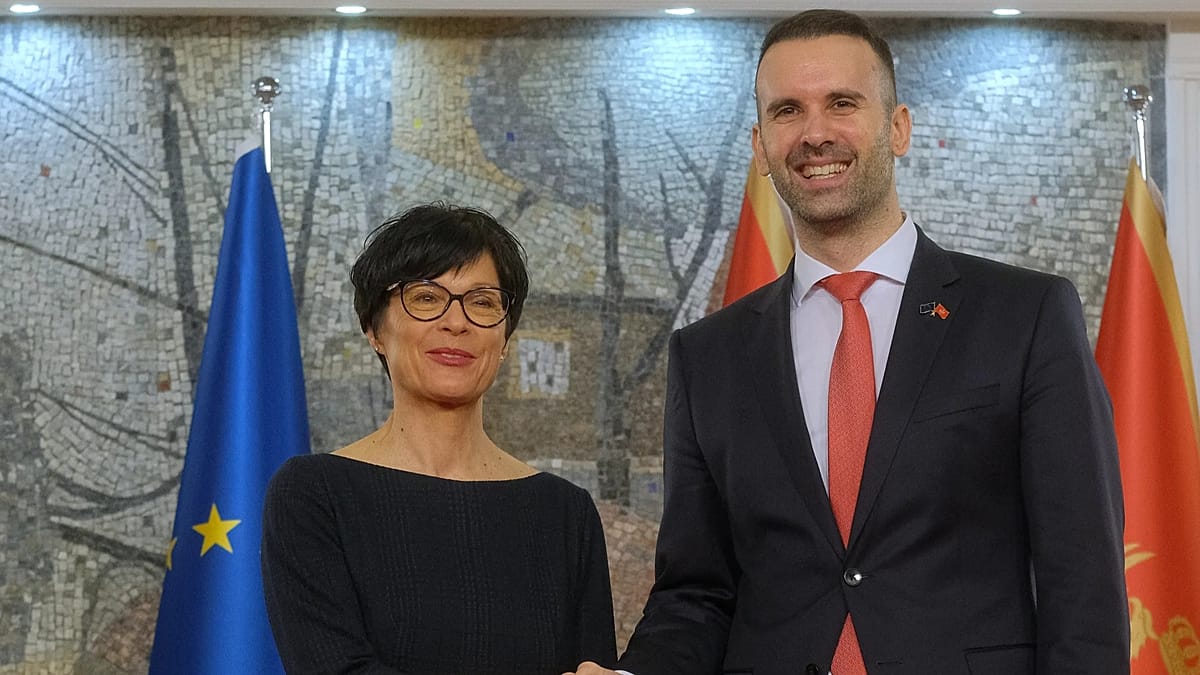
Montenegro may not be able to accurately translate all EU laws in time for accession, so the European Commission is currently weighing options for a derogation, including allowing Podgorica to use an existing EU language to fill the gaps. Croatian would be the most obvious choice.
Published on 01/10/2026 - 11:00 GMT+2•Updated 11:02
Montenegro may fall short of translating all EU laws accurately before it joins the bloc. The European Commission is weighing several options for a temporary derogation, including letting the country use an existing EU language in the meantime.
Montenegro aims to become the EU's 28th member by 2028. But first it must adopt and translate the so-called acquis, the tens of thousands of EU laws that form the bloc's legal framework. Brussels is growing wary that it will not finish in time.
"Montenegro will need to produce translations of the acquis into its official language in good time before accession and will need to train a sufficient number of translators and interpreters required for the proper functioning of the EU institutions upon its accession," reads the country's negotiating framework with the EU.
Podgorica has invested significantly in its administrative capacity and assures that the work will be completed on time. But the EU executive has started looking at contingency plans, EU officials told Euronews.
The reason is that Croatia has been raising concerns about the quality of some translated legal texts. Zagreb is locked in a bilateral dispute with Montenegro that could delay the whole accession process.
Since Croatia, the bloc's most recent entrant, joined in 2013, the body of EU legislation has almost doubled.
Candidate countries must translate all relevant EU legislation into their future official language. The EU institutions are only responsible for a final check before publication in the Official Journal at the time of accession.
Translation is also only part of the linguistic preparation. Some laws need adapting to the candidate's institutional context, for instance by designating which authorities will be in charge of supervision.
"The Commission services are in regular contact with Montenegro and reviewing the pace of work in this regard," a Commission spokesperson told Euronews.
The Commission is assessing several options for a potential derogation, including allowing Montenegro to use another official EU language until it has time to fill the gaps and accurately translate the remaining legislation.
It would be up to Podgorica to choose, but Croatian is the obvious candidate. It is the only official EU language that shares the same core features and is understandable to a Montenegrin speaker.
"The Montenegrin standard language belongs to the same dialect continuum as the Bosnian, Croatian, and Serbian standard languages, and that all are mutually intelligible," reads a recent study on the Montenegrin language.
Still, this is only one option among several, and it may not sit well with Montenegro. Identity politics runs deep in the Western Balkans, and Podgorica fought for years to have the Montenegrin language officially recognised internationally.
Derogations are not new. Malta set a precedent: short of qualified translators, it secured an exceptional, transitional derogation from the obligation to translate all EU acts into Maltese for three years after joining in 2004, with any backlog due by the end of 2008.
Ireland is another, with a key difference. Its derogation came decades after it joined, when Irish became a full official language, and it temporarily suspended the obligation to translate all EU acts into Irish.
In other words, Brussels has shown flexibility, not treating full translation of the acquis as an absolute condition for accession. Still, in this case, the most obvious fix may also be the hardest to sell politically.