Venezuela earthquake damages add up to almost $20 billion, World Bank says
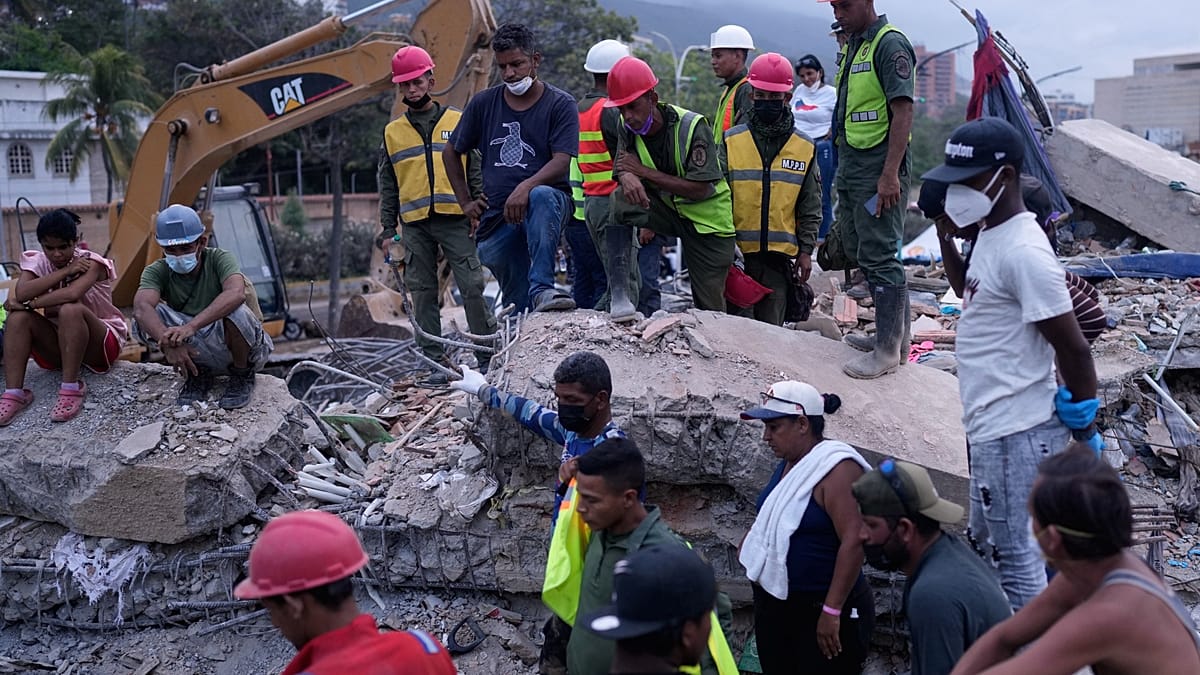
Almost a month after the devastating earthquakes, Venezuela has a mammoth task ahead in terms of rebuilding, rehabilitating and mitigating the social and economic damage of the biggest natural disaster in decades.
The 24 June Venezuela earthquakes could have resulted in around $19.6 billion (€17.2bn) worth of direct physical damage, according to the World Bank Group.
This significant number reveals a crucial need for the country to invest in timely and resilient reconstruction, in order for the economy to recover.
The findings were highlighted in a Global Rapid Damage Estimation (GRADE), carried out by the World Bank and published on Thursday.
The primary aim of the assessment is to provide the Venezuelan government and development partners with early insight into the scale of the rebuilding needed, and help outline the reconstruction and recovery efforts which need the most immediate attention to recover from the large-scale disaster.
"The earthquakes have disrupted lives, damaged critical infrastructure, and created new challenges for Venezuela's recovery," Susana Cordeiro Guerra, World Bank Vice President for Latin America and the Caribbean, said in a press release.
"Recovering effectively begins with reliable evidence. This assessment gives the Government of Venezuela and its partners an early objective foundation for recovery planning, and the World Bank Group is committed to supporting that effort every step of the way," Guerra added.
Majority of damage to residential buildings
The GRADE assessment estimated that 47% of the total damage was to residential buildings, with infrastructure accounting for 27% of the damage. Non-residential buildings made up 26% of the total damage.
La Guaira state and Distrito Capital bore the brunt of the damage, accounting for approximately half of the total impact.
The World Bank Group also carried out additional analysis of the possible macro and socio-economic implications of the earthquake, as well as what recovery could mean.
This data revealed that the pace of reconstruction will be of paramount importance in shaping how well the Venezuelan economy and society recovers.
Given the current state of public and private investment, most of the reconstruction funds would likely need to be diverted away from other less critical investment projects.
In this situation, reconstruction is expected to take over 10 years, with considerable negative effects on economic activity.
On the other hand, by prioritising rapid reconstruction and assigning higher public and private investment for this purpose, the economic and social impact of the earthquake could be greatly mitigated.
How has the GRADE methodology estimated damage?
The GRADE methodology offers an independent and most importantly, fast way of assessing direct physical damage after significant disaster.
It uses satellite imagery, exposure data, remote sensing and engineering models, with the help of more detailed sector assessments where needed.
In the case of the Venezuela earthquakes, GRADE combined earthquake damage modelling, catastrophe risk modelling, validation and calibration, along with an assessment of the capital stock value of different sectors and assets.
A mix of historic data, as well as scientific data like ground motion, engineering visibility on structural vulnerability, information on the build environment and population was also used, along with reported damage data from the government, community-based organisations, development partners, media and social media.
The GRADE assessment for Venezuela also received financial support from the Government of Japan through the Program through the Program for Mainstreaming Disaster Risk Management in Developing Countries and the Global Facility for Disaster Reduction and Recovery (GFDRR).
Household vulnerability should also be considered when rebuilding
The GRADE assessment also highlighted that household vulnerability should be particularly considered while embarking on rebuilding efforts.
This includes social factors such as age, income, housing quality, along with economic and environmental health, which can help determine a particular demographic’s vulnerability to disasters.
In this case, seven of the most affected states: Miranda, La Guaira, Distrito Capital, Carabobo, Yaracuy, Aragua and Falcón30 were home to around 11.5 million people, around 40% of the country’s population.
These seven states also held almost half of Venezuela’s exposed building and infrastructure stock, valued at around $657bn (€576.8bn).
Some of the social vulnerabilities seen in demographics across these states included female-headed households, single-parent households and households with elderly, disabled or ailing people.
As such, the GRADE assessment found that restoration and maintenance of basic services like water and electricity could be particularly beneficial to these communities while rebuilding. This is because service disruptions within vulnerable households can have outsized consequences, even when physical building damage is relatively low.
These lack of services could also deepen existing inequalities, instead of affecting households uniformly.
These insights could significantly help the Venezuelan government focus recovery efforts on high-priority areas for the coming months, in order to see progress as quickly as can be expected.
However, population numbers and limited institutional capacity continue to be major challenges when it comes to the pace and quality of response and recovery.