
European gas price crosses €100 for first time since 2022 as EU warns of new crisis
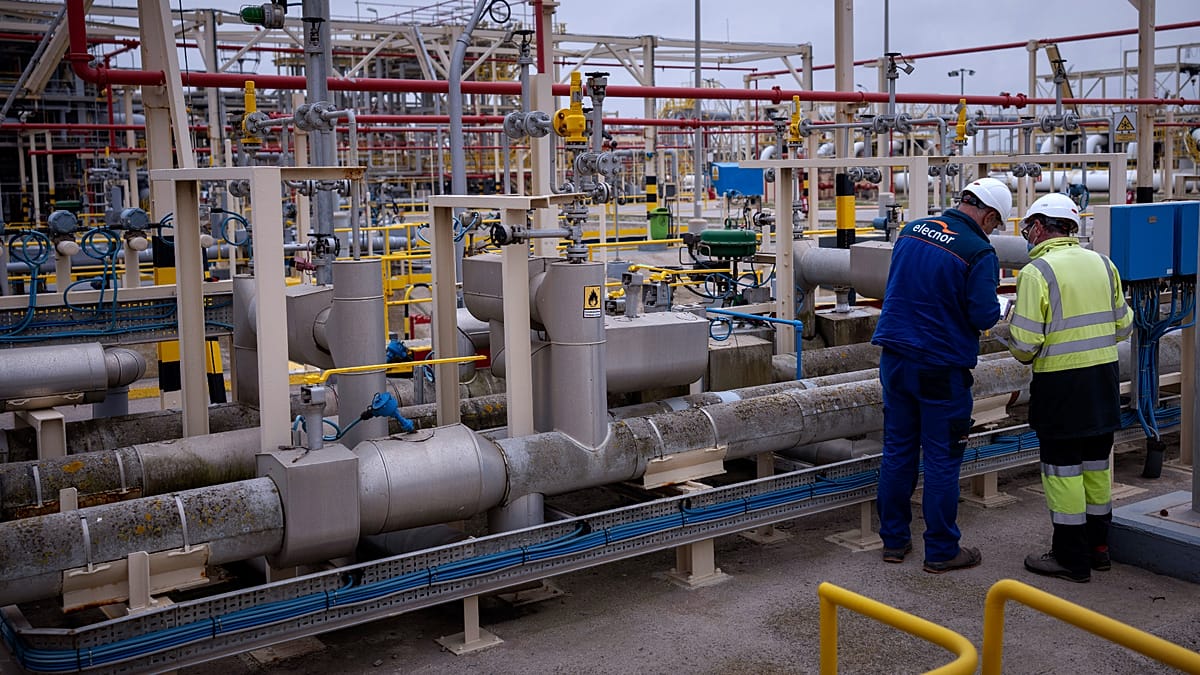
Europe's benchmark gas price crossed €100 per megawatt-hour on Wednesday afternoon for the first time since the 2022 energy crisis, just hours after EU Energy Commissioner Dan Jørgensen warned that Europe faces "another energy crisis" and a difficult winter.
Published on 28 October 2026 - 16:33 GMT+1
The price of Europe's benchmark natural gas contract broke above €100 per megawatt-hour on Wednesday afternoon, a level last seen in December 2022 at the height of the energy crisis that followed Russia's full-scale invasion of Ukraine.
The milestone came only hours after the EU's energy chief, Dan Jørgensen, said the bloc was facing a new energy crisis and a tough winter.
The front-month Dutch TTF contract, the benchmark for gas prices in Europe, traded at €100.37 per megawatt-hour at 16:00 CET, up over 4% on the day. It stood at around €32 before the Iran war began in late February, though it remains well below its record of about €340 in August 2022.
"Once again, due to geopolitical turbulence, Europe faces another energy crisis," Jørgensen told reporters in Brussels on Wednesday morning, after a meeting with European oil refiners.
"We know that this winter will be difficult for European citizens and for our economy in general," he said, adding that fuel bills in the EU were "skyrocketing".
The Commission also sees the worldwide diesel market staying tight well into 2027, keeping energy prices high, and wants to boost output at European refineries, around a quarter of which have closed over the past two decades.
Storage lags as winter nears
European gas supply is currently tight.
Disruption to liquefied natural gas (LNG) shipments caused by the Iran war has cut off supplies from several sources, mainly Qatar, while Europe entered the summer with storage levels well below normal.
EU gas storage stood at 75% on 21 October, according to the EU Agency for the Cooperation of Energy Regulators (ACER), well short of the bloc's usual target of 90% by 1 November, which countries have been allowed to apply more flexibly.
Storage sites were just 28% full at the end of last winter, compared with a nine-year average of around 40%, and refilling has been slow and costly. ACER estimated the war has pushed up Europe's bill for gas imports by between €18 billion and €33 billion.
Almost no Qatari LNG made it to the EU over the summer, leaving the bloc increasingly reliant on the US, which now supplies roughly 30% of its gas, ACER added.
Europe will also compete with Asia for spare LNG cargoes over the winter, potentially exposing it to further price swings, the agency warned. However, gas demand is around 20% lower than before the 2022 crisis, making the gas that is in storage stretch further.
The EU is scrambling for alternatives.
The bloc and Canada are exploring a long-term LNG deal, according to a draft statement for their summit in Montreal on Thursday and Friday, seen by Euronews.
EU energy ministers are also due to meet on Thursday.