Seismic doublet: the phenomenon that turns Venezuela's tragedy into catastrophe
On Wednesday 24 June 2026 at 18:04 local time, north-western Venezuela began to shake and, 39 seconds later, a second quake struck, amplifying the first. So what is a seismic doublet and why is it so dangerous?
In seismology, not all earthquakes are alike, and not all sequences of tremors follow the same pattern. Typically, after a major earthquake, smaller aftershocks occur whose magnitude gradually decreases over time. But there is a more exceptional and unsettling phenomenon: the seismic doublet.
As seismologist Lucía Lozano of Spain's National Seismic Network explained, a seismic doublet occurs when "two earthquakes of very similar magnitude, very close together in time and very close together in space" coincide.
The key lies in that similarity of magnitudes: whereas a conventional aftershock is, according to the so‑called Båth's law, roughly 1.2 points lower in magnitude than the main event, in a doublet both quakes share comparable strength, generally within a margin of 0.4 on the moment magnitude scale (Mw), which makes them a sequence of two mainshocks rather than one mainshock and its minor aftermath.
Technically, these events also display almost identical seismic waveforms, as they originate from the same rupture zone and the same stress field. This characteristic is what allows scientists to identify them as a pair rather than as independent events.
What happened in Yaracuy: the data from the Venezuelan doublet
The seismic doublet of 24 June 2026 occurred in the Venezuelan state of Yaracuy, in the north‑west of the country, with the two epicentres located near the towns of San Felipe and Yumare.
The first of the quakes, considered the foreshock, was recorded at 22:04:33 UTC (18:04 local time), with a magnitude of 7.2 Mw, an epicentre 24 kilometres east‑north‑east of San Felipe and a focal depth of 21.9 kilometres.
Thirty‑nine seconds later, at 22:05:12 UTC, came the mainshock: a jolt of 7.5 Mw, with its epicentre 23 kilometres south‑east of Yumare, on the border between Yaracuy and Carabobo, and at a depth of barely 10 kilometres.
Both earthquakes reached a maximum intensity of VIII on the Modified Mercalli scale, classified as "severe" to "severe‑extreme". According to the technical report by the University of the Andes, they represent the largest instrumentally recorded seismic event in Venezuela in the 21st century.
What makes this doublet particularly striking is the very short interval between both events. As Brandon Bishop, a seismologist at Saint Louis University, noted: "Most doublets do not occur with such a small difference in time."
Stephen Hicks of University College London even suggested that it might be more accurate to think of the sequence as "a single earthquake that lasted about 50 seconds", that is, an almost continuous rupture that unleashed a progressive catastrophe.
When a fault ruptures and releases energy, it does more than generate an earthquake: it also changes the stress state on neighbouring faults. If any of them was already close to its breaking point, that change may be enough to trigger a new quake.
This process is known as Coulomb stress transfer, and, according to experts, it is the most likely explanation for what happened on 24 June. Harold Tobin, director of the Pacific Northwest Seismic Network at the University of Washington, was unequivocal: "It is very likely that the first one triggered the second."
The seismometers' trap: why the initial magnitude was overestimated
The fact that the two quakes occurred with so few seconds between them caused a side effect in the measuring instruments themselves: the seismograms of both events overlapped.
Automated warning systems initially reported a peak magnitude of 7.8 Mw, a figure that did not correspond to either of the two quakes separately, but to the combined noise of both superimposed signals. Subsequent manual analysis of the seismic records made it possible to clean up the data and establish the real magnitudes of 7.2 and 7.5.
This initial confusion, far from being a trivial technical error, perfectly illustrates the nature of the phenomenon: a seismic doublet is, in a sense, greater than each of its components.
The geology behind the disaster: two plates in endless conflict
Venezuela is not a country that is safe from earthquakes. Its northern region lies on one of the most active tectonic boundaries in the Americas: the boundary between the Caribbean Plate and the South American Plate.
Unlike the famous Pacific Ring of Fire, which concentrates most of South America's major earthquakes along the west coast, northern Venezuela has an equally intense but less well‑known geological dynamic.
In this area, the Caribbean Plate moves eastwards relative to the South American Plate at a speed of roughly 20 millimetres per year, less than a centimetre, a seemingly insignificant movement that nonetheless builds up colossal stresses over decades and centuries.
That constant friction has created a complex system of active geological faults running across the north of the country. The most important are the Boconó fault, the San Sebastián fault and the El Pilar fault, although in the area of the 24 June doublet the El Guayabo fault and the Morón fault have also been identified. According to preliminary USGS analyses, the 7.5 quake seems to have been closer to the El Guayabo fault, while the 7.2 one was nearer the Morón fault.
Torsten Dahm, head of the Section of Physics of Earthquakes and Volcanoes at the Helmholtz Centre Potsdam – GFZ German Research Centre for Geosciences, placed these quakes among the strongest recorded in that region in roughly a century, although he recalled that the area has an imposing historical record: a magnitude‑7.7 earthquake in 1900, a 6.5 in Caracas in 1967, and the devastating 1812 event, with an estimated magnitude of up to 8.
Why the seismic doublet in Venezuela was so destructive
The Venezuelan seismic doublet brought together several factors that combined to maximise its destructive power:
- Shallow depth. The 7.5 quake had its focus at just 10 kilometres deep, and the 7.2 at less than 22. These are shallow earthquakes, a technical term in seismology for events with a focus above 70 kilometres. The shallower an earthquake is, the greater the intensity with which its waves reach the surface, because they have travelled a shorter distance and lost less energy. This shallow depth is, according to experts at the University of the Andes, one of the main reasons for the violence with which the shaking was felt.
- The cumulative nature of the doublet. A single large‑magnitude earthquake already subjects structures to extreme stress. A second quake of comparable magnitude, occurring before the vibrations of the first have died away, means a second cycle of seismic loading on buildings that are already compromised. Structures that withstood the first blow, albeit with damage, were unable to withstand the second.
- The vulnerability of the building stock. The USGS warned in its analysis that the affected area combines modern buildings with "unreinforced brick masonry houses" and "adobe block" dwellings, precisely the types of construction most vulnerable to seismic shaking. Many structures also had pre‑existing deficiencies such as poor confinement, short columns or extensions without adequate structural design.
- Seismic amplification in La Guaira and Caracas. The nature of the ground on which the affected cities stand plays a crucial role. Soft or sedimentary soils amplify seismic waves, increasing the perceived intensity compared with rocky ground. Coastal areas such as La Guaira, with fill and alluvial soils, are particularly susceptible to this amplification phenomenon.
The trail of destruction: affected areas and death toll
The consequences of the doublet extended across a wide swathe of Venezuelan territory. The most serious damage was concentrated in:
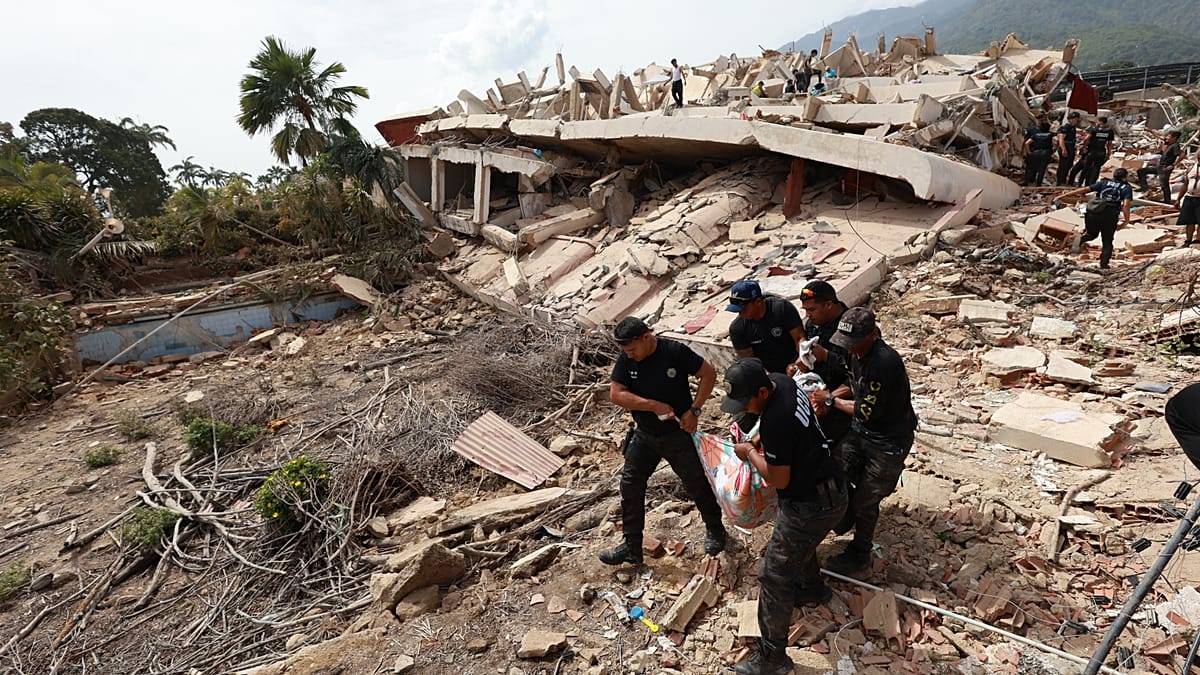
- La Guaira state: the hardest‑hit area, with dozens of collapsed buildings along the coastal strip, streets split by cracks in which vehicles were trapped, and Simón Bolívar International Airport with its roof partially collapsed, forcing it to close temporarily.
- Caracas: building collapses in San Bernardino, the historic centre and the Baruta district; facades torn off and streets covered in rubble. The mayor of the Chacao municipality reported rescuing 18 people from a single building.
- Montalbán municipality (Carabobo): described as "ground zero" in the academic report by the University of the Andes, with several structures completely collapsed.
- San Felipe (Yaracuy): cracks in walls and the collapse of power lines in the city closest to the epicentres.
- Aragua state: buildings with fallen and cracked walls in the Andrés Bello neighbourhood of Maracay.
The Military Academy of the Bolivarian Navy (AMARB) was largely destroyed. The Morón road in Carabobo cracked and collapsed. The quake was felt strongly in northern Colombia, including Bogotá, in northern Brazil and on several Caribbean islands: Aruba, Bonaire and Curaçao.
The Pacific Tsunami Warning Center initially issued an alert for Puerto Rico and the US Virgin Islands, which was cancelled hours later when it was confirmed that no destructive wave had been generated.
The provisional toll, according to figures from the Venezuelan authorities, is more than 235 dead, around 5,000 injured and over 150 missing, with more than 250 buildings affected and 138 aftershocks recorded in the first 24 hours.
The aftershocks: the danger that does not cease
The doublet was not the end of the seismic episode, but its beginning. The USGS has issued aftershock forecasts indicating that the region will be shaken by tremors of magnitudes between 3 and 5 for weeks.
Within the first month, there is a 24% probability that a magnitude‑6 quake will hit the area and a 3% probability of another magnitude‑7 earthquake.
The aftershocks will follow a familiar pattern: they will occur more frequently immediately after the mainshock and then decrease exponentially over days, weeks and even years.
The problem is that structures already weakened by the doublet are much more vulnerable to these secondary blows, which turns each aftershock into a real threat for buildings that apparently survived the main event.
The international response and the political context
The disaster struck at a delicate moment for Venezuela. The country is going through a political transition following the arrest of former president Nicolás Maduro in January 2026, with acting president Delcy Rodríguez heading a government that has yet to set a date for elections. The catastrophe will be a major test for her administration.
The international community responded swiftly. Switzerland announced it was sending 80 rescue workers and 18 tonnes of rescue equipment. Colombia deployed its USAR‑1 team, made up of 62 specialists and four canine teams, together with 12 tonnes of equipment. The Dominican Republic, Chile and numerous Latin American countries also sent humanitarian aid and emergency teams.
Spain has sent an A330 aircraft that has landed in the Venezuelan city of Valencia, approximately 172 kilometres from Caracas, with rescue equipment, 59 troops from the Military Emergencies Unit (UME), two engineers and eight canine units.
The US Army joined the relief efforts, while the US Department of the Treasury authorised transactions with Venezuela, previously restricted by sanctions, provided that they were related to humanitarian aid, with validity until 23 October 2026.